


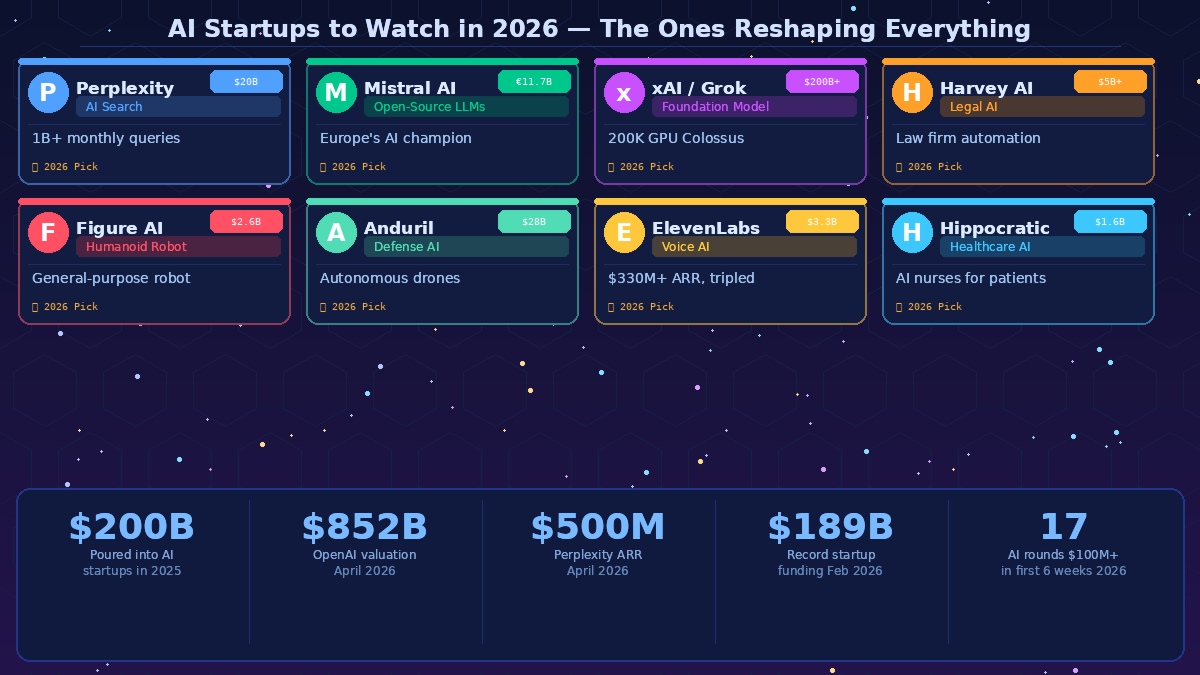
February 2026 became the largest single month of startup funding ever recorded — $189 billion globally. Almost all of it went to AI companies. Three deals alone — OpenAI at $110 billion, Anthropic at $30 billion, and Waymo at $16 billion — accounted for most of that total. But the real story isn’t the mega-rounds at the top. It’s the companies just below them, moving fast, solving real problems, and building businesses that will matter for the next decade.
Here are eight AI startups worth understanding right now.
Perplexity — Rethinking Search From Scratch
Perplexity’s pitch was blunt: Google gives you ten blue links and makes you do the work. We’ll just answer your question. That sounds simple. Executing it is not. Founded in 2022 by former OpenAI and Google Brain researchers, Perplexity reached a $20 billion valuation by September 2025 and crossed $500 million in annualised revenue by April 2026 — up 335% year on year. It now handles over one billion monthly queries and recently launched its own Comet browser, which it made free worldwide after millions joined the waitlist. Every answer cites its sources. For research, it’s already the tool many knowledge workers reach for first.
Mistral AI — Europe’s Homegrown Champion
France has its first genuine AI heavyweight. Mistral builds open-source large language models that businesses can deploy, customise, and run without handing their data to an American tech giant. It raised a €1.7 billion Series C in September 2025, pushed its valuation to €11.7 billion, and in March 2026 secured $830 million in debt to buy 13,800 Nvidia chips for a new data centre near Paris. Its Le Chat product hit one million downloads in 14 days. Mistral is targeting over €1 billion in annual recurring revenue by end of 2026. For European enterprises worried about AI sovereignty and data residency, Mistral is increasingly the answer.
Harvey AI — Bringing AI Into the Courtroom
Legal work is expensive, slow, and heavily dependent on junior associates doing repetitive document review. Harvey AI is automating exactly those tasks — contract analysis, legal research, due diligence drafting — and the major law firms are paying attention. Valued at over $5 billion, Harvey knows legal workflows deeply enough that it doesn’t feel like a general-purpose chatbot that was repurposed. It’s purpose-built for the profession and has become the benchmark for vertical AI done properly.
xAI — The Wildcard With the Biggest Computer
Elon Musk’s xAI built Colossus, a supercomputer with around 200,000 Nvidia GPUs, in 122 days — a record. It powers Grok, the AI assistant baked into X. The company raised a $20 billion round in late 2025 with Nvidia among the investors, pushing its valuation past $200 billion. Whether you find Musk’s politics appealing or exhausting, xAI’s infrastructure ambitions are genuinely significant. An xAI-SpaceX IPO target has been floated at $1.75 trillion. Whatever you think of the company, it can’t be ignored.
ElevenLabs — Voice AI That Actually Sounds Human
ElevenLabs turned AI voice synthesis into a product people are actually willing to pay for. It’s passed $330 million in annualised revenue — tripling in a single year — with a valuation now at $3.3 billion. The technology goes beyond text-to-speech. It clones voices, translates content while preserving the speaker’s tone, and powers voice agents that can handle customer interactions at scale. Podcasters, filmmakers, educators, and enterprises doing multilingual content are all customers.
Figure AI — Putting AI Into a Body
Humanoid robots are no longer a lab experiment. Figure AI has a general-purpose bipedal robot that can learn physical tasks and is actively being trialled in industrial settings. Valued at $2.6 billion, it’s one of several companies — alongside Tesla’s Optimus and Boston Dynamics — racing to make the humanoid robot commercially viable. The applications stretch from warehouse work and manufacturing to elder care and logistics. If even one of these companies cracks reliable, affordable deployment, the labour market implications will be significant.
Anduril Industries — Defence AI for a New Kind of War
Anduril builds autonomous drones, submarines, and AI-powered weapons systems. It’s co-founded by Palmer Luckey, who built Oculus before selling it to Meta. With billions in funding and federal contracts, Anduril now operates at a scale where it’s influencing how the US military thinks about AI-driven warfare. The ethical questions are genuine and unresolved. The business reality is that defence AI has become one of the best-funded corners of the startup world, and Anduril is the most prominent company in it.
Hippocratic AI — Addressing the Healthcare Staffing Crisis
Hospitals are understaffed. Nurses spend enormous amounts of time on routine patient communications — follow-up calls, pre-operative preparation, chronic condition check-ins — that don’t require clinical judgement but do require human-level empathy and reliability. Hippocratic AI builds agents specifically designed for these tasks. Valued at $1.6 billion, it’s one of the clearest examples of AI addressing a genuine, measurable problem rather than creating a solution looking for one.
The pattern across all eight of these companies is the same: they’re not trying to replace everything at once. They’ve picked a specific domain, gone deep on it, and built something that outperforms the status quo in a way that’s hard to replicate. That’s the formula that’s attracting almost $200 billion a year in venture capital — and it’s why 2026 may be the most consequential year yet for AI moving from hype to industry.


