


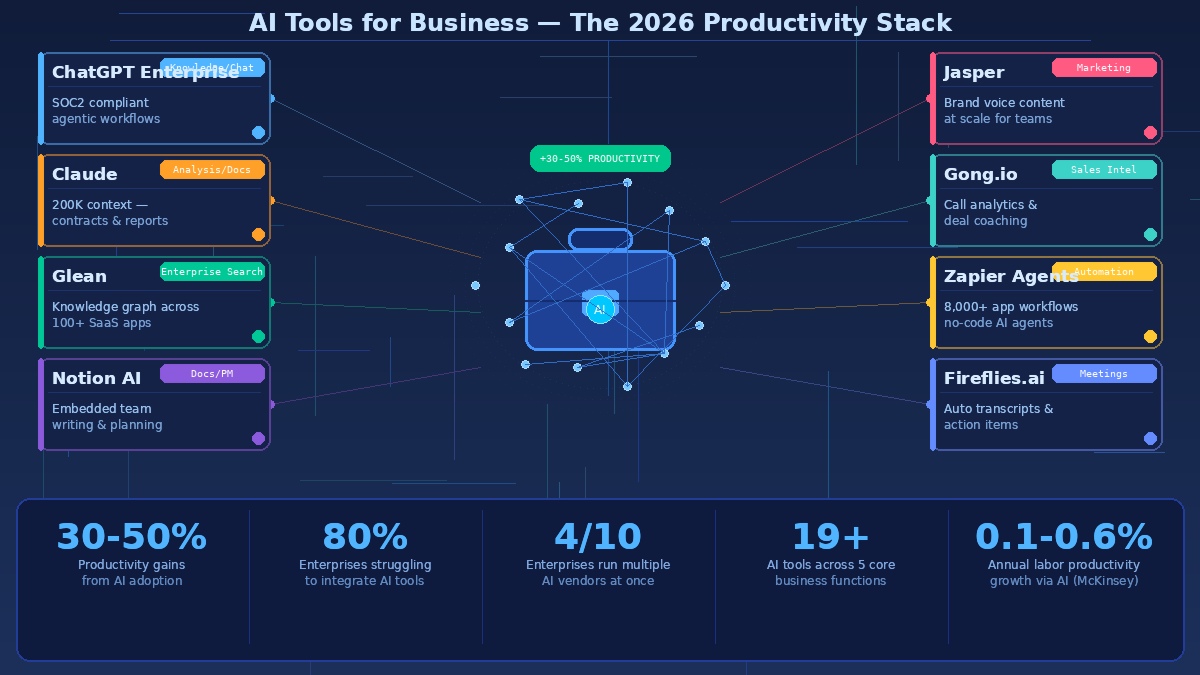
Every business now has an AI tools problem, and it’s not the one you’d expect. It’s not “should we use AI” — that debate is over. Companies adopting AI tools are reporting 30-50% productivity gains, and the question has shifted entirely to which tools, for which function, and how do we stop them from becoming twelve disconnected subscriptions nobody fully uses.
That last part is a real problem. Nearly 80% of enterprises are struggling to integrate AI with their existing tech stacks, and more than four in ten run multiple AI vendors simultaneously without those tools talking to each other. The businesses getting genuine value aren’t the ones with the most tools — they’re the ones who matched the right tool to the right function and made sure it actually connects to how they work.
Here’s how to build that stack properly, organised by what each tool is actually for.
Knowledge and Communication: Where Most Teams Start
ChatGPT Enterprise remains the foundational choice for general business productivity — drafting, brainstorming, summarising, and increasingly, autonomous multi-step tasks through its 2026 agentic updates. Critically for business use, it carries SOC 2 compliance and enterprise data security, meaning your company’s data is never used to train public models. That distinction matters enormously once legal and compliance teams get involved.
Claude has become the go-to for work requiring deeper reasoning — legal review, research synthesis, and analysis of lengthy documents. Its 200,000-token context window means you can drop in an entire contract or report and have a genuine conversation about it, which makes it the preferred tool for legal, research, and policy teams handling dense material.
For teams already living inside their company’s internal knowledge base, Glean has emerged as the leading enterprise search and knowledge platform. It builds a secure, personalised knowledge graph by connecting to over 100 SaaS applications — Google Drive, Jira, Salesforce, Slack — and lets employees ask natural-language questions that pull answers from across the entire organisation rather than wherever they happen to remember a document was saved.
Documentation and Project Management
Notion AI has become the practical choice for teams that already organise their work in Notion. It isn’t necessarily the best standalone writer, but it removes the friction of switching between a writing tool and your actual workspace — drafting, summarising, and generating content directly where your team already plans and collaborates.
For task and timeline management specifically, Asana, ClickUp, and Motion have all built genuine AI layers that go beyond simple reminders — analysing team schedules, protecting focus time blocks, and automatically rescheduling flexible meetings based on shifting priorities.
Marketing: Producing More With the Same Headcount
Marketing teams in 2026 are expected to ship more content across more channels with the same or smaller headcount, and the tools reflect that pressure directly. Jasper remains purpose-built for this — brand voice training that keeps every piece of content consistent with company tone, campaign generation across multiple formats from a single brief, and direct integration with Surfer SEO for search optimisation while drafting.
For visual content, Canva’s Magic Studio and Midjourney cover different needs — Canva for fast, accessible design work across social and presentations, Midjourney for the most visually striking, editorial-quality image generation when craft matters more than speed.
Sales: Intelligence From Every Conversation
Gong.io has become the standard for revenue intelligence — automatically recording and analysing customer calls, video meetings, and emails to surface what’s actually happening in sales conversations rather than relying on rep self-reporting. It tracks sentiment, flags buying signals, identifies objections, and builds a searchable archive that makes deal reviews and coaching sessions genuinely productive rather than guesswork.
For teams in the Salesforce ecosystem, Einstein AI provides predictive forecasting based on historical sales cycles, automated chatbot deployment across web and messaging channels, and proactive pipeline alerts that flag at-risk opportunities before a deal stalls.
Automation: The Glue Between Everything
This is the category that determines whether your AI stack functions as a system or a pile of disconnected tools. Zapier has evolved well beyond simple triggers — its AI Agents now take autonomous multi-step actions across more than 8,000 apps, drafting emails, preparing reports, and analysing data based on natural-language instructions you define once.
The practical value here is significant: when a lead fills out a form, automation can add them to your CRM, notify sales, and trigger a welcome sequence without anyone touching a keyboard. For technical teams needing fully custom logic, dedicated AI agent builders let you construct workflows tailored to your specific business processes rather than generic templates.
Meetings: Stop Taking Notes, Start Listening
Fireflies.ai and Otter.ai both automatically record, transcribe, and summarise meetings, but the more advanced 2026 versions go further — pushing action items directly into your CRM and project tools, supporting over 100 languages, and in some cases answering questions live during the meeting itself. For any team running more than a handful of calls per week, this single category change — not taking your own notes — recovers meaningful hours and improves what actually gets followed up on.
Finance and Operations: Where Precision Matters Most
Finance teams deal with dense reports and strict accuracy requirements, which is why tools like Ramp combine corporate card management with AI-driven expense analysis rather than offering generic AI assistance. For operations teams running on data, ThoughtSpot lets non-technical staff ask business questions in natural language and get back relevant, cited answers — flagging anomalies and surfacing predictive insights without anyone needing to write a query.
Building Your Stack Without the Chaos
The single most important principle for 2026: match the tool to the specific function rather than adopting broadly and hoping for adoption. A common, effective combination is ChatGPT or Jasper for first drafts, Grammarly for tone and clarity, and Claude or Gemini for research and summarisation — each doing the part it’s actually best at, rather than one tool trying to do everything adequately.
Before adding any new tool, ask whether it connects to what you already use. The productivity gain from a great standalone tool evaporates quickly if your team has to manually move information between five disconnected platforms. Choose an orchestration layer — Zapier or a similar automation platform — early, so your AI tools talk to each other rather than existing as isolated experiments.
The businesses winning with AI in 2026 aren’t the ones who adopted first. They’re the ones who built the organisational habit of reaching for the right AI tool when repetitive work shows up — and made sure that tool fits into a system rather than sitting next to it.


