



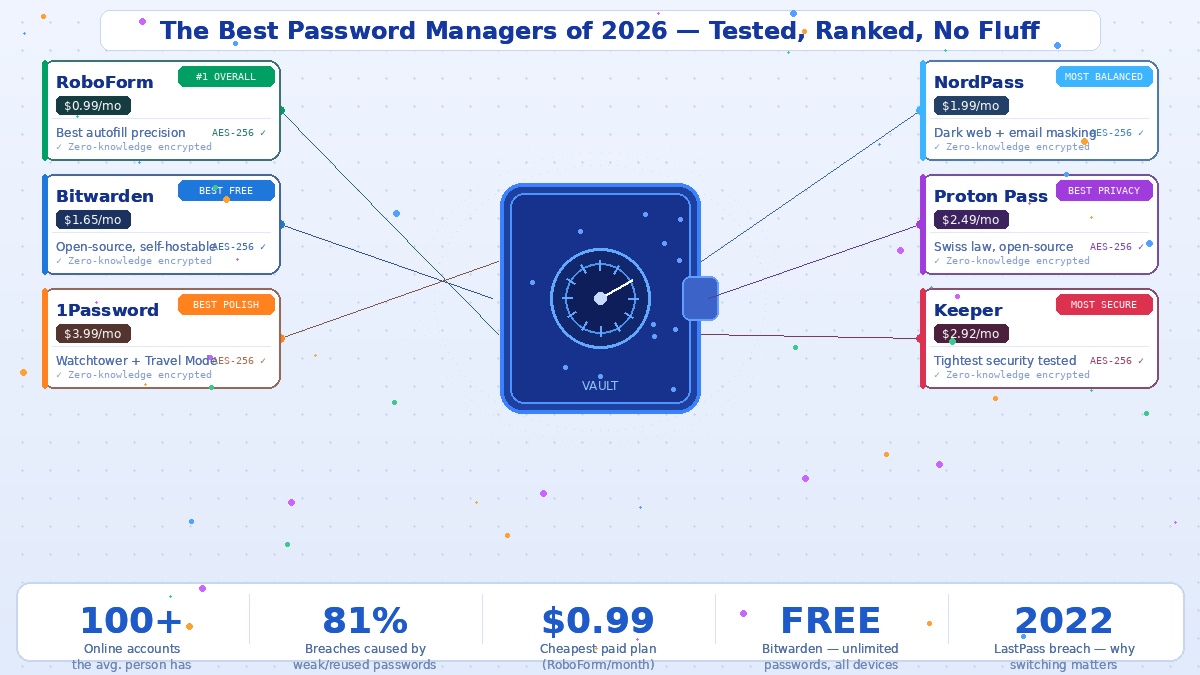
Here’s a stat that should make you a little uncomfortable: the average person has over 100 online accounts. Nobody remembers 100 different passwords. So most people do the thing they know they shouldn’t — they reuse the same two or three passwords everywhere. And that single habit is responsible for 81% of hacking-related data breaches.
Password managers solve this completely. They generate unique, complex passwords for every site, store them in an encrypted vault, and fill them in automatically when you log in. You remember one master password. Everything else is handled.
The market shifted noticeably in early 2026 — Bitwarden doubled its premium price, 1Password raised its rates, and Dashlane killed its free plan entirely. Meanwhile, Proton Pass cut its price in half. Here’s where things stand after independent testing across desktop, mobile, and browser extensions.
RoboForm — Best Overall
Multiple independent rankings have landed on RoboForm as the top pick for 2026, and after hands-on testing the reason is clear: it’s fast, precise, and it actually fills forms properly — not just login boxes, but addresses, payment details, and custom fields. It supports one-click logins to desktop applications as well as websites, includes built-in TOTP authentication, and works smoothly across Windows, macOS, iOS, and Android. The pricing is exceptional — Premium starts at just $0.99 per month on a long-term plan, with a Family plan covering five users from $1.59 per month. There’s a free tier for single-device use if you want to try before committing.
Bitwarden — Best Free Option
Bitwarden is the only password manager that gives you genuinely unlimited passwords across unlimited devices for free. No device cap, no password limit, no time limit — it’s free indefinitely. The premium plan adds advanced two-factor authentication options, encrypted file attachments, and detailed security reports for $19.80 per year following a January 2026 price increase. It’s fully open-source, has been audited by independent security firms, and uniquely allows self-hosting — meaning you can run the entire vault on your own server if you want complete control over your data. The interface is a little more functional than beautiful, but that’s a fair trade for what you get at the price.
1Password — Best for Daily Use and Families
1Password has the most polished experience of any manager on this list. Its Watchtower feature constantly monitors your stored credentials against known breach databases and flags anything compromised. The travel mode is genuinely unique — it temporarily removes selected vaults from your device when crossing borders, protecting sensitive data from device inspections. Pricing increased to $3.99 per month in March 2026, making it the most expensive personal option, and there’s no free tier — only a 14-day trial. If price is a priority, look elsewhere. If experience is what matters, nothing beats it.
NordPass — Most Balanced
TechRadar named NordPass the best password manager for most people in 2026, and it earns that. Dark web monitoring alerts you when your email or credentials appear in leaked data. Email masking lets you create alias addresses to protect your real inbox. The interface is clean and intuitive across all platforms — Windows, macOS, Linux, iOS, Android, and every major browser. Premium starts at around $1.99 per month. It’s the easiest recommendation for someone who wants everything to just work without overthinking the options.
Proton Pass — Best for Privacy
Proton Pass is built by the team behind ProtonMail, the encrypted email service used by journalists and activists worldwide. It operates under Swiss privacy law, its code is entirely open-source — meaning anyone can audit it at any time — and it submits to regular third-party security audits. It includes built-in email alias generation, meaning you can sign up for websites using a masked address rather than your real one. The Pass Plus plan dropped to $2.49 per month in 2026 as Proton cut prices to compete. For privacy-focused users, it’s the clear choice.
Keeper — Most Secure
Keeper consistently scores highest on security-specific testing. It uses zero-knowledge architecture, never has had a data breach, and supports the widest range of two-factor authentication methods of any manager tested. It’s not cheap — plans start around $2.92 per month — and some advanced features like dark web monitoring and secure file storage cost extra. But for anyone whose primary concern is security over everything else, no manager has a better record.
What About Your Browser’s Built-In Manager?
Chrome, Safari, and Firefox all offer built-in password storage, and they’re better than nothing. But they lack cross-browser support, secure sharing with others, breach monitoring, emergency access for family members, and the ability to store things like secure notes and payment details in an organised way. They’re a starting point, not a solution.
The LastPass breach in 2022 — where encrypted vault data was stolen from millions of users — remains the most important cautionary tale in this space. Encrypted vault data is still out there. If you used LastPass before 2022, change your passwords and switch. The good news is that all six options above use the same zero-knowledge encryption that means even the provider can’t read your vault — the differentiator is everything else on top of that foundation.


