


The internet most of us use today — social media feeds, search engines, cloud apps, streaming platforms — is Web 2.0. It’s centralised, fast, and dominated by a handful of companies that own your data, decide what you see, and profit from your attention. It works. But it has obvious cracks, and the next version of the internet is already being built around them.
Here’s what the web actually looks like in 2026, and where it’s heading.
The AI Layer Is Being Woven Into Everything
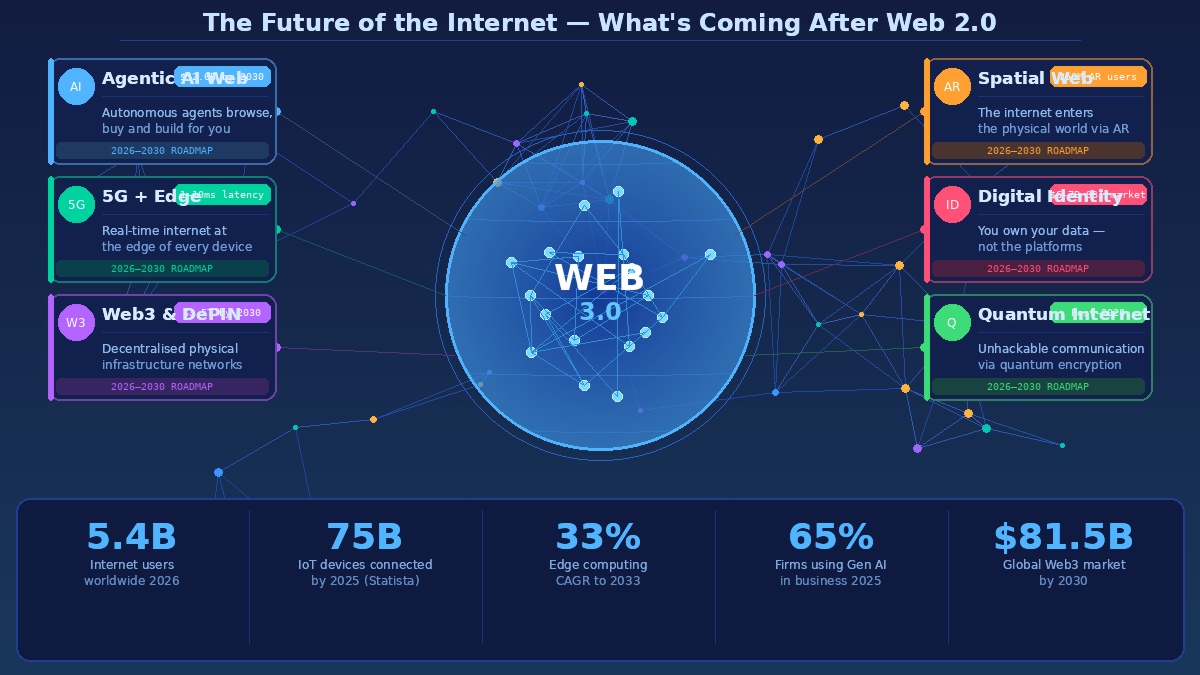
The most immediate shift isn’t Web3 or spatial computing — it’s AI becoming the interface layer of the internet itself. In 2025, 65% of companies reported using generative AI in at least one business function, up from a third the year before. Gartner projects that by 2028, 15% of daily work decisions will be made autonomously by AI agents — systems that don’t just answer questions but browse the web, complete tasks, and transact on your behalf.
This is already happening. Tools like Perplexity are replacing search with direct answers. AI agents are booking travel, managing emails, and executing code without human prompting for each step. The internet isn’t going away — but increasingly, AI is sitting between us and it, acting as an intermediary that filters, interprets, and executes.
5G and Edge Computing: The Invisible Infrastructure Shift
Most people don’t think about where the internet is processed. The answer, for most of the last decade, has been: in a data centre somewhere far away. Edge computing changes that. By moving computation closer to where data is generated — in factories, hospitals, autonomous vehicles, smart city sensors — edge computing drops latency to 1–10 milliseconds compared to 30–50ms on 4G.
The edge computing market is expanding at a 33% compound annual growth rate through 2033. This isn’t abstract. It’s what makes a self-driving car’s split-second decisions possible, what enables a surgeon to operate remotely with haptic feedback, and what allows IoT devices — projected to reach 75 billion connected units by 2025 — to function in real time without bottlenecks.
Web3: Less Hype, More Infrastructure
Web3 spent several years attracting enormous speculation and equally enormous scepticism. In 2026, the picture is more grounded. The Global Web3 market is projected to reach $81.5 billion by 2030, and the use cases driving that growth are less about NFT profile pictures and more about decentralised physical infrastructure.
DePIN — Decentralised Physical Infrastructure Networks — is one of the most concrete examples. As of early 2026, over 650 active DePIN projects exist with a combined market cap exceeding $16 billion. These networks coordinate real-world infrastructure — compute power, wireless coverage, storage, energy — using blockchain-based incentive structures rather than centralised corporate ownership.
The convergence of AI and Web3 is also becoming structural rather than theoretical. AI agents need verifiable identity, tamper-proof data, and payment rails that work across platforms without requiring a bank account. Web3 provides all three. The result is autonomous agents settling micropayments via stablecoins, AI-generated content with on-chain provenance records, and decentralised compute networks training AI models without centralised providers.
The Spatial Web: The Internet Steps Into the Room
More than 350 million Snapchat users engaged with augmented reality daily in Q2 2025. Apple’s Vision Pro has seeded a generation of spatial computing interfaces. The question is no longer whether the internet will have a physical presence in the room — it already does. The question is how deep that presence gets.
Spatial computing represents the merging of physical and digital environments through AR, VR, and mixed reality. Virtual workspaces that replicate in-person collaboration. Retail experiences where you try on clothes without going to a store. Medical training simulations that let surgeons practice on digital patients before touching real ones. Voice assistant users in the US alone are projected to reach 170 million by 2028, and voice is increasingly the control layer for spatial environments — hands free, always present.
Digital Identity: Taking Back Ownership of Your Data
One of the quietest but most significant shifts happening in the internet’s future is around identity. Right now, your digital identity is fragmented across dozens of platforms — each one storing your data, each one profiting from it, each one a potential breach waiting to happen. The Identity Theft Resource Center recorded 1,732 data breaches in just the first half of 2025.
Self-sovereign identity — the idea that you control a single, verifiable digital identity that you own and selectively share — is moving from concept to market. The SSI market grew from $3–6 billion in 2025 toward projections of $6–7 billion in 2026, heading toward what analysts describe as a trillion-dollar long-term opportunity as government ID, financial credentials, and professional certificates migrate onto user-controlled infrastructure.
The Quantum Horizon
Quantum internet remains further out — IBM has suggested practical quantum computing at commercial scale is post-2028 — but the research is accelerating. Quantum communication offers theoretically unhackable channels via quantum key distribution, and several national governments are funding quantum network trials. When it arrives, it won’t replace the classical internet — it will add a security layer that makes certain classes of sensitive communication genuinely impenetrable.
The Thread Through All of It
The internet is moving in one consistent direction: away from centralised control and toward a distributed, AI-mediated, physically integrated experience that users own more of. The platforms that dominated Web 2.0 aren’t going away — but the next layer of the internet is being built around their limitations, not on top of their infrastructure.
The 5.4 billion people online today are the early users of something that will look very different by the time the next generation grows up with it.


