


Every few decades, something comes along that genuinely changes everything — the printing press, electricity, the internet. We’re living through one of those moments right now, except this time, several game-changing technologies are arriving at once.
Here are six breakthroughs that aren’t just hype. They’re already happening — and their full impact is still years away from being felt.
1. Quantum Computing — Solving the Unsolvable
Classical computers, for all their power, hit a wall with certain problems — simulating drug molecules, breaking encryption, optimizing global supply chains. Quantum computers don’t. By harnessing the physics of quantum mechanics, they can process millions of possibilities simultaneously.
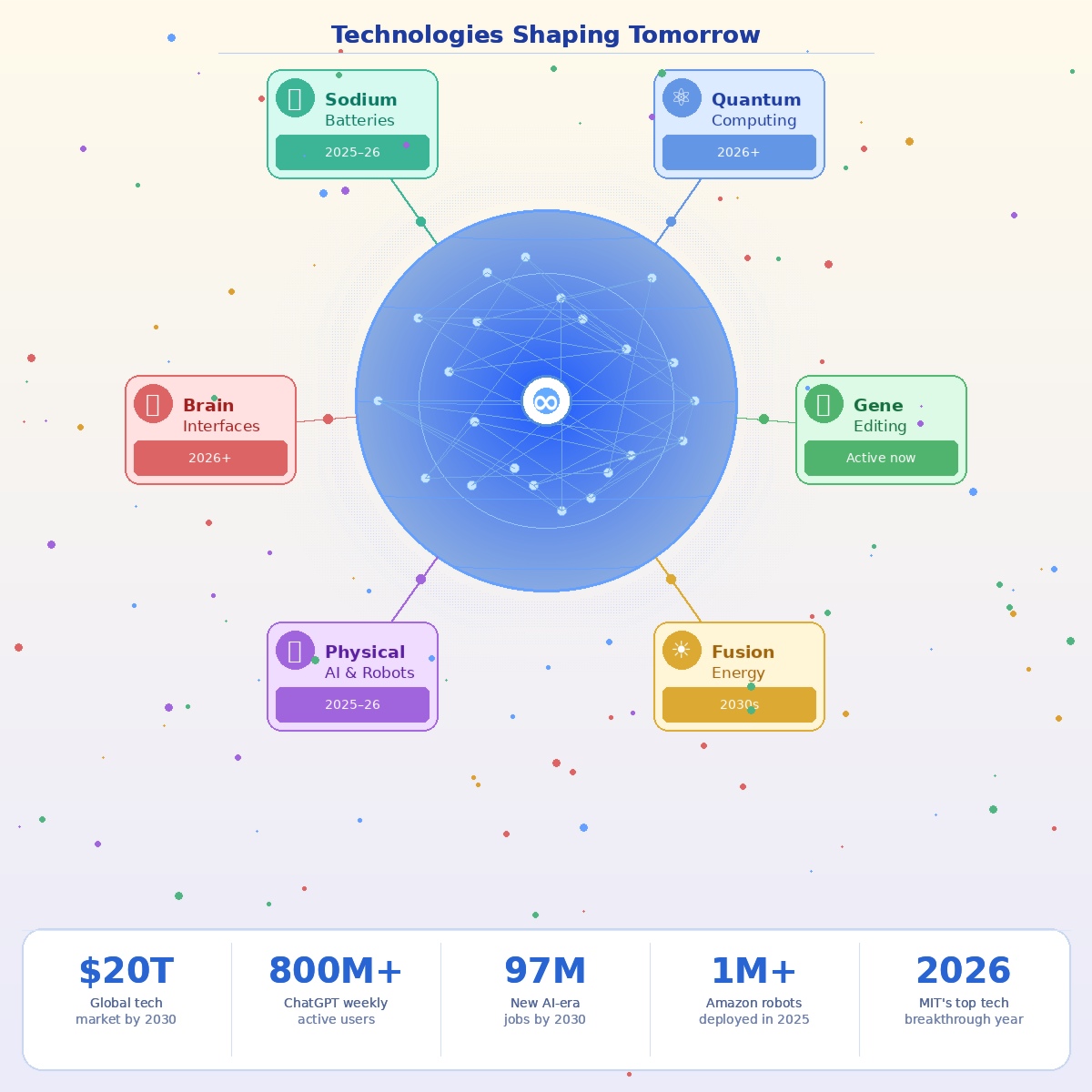
In 2025, quantum computing crossed a meaningful threshold. Commercial devices began tackling real-world problems for the first time, particularly in pharmaceutical research and materials science — areas where traditional computing has always been frustratingly slow. The World Economic Forum flagged quantum computing as one of its top emerging technologies of 2025, and IBM, Google, and a wave of startups are pouring billions into making it production-ready. The timeline to widespread commercial use is shortening every year.
2. Gene Editing — Rewriting the Code of Life
CRISPR-Cas9 has been around for over a decade, but 2025 was the year it started actually saving lives at scale. Around 25 clinical trials are currently underway using gene-editing techniques to treat conditions ranging from sickle cell disease to certain cancers. The US FDA has already approved the first CRISPR-based therapy.
The implications go far beyond medicine. Gene editing is being explored for drought-resistant crops, biodegradable plastics, and even solutions to antibiotic resistance. MIT Technology Review listed engineered living therapeutics — organisms reprogrammed to fight disease from inside the body — among its breakthrough technologies of 2025. We are, in the most literal sense, learning to rewrite biology.
3. Fusion Energy — Finally, Clean Unlimited Power
Nuclear fusion has been “20 years away” for 60 years. Except now it might genuinely be 10. In late 2022, the National Ignition Facility achieved fusion ignition for the first time — producing more energy than it consumed. Since then, private companies like Commonwealth Fusion Systems and Helion have secured billions in funding and set aggressive commercialisation timelines for the early 2030s.
Fusion produces no carbon emissions, no long-lived radioactive waste, and runs on hydrogen isotopes found in seawater. If it works at scale, it doesn’t just solve the energy crisis — it removes energy scarcity as a concept.
4. Physical AI and Robotics — Intelligence in the Real World
AI leaving the screen and entering the physical world is one of Gartner’s top strategic technology trends for 2026. Amazon now has over one million robots deployed across its operations. BMW plants are running self-driving vehicles on their factory floors. Figure, Boston Dynamics, and Tesla’s Optimus program are racing to put general-purpose humanoid robots into warehouses, hospitals, and eventually homes.
Gartner predicts half of all B2B buyers will interact with a digital human — an AI-driven entity with human-like appearance and intelligence — in a buying cycle by 2026. The line between the digital and physical is blurring faster than almost anyone predicted.
5. Brain-Computer Interfaces — Merging Mind and Machine
Neuralink made its first human implant in early 2024. By 2025, MIT Technology Review reported that around 25 clinical trials involving brain-computer interfaces are now underway globally. The technology allows paralyzed patients to control computers with thought alone, and early results have been remarkable.
Longer term, BCI raises profound questions about what it means to think, remember, and communicate. The medical applications alone — restoring movement, speech, and memory to those who have lost them — could be transformational for millions of people.
6. Sodium-Ion Batteries — The Energy Storage Revolution
This one flies under the radar, but its consequences could be enormous. Lithium — the material powering virtually every electric vehicle and smartphone — is expensive, geographically concentrated, and environmentally costly to mine. Sodium-ion batteries are made from salt. They’re cheaper, safer, more abundant, and already being produced at commercial scale by CATL, the world’s largest battery manufacturer.
MIT Technology Review named sodium-ion batteries one of its 10 breakthrough technologies of 2026. Wider adoption could dramatically reduce the cost of EVs and make grid-scale renewable energy storage economically viable worldwide — which in turn accelerates the entire clean energy transition.
The Bigger Picture
What’s striking about this moment isn’t just the individual technologies — it’s the convergence. AI is accelerating drug discovery. Quantum computing is unlocking new materials for batteries. Fusion research is powered by machine learning simulations. These aren’t separate stories. They’re one story, and we’re only in the early chapters.
The world of 2035 will look different from today in ways that are genuinely hard to predict. But these six technologies will be at the center of whatever it becomes.


