Let’s be real — the AI tools space is a mess right now. There are hundreds of apps all promising to “10x your productivity,” and most of them are just a slick interface sitting on top of the same model you already have access to for free. The hype is real. The useful tools are fewer than you’d think.
But here’s the thing: the right combination of AI tools genuinely can give you back 15 to 20 hours a week. Not in theory. In practice. The key is knowing which ones to actually use.
Here are the tools that have earned their place in 2026.
ChatGPT — Still the One You Can’t Ignore
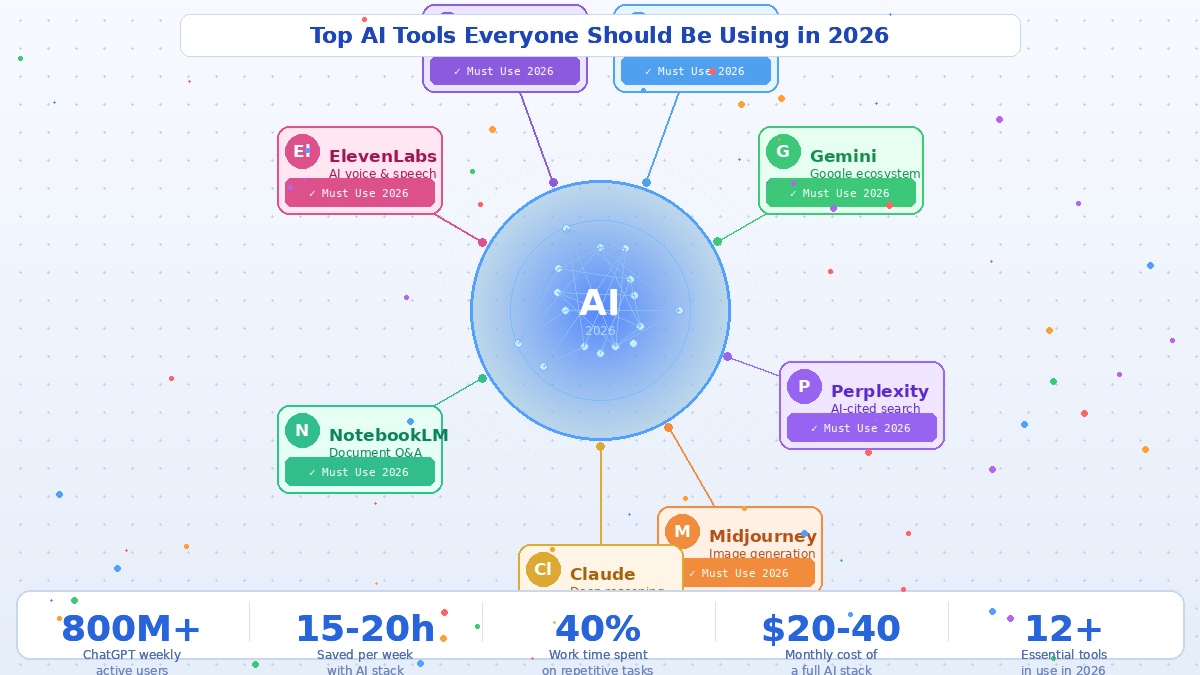
It has been the dominant AI tool for three years running, and ChatGPT is still at the top for a reason. The latest GPT-5.4 Thinking model handles writing, brainstorming, document analysis, coding, research, and summarisation in a single interface. The memory feature means you don’t have to keep explaining your context. The Projects feature keeps your work organised by client or campaign. Voice mode lets you think out loud on the go. With over 800 million weekly active users as of late 2025, the scale of adoption tells you something. If you’re only going to use one AI tool, this is the one.
Claude — For When You Need to Actually Think
Where ChatGPT is fast and versatile, Claude goes deep. Its 200,000-token context window means you can drop in an entire contract, codebase, or research paper and have a genuine conversation about it. For writers, researchers, strategists, and anyone dealing with complex problems that require careful reasoning, Claude consistently produces more thoughtful, nuanced output. It’s become the default tool for developers and data analysts who need more than just a quick answer.
Perplexity — Search That Doesn’t Waste Your Time
Perplexity has replaced Google for a lot of knowledge workers, and it’s easy to understand why. Every answer cites its sources. Every sentence is verifiable. With its Pro Search and Comet browser launched in mid-2025, it aggregates real-time web data into concise, cited reports. It added dedicated Finance and Shopping hubs for data-heavy queries. If you’re doing market research, competitor analysis, or any kind of due diligence, Perplexity saves hours compared to traditional search.
Google Gemini — If You Live in Google’s World
If your workflow already runs through Gmail, Docs, Sheets, Drive, and Calendar, Gemini is the natural choice. It integrates natively into all of them, which means you’re not switching apps to get AI assistance — it’s already where your work is. Gemini also excels at complex research tasks and image generation, and for anyone already paying for Google Workspace, it’s essentially included.
NotebookLM — The One Most People Haven’t Tried Yet
This one flies under the radar and it really shouldn’t. NotebookLM lets you upload your own documents — PDFs, reports, transcripts, research papers — and then asks questions of them directly. The answers come from your documents, not from the general internet, which means the responses are actually grounded in the specific information you care about. For students, researchers, and anyone managing large amounts of reading, it’s genuinely transformative.
ElevenLabs — For Anyone Working With Audio
Voice cloning and text-to-speech have been around for a while, but ElevenLabs is genuinely in a different category. The voices sound real. The tool supports dozens of languages, and the voice agent functionality lets you build interactive audio workflows without touching a line of code. Content creators, podcasters, businesses doing customer service, and developers building voice apps all find different reasons to rely on it.
Gamma — Because Nobody Wants to Make Slides
Gamma takes your notes, a document, or even just a rough idea and converts it into a polished presentation, document, or webpage. The output looks professional without requiring design skills. For anyone who needs to communicate ideas visually but dreads the blank slide, it removes most of the pain from the process.
Midjourney — For Images That Don’t Look AI-Generated
Image generation has come a long way, and Midjourney is still the benchmark for quality. The images it produces have a visual coherence and artistic quality that most other tools haven’t matched. For marketers, designers, and content creators who need strong visuals without a photography budget, it’s become essential.
The Bottom Line
Knowledge workers currently waste an estimated 40% of their working time on repetitive tasks. A well-chosen AI stack — typically costing $20 to $40 per month — can cut that dramatically. The tools above aren’t exhaustive, but they cover the foundations: thinking, researching, creating, communicating, and automating.
Pick two or three. Get genuinely good at them. Then add more as the need arises. That’s how you get real value from AI in 2026 — not by chasing every new release, but by building a stack that actually fits how you work.
