


Let’s put the clickbait version aside immediately: AI is not going to “beat” humans. And humans are not going to stay effortlessly superior in every domain. The honest conversation in 2026 is more interesting than either of those takes — because what’s actually happening is a convergence, not a competition, and understanding the difference matters enormously for how you work, learn, and make decisions.
Where AI Is Already Decisively Better
There are tasks where the comparison isn’t close, and pretending otherwise is just vanity.
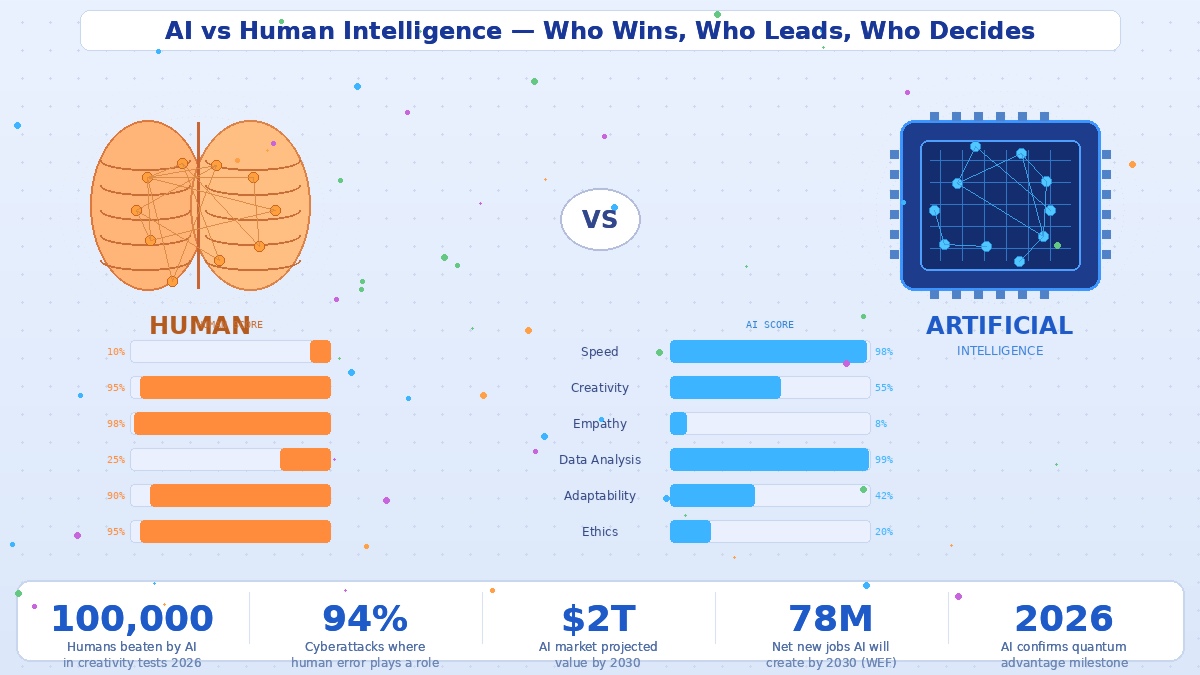
Speed and scale: AI processes millions of data points in seconds. What takes a human analyst weeks to spot in a dataset — a pattern in financial transactions, an anomaly in medical records, a correlation across satellite images — AI can surface in milliseconds. In data-heavy environments, AI isn’t optional in 2026. It’s infrastructure.
Consistency: AI doesn’t have bad days. It doesn’t lose focus at 4pm on a Friday or make errors because it’s tired or emotionally distracted. In tasks requiring sustained precision — quality control in manufacturing, medical image classification, fraud detection — that consistency is genuinely valuable and demonstrably better than what humans deliver under the same conditions.
And perhaps most surprisingly: in 2026, AI beat more than 100,000 humans on standardised creativity tests. Not by being more imaginative in the human sense, but by generating a wider range of novel combinations across a larger search space than human minds can scan. Whether that constitutes “real” creativity is a philosophical question. The test scores are not.
Where Humans Still Hold Ground — And Why It Matters
The places where human intelligence remains essential aren’t arbitrary. They reflect something fundamental about what intelligence is actually for.
Empathy and emotional understanding: An AI can recognise that someone is upset. It can respond in ways that are calibrated to reduce distress. It cannot genuinely care. In healthcare, therapy, leadership, parenting, and negotiation, the difference between simulated empathy and actual empathy is not academic — it changes outcomes. People know when they’re dealing with something that cares and when they’re not.
Ethical judgement in ambiguous situations: Intuit’s April 2026 analysis put it plainly — a model can flag a risky transaction or draft a customer communication, but it can’t be held accountable for what happens next. Accountability requires moral agency. Moral agency requires the capacity to genuinely weigh competing values, not just optimise a function. Courts, medical ethics boards, and every organisation making consequential decisions about people’s lives need humans who can own outcomes, not systems that produce outputs.
Common sense in unfamiliar situations: AI is powerful within the distribution of data it has seen. When genuinely novel situations arise — ones where no training data gives clear guidance — human contextual reasoning still outperforms the best AI systems. This is partly why autonomous vehicles still struggle with rare edge cases that a human driver resolves instinctively within seconds.
The Collaboration Frame Is Not a Consolation Prize
There’s a temptation to treat “humans and AI working together” as a diplomatic middle ground — something you say so nobody feels threatened. It’s not. It’s actually the highest-performance model, and the evidence in 2026 supports it strongly.
Organisations using augmented intelligence — humans and AI each doing what they’re best at — consistently outperform those chasing full automation. The value of human roles is shifting toward directing what should be done rather than doing it mechanically. That’s not a lesser role. In most organisations, that’s the role that’s always been most valuable and hardest to fill.
The AI market is projected to reach $2 trillion by 2030. The World Economic Forum estimates AI will create 78 million net new jobs by then. The work isn’t disappearing. The nature of work is changing — and the people who understand what AI can and can’t do are the ones best placed to navigate that change.
The Question That Actually Matters
The right question in 2026 isn’t “is AI smarter than humans?” It’s “what kinds of intelligence do different tasks require, and who should be applying them?”
Speed, scale, pattern recognition, and consistency: lean on AI. Accountability, empathy, ethical judgement, and navigating genuine novelty: those stay human for the foreseeable future. The organisations and individuals who understand this clearly — rather than either fearing AI or blindly delegating to it — are the ones who’ll make the best decisions in the years ahead.
AI doesn’t know when it’s wrong. Humans must know when to intervene. That distinction is not a limitation of current technology. It’s a feature of what intelligence means when it has to operate in the real world with real consequences.


