


Google wants Gemini to feel like an assistant that can handle almost anything without forcing users to think about how the technology works. However, the growing number of individually branded features inside the app may be making that goal harder to achieve.
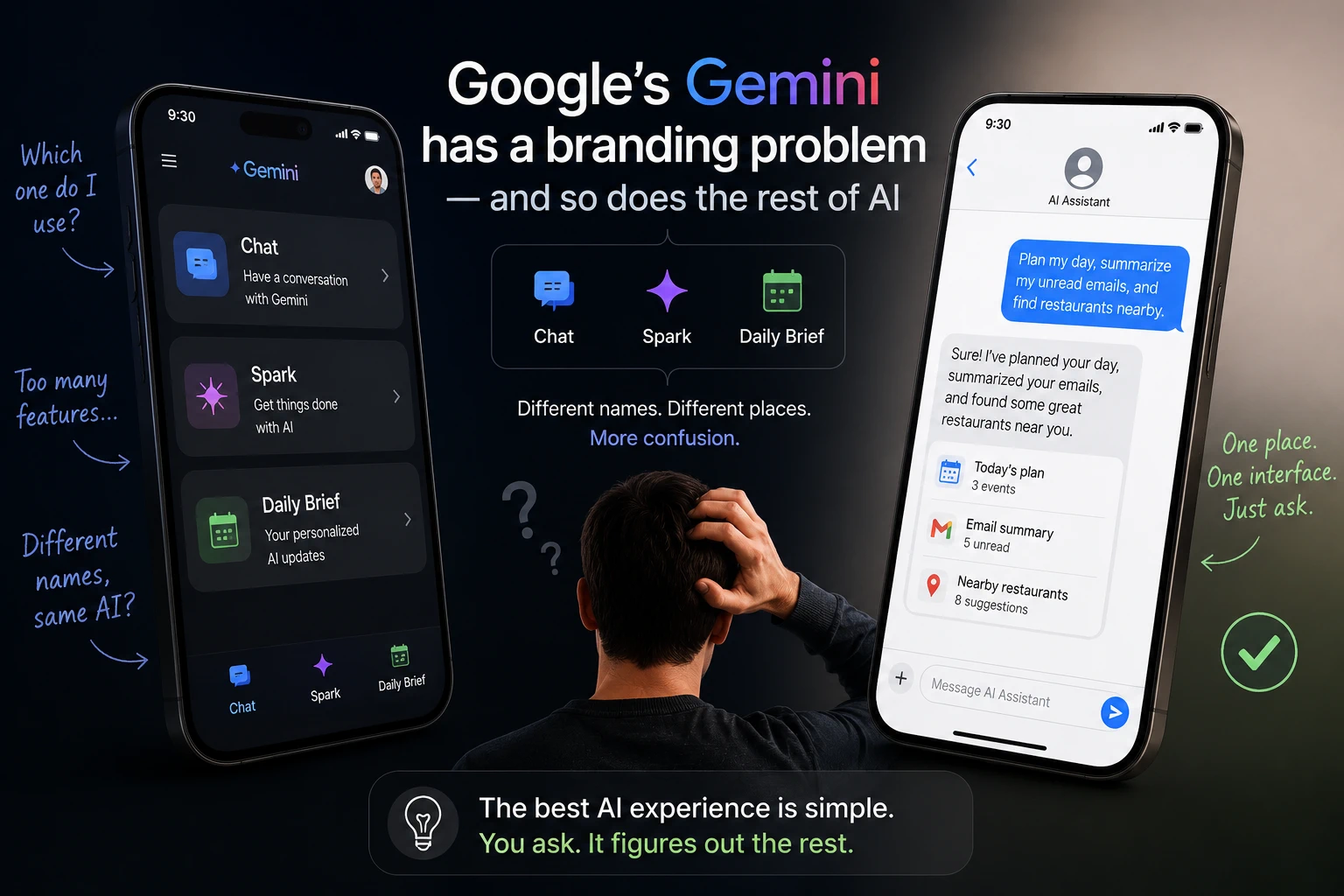
Google recently introduced additional capabilities for Gemini Live, emphasizing that users shouldn’t need to determine which specific tool is appropriate before asking for help. Yet Gemini itself currently includes separate experiences such as Chat, Spark, and Daily Brief, each with its own identity and position within the interface.
For everyday users, that can create unnecessary complexity.
Daily Brief may be trying to do too much
Daily Brief is designed as a personalized AI-powered overview that gathers information from services such as Gmail and Google Calendar. In theory, it can surface useful updates and help users understand what deserves their attention.
The challenge is deciding what actually matters.
Alongside potentially important reminders, Gemini may bring back previous activities, research topics, or searches. While technically impressive, resurfacing older interests isn’t necessarily something users want from an assistant.
Personalization becomes less useful when people feel they are being reminded about activities they never asked the AI to track.
Spark is useful, but does it need its own identity?
Spark presents a different issue.
Its ability to act as an AI agent and complete tasks for users could make it one of Gemini’s more practical capabilities. However, giving the functionality its own branded section means users must understand what Spark does before knowing when to use it.
A simpler approach would be for someone to tell Gemini what they need and allow the system to automatically determine whether an AI agent is required.
The underlying technology can remain complicated without exposing that complexity to the person using it.
This isn’t only Google’s problem
Similar design choices are appearing throughout the AI industry.
Anthropic has offered different experiences for interacting with Claude, while ChatGPT also provides different environments depending on whether someone wants a normal conversation or a more involved workspace.
These distinctions can make sense from a product-development perspective, but consumers may not care which internal system performs the task. They simply want the assistant to understand the request and complete it.
Apple has taken a somewhat different route with Siri. Rather than requiring users to learn entirely new AI interfaces, Apple has been adding intelligence to familiar experiences such as Siri, Spotlight, Photos, and the iPhone camera.
Simplicity could become a competitive advantage
The popularity of AI assistants that work through ordinary text messaging reinforces this idea. Services including Poke, Ollie, Lindy and others are experimenting with interfaces where interacting with AI feels similar to messaging another person.
There’s very little to learn: send a message and explain what you need.
As AI systems become increasingly capable, companies may discover that adding more branded features isn’t necessarily the best way to demonstrate progress.
The strongest AI experience could ultimately be the one where users never have to think about which AI feature they’re using at all.


