


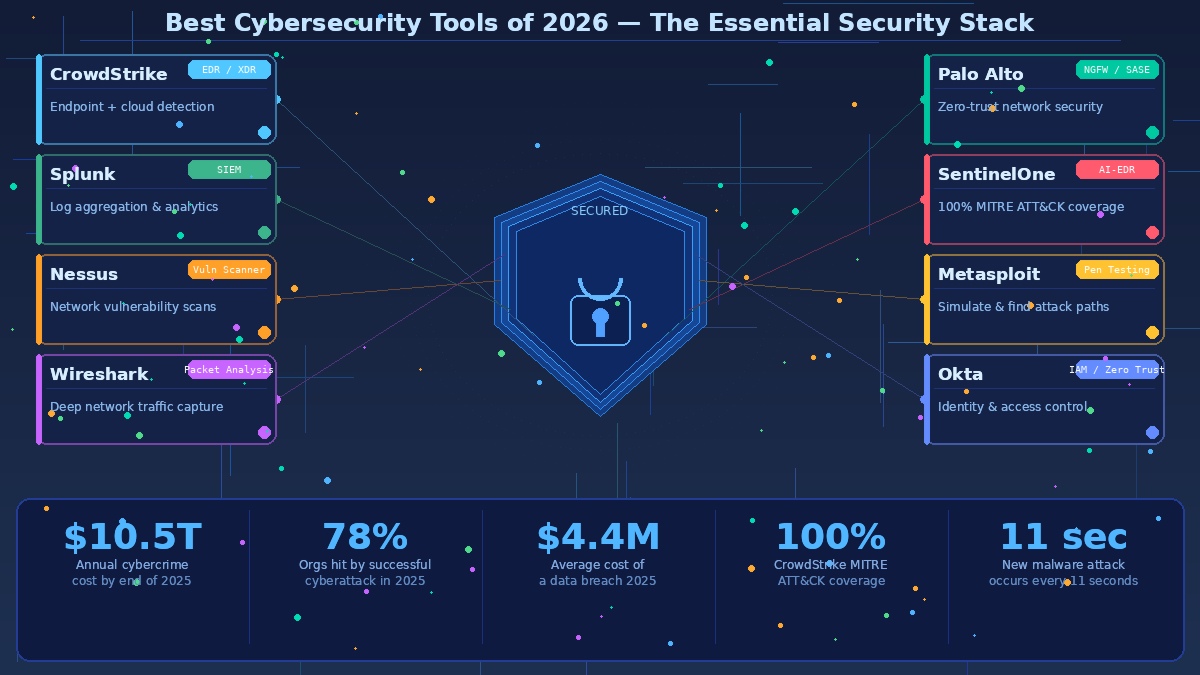
In 2025, 78% of organisations worldwide reported experiencing a successful cyberattack. The average cost of a data breach for US companies hit $10.22 million — a record. Global cybercrime costs are on track to reach $10.5 trillion annually by the end of 2025. These aren’t statistics from an alarmist report. They’re operating conditions.
The organisations that get breached aren’t usually missing tools. They’re missing integration. Fifteen years ago, cybersecurity was an IT problem. Today, it determines whether your business survives a weekend. Attackers have professionalised — Ransomware-as-a-Service means sophisticated attacks are available to anyone willing to pay. AI is accelerating both sides of the battle, and attackers don’t have compliance requirements or change management processes slowing them down.
Here are the tools that matter most in 2026, organised by what they actually do.
CrowdStrike Falcon — Best EDR / XDR Platform
Endpoint Detection and Response is the category that’s replaced the traditional antivirus, and CrowdStrike is where most enterprise security teams land. Its Falcon platform achieved 100% detection coverage in the MITRE ATT&CK Enterprise 2025 evaluation — the industry’s most rigorous independent test — and has done so consistently across multiple years. It monitors every endpoint, laptop, server, and cloud workload in your environment for suspicious behaviour and provides investigation and containment tools when something is flagged. With remote work permanent, endpoints are the new perimeter, and CrowdStrike provides visibility into what’s actually happening on every device. It’s recognised as a Magic Quadrant Leader by Gartner for four consecutive years.
Splunk — Best SIEM
A Security Information and Event Management platform aggregates log data from across your entire environment — firewalls, endpoints, applications, cloud services — and analyses it to detect threats and anomalies. Without a SIEM, SOC analysts are manually correlating alerts from dozens of disconnected consoles. Splunk is the platform most enterprise security operations centres run on, and its integration with SOAR (Security Orchestration, Automation and Response) allows automated responses to common threat patterns, reducing the alert fatigue that burns out security teams. If you’re running a SOC in 2026, you need a SIEM, and Splunk is the reference standard.
Tenable Nessus — Best Vulnerability Scanner
You can’t protect what you can’t see. Nessus assesses networks, systems, and applications for vulnerabilities, providing risk ratings and reports that help security teams prioritise what to fix first. In a world where a single unpatched vulnerability can be the entry point for a ransomware attack — as it was in the Colonial Pipeline incident and the MOVEit breaches — continuous vulnerability scanning isn’t optional. Nessus remains the most widely deployed vulnerability assessment tool globally, used by security engineers from small teams to enterprise SOCs.
Wireshark — Best for Network Analysis
Even in 2026, Wireshark remains the premier open-source tool for deep packet inspection. It captures and analyses network traffic in real time, revealing everything from protocols and headers to actual payload content. Security professionals use it to identify anomalies, troubleshoot network issues, and uncover malicious activity hidden inside seemingly normal traffic. It’s free, runs on every major operating system, and provides a level of granular visibility that paid commercial tools often can’t match. For anyone building foundational security skills, Wireshark is where you start.
Palo Alto Networks — Best NGFW / SASE
Palo Alto has evolved from a next-generation firewall vendor into a comprehensive platform covering network security, cloud security, and endpoint protection under a unified architecture. Its Prisma SASE offering brings together Zero Trust Network Access, a Cloud Access Security Broker, and a Secure Web Gateway into a single platform designed for the hybrid workforce. For organisations managing distributed teams, multiple cloud environments, and legacy on-premises infrastructure simultaneously, Palo Alto provides the connectivity and security controls to enforce consistent policy across all of it.
SentinelOne — Best AI-Native EDR
SentinelOne takes a different approach to endpoint security than CrowdStrike — its Singularity platform uses AI trained on threat data to identify and respond to attacks autonomously, without relying on human SOC analysts for every alert. Its 100% MITRE ATT&CK coverage has been independently verified, and its automated response capabilities mean threats can be contained in milliseconds rather than the minutes or hours that human-led response requires. For organisations without a 24/7 SOC, SentinelOne provides the closest thing to automated expert-level response available at scale.
Metasploit — Best Penetration Testing Framework
The only way to know whether your defences actually work is to test them against real attack techniques. Metasploit is the industry-standard framework for penetration testing — used by security engineers, red teams, and ethical hackers to simulate attacks, identify exploitable vulnerabilities, and validate that patches and controls are effective. It’s open-source, continuously updated with the latest exploit techniques, and widely used for certification training as well as production security assessments. In 2026, any organisation running regular security assessments needs a penetration testing capability, and Metasploit is where most teams build it.
Okta — Best IAM and Zero Trust
Identity is the new perimeter. In a decentralised world where employees access systems from anywhere on any device, controlling who has access to what — and verifying that access continuously — is more important than any firewall. Okta’s Identity and Access Management platform provides single sign-on, multi-factor authentication, and continuous verification across cloud and on-premises applications. Its Zero Trust architecture assumes no user or device is trusted by default, requiring verification at every access request. Okta has become the reference standard for enterprise identity security, and integrates with virtually every major enterprise application.
Building the Right Stack
No single tool covers the entire attack surface. Effective cybersecurity in 2026 requires layers — EDR for endpoints, SIEM for visibility, a vulnerability scanner to find gaps before attackers do, network analysis for anomaly detection, and IAM to control access. The organisations that get this right aren’t necessarily the ones with the biggest budgets. They’re the ones that understand their threat surface, choose tools that integrate cleanly with each other, and have the operational capacity to act on what those tools reveal.
Start with your environment. Map your threats. Match your tools to your actual risk profile, not a generic best-of list. And make sure what you deploy talks to everything else in your stack — because integration is where cybersecurity either works or falls apart.


