



Let’s be honest — the question isn’t really if AI will replace certain jobs anymore. It’s which ones, how fast, and what happens to the people doing them.
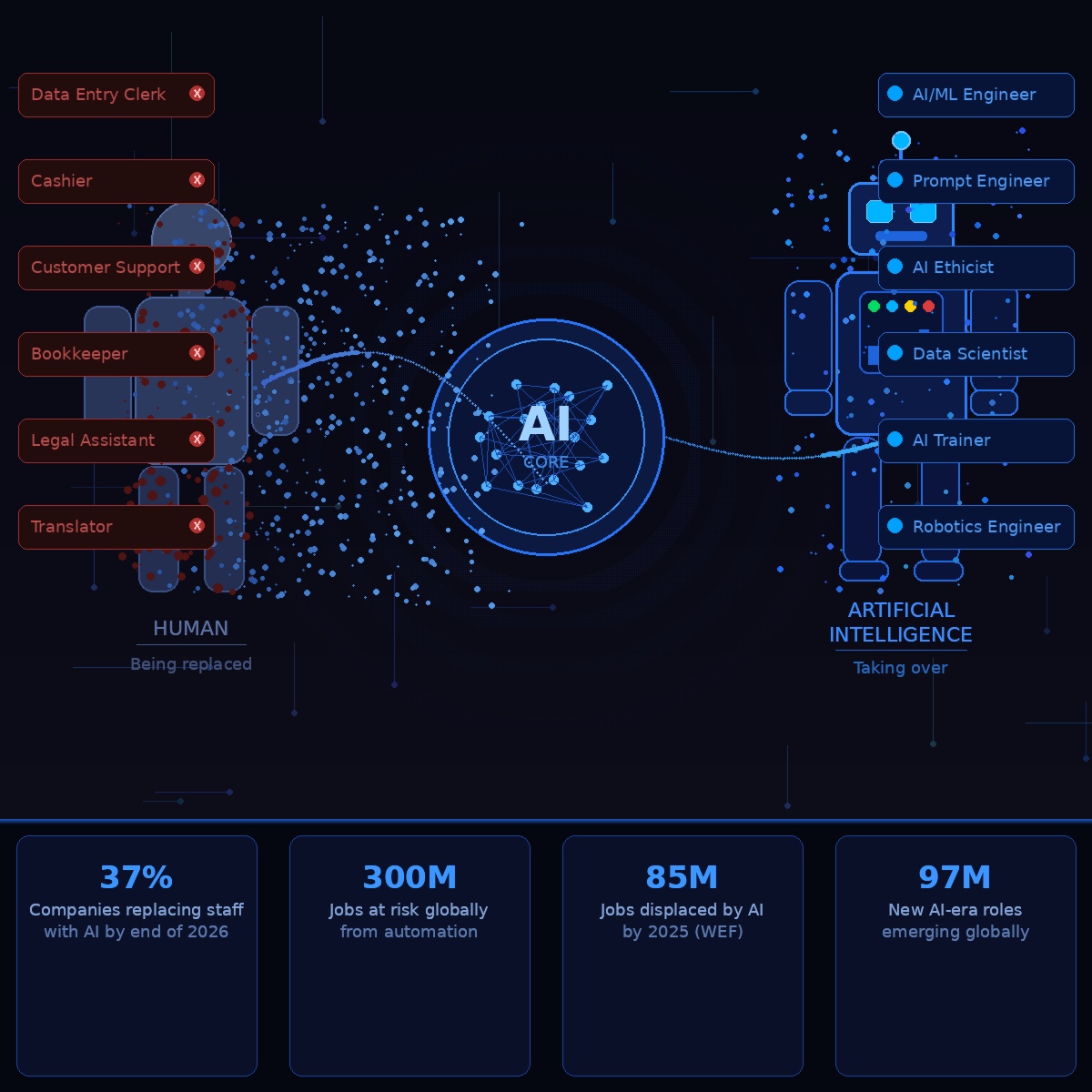
The numbers coming out in 2025 and early 2026 are hard to ignore. A Resume.org survey found that nearly 3 in 10 companies have already replaced workers with AI — and by the end of 2026, 37% expect to have done so. A separate MIT study found that AI can already replace 11.7% of the entire U.S. workforce, covering roles across finance, healthcare, logistics, and office administration. That’s not a future prediction. That’s right now.
So which jobs are actually on the line?
Customer Service Representatives
This one is already happening at scale. Klarna publicly announced its AI handles the workload of 700 customer service agents. IBM’s internal AI system, AskHR, processes over 11 million employee interactions a year — with less than 5% requiring a human. The automation risk for customer service roles sits at around 80%, making it one of the most vulnerable sectors in the workforce today.
Data Entry and Administrative Clerks
If your job involves copying, sorting, or transferring information between systems, AI does it faster, cheaper, and with fewer errors. Manual data entry roles face a staggering 95% automation risk. It’s estimated that 7.5 million data entry and administrative jobs could disappear by 2027.
Paralegals and Legal Assistants
AI tools can now review contracts, flag legal risks, and summarize case law in minutes — tasks that used to take junior legal staff hours or days. Law firms are already cutting entry-level positions. This isn’t about replacing senior lawyers; it’s about removing the bottom rungs of the career ladder entirely.
Bookkeepers and Accounting Clerks
Routine financial tasks — reconciling accounts, generating reports, processing invoices — are being absorbed by AI-powered accounting platforms. The CFO role isn’t going anywhere, but the support staff beneath it is shrinking fast.
Junior Software Developers
This one surprises people. A Harvard Business School study found that job postings for structured, repetitive coding roles dropped 13% after ChatGPT launched. Anthropic CEO Dario Amodei has predicted AI could eliminate roughly 50% of entry-level white-collar positions within five years. Junior developers writing boilerplate code are already feeling the squeeze.
Retail Cashiers and Bank Tellers
Self-checkout systems and automated kiosks have been quietly replacing cashiers for years. Walmart’s self-checkout expansion alone could eliminate thousands of positions. Bank tellers face a similar story as mobile banking and AI-driven customer interfaces handle the vast majority of in-branch transactions.
Translators and Content Moderators
AI translation has become genuinely good — fast, affordable, and accurate enough for most business needs. Content moderation, long handled by underpaid human reviewers, is increasingly automated too, raising its own set of ethical concerns.
But It’s Not All Bad News
Here’s what the doom headlines often leave out: the same Harvard study that tracked a 13% drop in routine job postings also found a 20% rise in demand for analytical, technical, and creative roles. New job categories — AI trainers, prompt engineers, machine learning auditors, AI ethicists — are growing quickly.
The shift isn’t painless, and it isn’t fair to everyone. Workers in routine, entry-level roles are bearing the brunt of it while senior positions remain largely untouched — for now. But the people who adapt, who learn to work with AI rather than compete against it, are finding themselves more valuable, not less.
The job market isn’t disappearing. It’s being rewritten. The real question is whether you’re ready to write yourself into the new version of it.


