



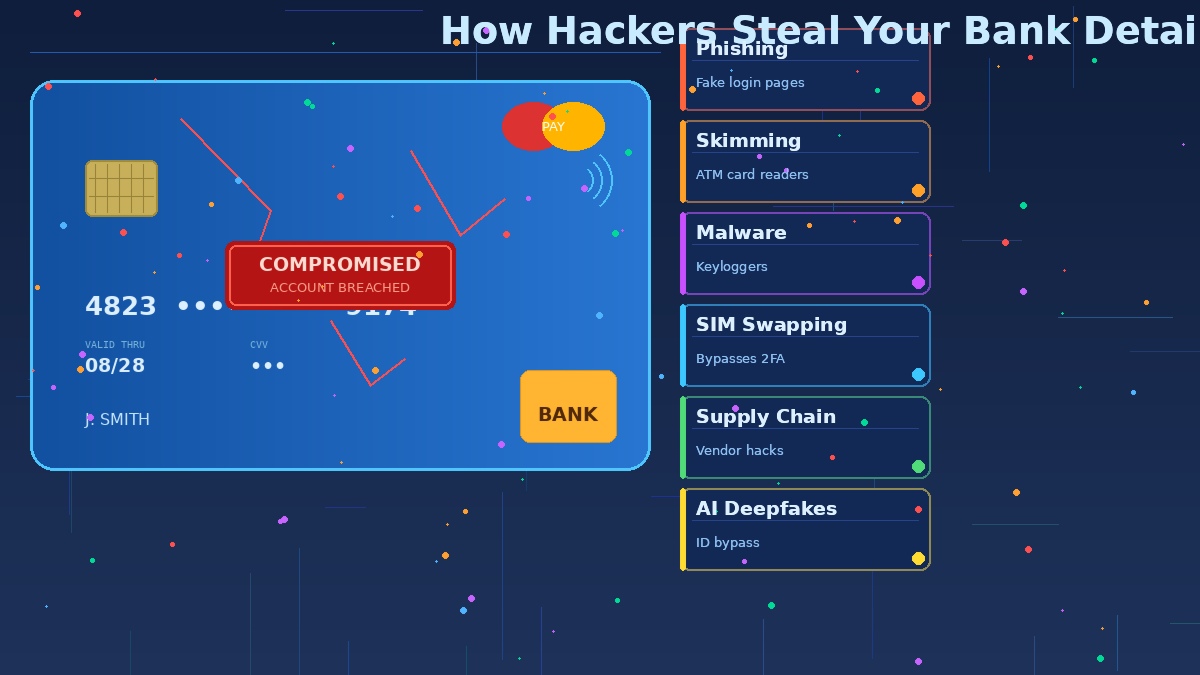
Most people assume bank fraud happens to someone else. It won’t happen to me — I’m careful. But the uncomfortable truth is that the most sophisticated attacks don’t require you to do anything obviously wrong. Sometimes just using the wrong ATM, clicking a link that looks perfectly legitimate, or having your bank use a vulnerable third-party software vendor is all it takes.
The US financial industry now faces average data breach costs of $9.36 million per incident. In 2025 alone, Prosper Marketplace had 13.1 million customers exposed, and a ransomware attack on fintech vendor Marquis compromised the bank details of over 672,000 people — at banks most of those customers had never heard of. The threat is constant, evolving, and closer to home than most of us realise.
Here’s exactly how hackers do it — and what you can do to stay ahead of them.
1. Phishing — Still the Number One Method
It’s the oldest trick in the digital book, and it still works more reliably than anything else. Hackers create near-perfect replicas of your bank’s login page and send you a link via email, text, or even social media. You type in your username and password. The fake page captures it, then quietly redirects you to the real bank website so you don’t notice anything happened.
What makes modern phishing so dangerous is the quality. AI tools now generate flawless grammar, personalised greetings, and near-pixel-perfect clones of real bank interfaces. Phishing attacks have surged 4,151% since ChatGPT’s public release in 2022. Your instinct to spot “bad English” no longer protects you.
2. Card Skimming — The Physical Attack
Not every theft happens online. Skimming devices are small pieces of hardware criminals physically attach to ATMs, petrol station terminals, and card readers. When you swipe or insert your card, the device silently copies your card data. A tiny camera or fake keypad overlay records your PIN at the same time.
The stolen data is then cloned onto a blank card and used for withdrawals or sold in bulk on dark web markets. These devices are often nearly invisible and can be in place for days before anyone notices.
3. Keyloggers and Banking Malware
If your device is infected with a keylogger, every character you type — including your online banking password — is quietly recorded and sent to a remote attacker. Banking trojans go further still, sitting dormant until you open your bank’s website, then activating to capture session cookies, intercept transactions, or redirect payments in real time.
These infections typically arrive via email attachments, pirated software, or malicious links. The software runs silently in the background and leaves no obvious trace.
4. SIM Swapping — Defeating Two-Factor Authentication
You’ve set up two-factor authentication. You feel secure. SIM swapping is designed specifically to defeat it. Criminals call your mobile carrier, impersonate you using personal information scraped from social media or data breach records, and convince the operator to transfer your phone number to a SIM card they control.
From that point, every one-time password, verification code, and account recovery text goes straight to the attacker. In minutes, they can lock you out of your bank account and drain it before you even realise what happened.
5. Supply Chain Attacks — The Breach You Never Saw Coming
This is the fastest-growing attack vector in banking, and arguably the hardest to defend against. Rather than attacking your bank directly, hackers target the third-party software vendors, payroll providers, and data services your bank relies on.
In 2025, supply chain vulnerabilities were the primary vector for banking breaches, according to American Banker’s year-end review. A single vendor compromise — like the 2025 Marquis ransomware attack — can cascade across hundreds of banks and credit unions simultaneously. You did nothing wrong. Your bank did nothing obviously wrong. The weak link was three companies removed from you.
6. AI Deepfakes — The Emerging Threat
This one is newer, and it’s escalating quickly. Criminals now use AI-generated voice and video to impersonate bank customers during phone verification, or to trick bank employees into authorising transfers. Some fraudsters have cloned the voices of executives to authorise large wire transfers — a technique known as “CEO fraud” that has cost companies millions.
As biometric authentication becomes more widespread, deepfake technology is being developed in direct response. The arms race between security teams and criminals is now partly being fought with artificial intelligence on both sides.
How to Protect Yourself
The fundamentals still matter more than most people apply them. Use a unique, strong password for your bank that you don’t use anywhere else. Enable two-factor authentication — even though SIM swapping exists, it stops the vast majority of automated attacks. Check your bank statements weekly, not monthly. If your bank or any service you use announces a breach, change your password that day, not when you get around to it.
And be suspicious of urgency. Legitimate banks never call you out of the blue and ask you to confirm your PIN, install software, or act immediately on a suspicious transaction. That pressure is the attack.


