
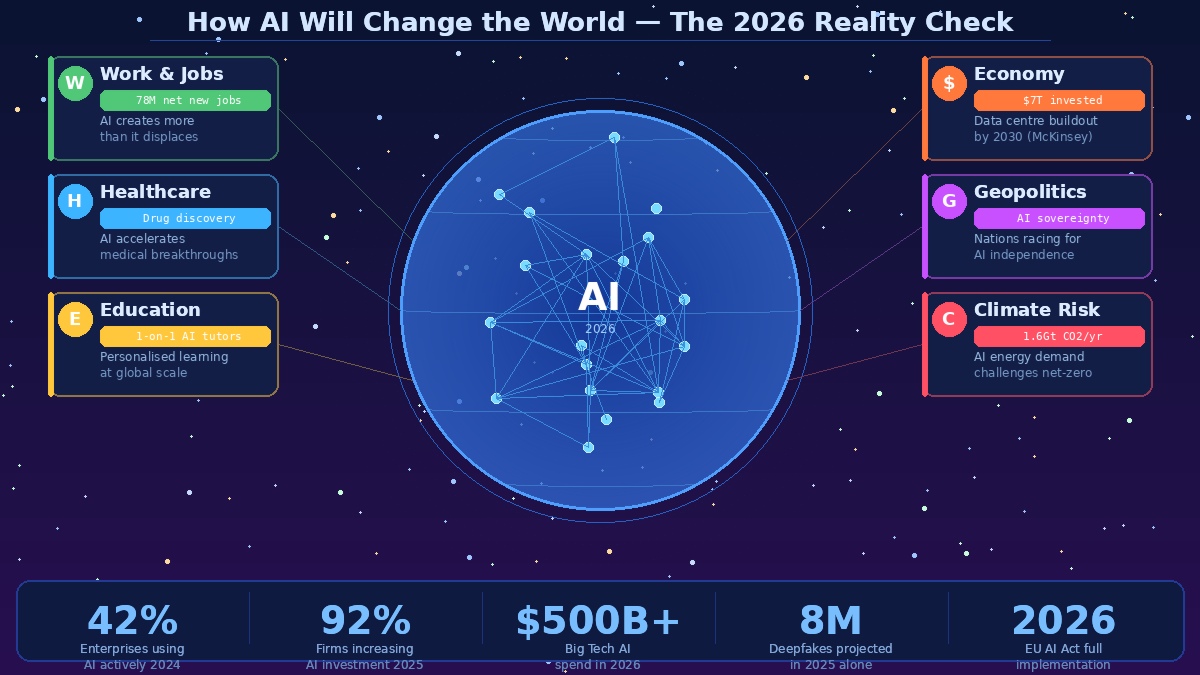
There’s a version of the AI conversation that sounds like science fiction — superintelligence, robot uprisings, the end of human work. And then there’s what’s actually happening right now, in 2026, in hospitals, offices, classrooms, and data centres across the world. The reality is less dramatic but in some ways more profound, because it’s already here and most people haven’t fully noticed it yet.
Here’s what the data actually says about how AI is reshaping the world — and what it still can’t fix.
The Economy: More Money Than Anything in History
Let’s start with the scale. McKinsey estimates companies will invest nearly $7 trillion in data centre infrastructure globally by 2030. Big Tech’s AI capital expenditure is expected to exceed $500 billion in 2026 alone. Nvidia crossed a $5 trillion market valuation — the first company in history to reach that milestone — on the back of GPU demand from AI training.
OpenAI is targeting $30 billion in annual revenue for 2026, roughly double its 2025 figure. Anthropic is targeting $15 billion. These aren’t projections from optimistic startup decks. These are the numbers companies are already working toward.
But here’s the uncomfortable part: a lot of this spending is still ahead of the returns. Stanford’s AI economists predict 2026 is the year companies will begin honestly measuring AI’s economic impact — and some will discover it hasn’t worked as well as the hype suggested.
Work: The Jobs Picture Is Messier Than You’ve Been Told
The World Economic Forum’s 2025 Future of Jobs Report analysed over 1,000 major employers and found AI will create 170 million new roles while displacing 92 million — a net gain of 78 million jobs by 2030. That sounds reassuring. What it doesn’t capture is the disruption in between.
Amazon laid off 14,000 corporate employees in late 2025, explicitly citing AI efficiency gains. Early-career workers in AI-exposed occupations are already experiencing weaker employment outcomes — Stanford’s economists describe them as “canaries in the coal mine.” The new jobs being created require AI skills that the existing workforce largely doesn’t have yet, and the training infrastructure to bridge that gap is still being built.
The honest picture is this: AI will probably produce more work than it eliminates in the long run, but the transition period is genuinely difficult for specific groups of workers.
Healthcare and Science: The Most Genuinely Exciting Part
This is where the optimism is hardest to argue with. AI is shortening the timeline for drug discovery — a process that once took a decade and billions of dollars is being compressed by autonomous systems that can plan and execute experiments rather than just summarise existing data.
IBM has stated that 2026 marks the year quantum computing will outperform classical methods on real-world problems, which opens further possibilities in protein folding, drug design, and materials science. Stanford researchers published work on using AI to identify which features of neural networks drive medical predictions — a critical step toward actually understanding, rather than just using, AI in clinical settings.
Education: Personalised Learning at Scale
In 2026, every student can theoretically have access to a patient, tireless tutor that adapts to their specific learning style, pace, and gaps. That’s not a future prediction — it’s a present capability. The World Economic Forum has flagged AI-powered personalised learning as one of the most significant equity opportunities in the technology’s history, given that access to quality education has historically depended on wealth and geography.
The shift, as one education executive put it, is from content-centricity to outcome-centricity. AI doesn’t just deliver information — it measures whether learning is actually happening and adjusts accordingly.
The Parts That Are Less Comfortable
The deepfake problem is real. Projected at 8 million deepfakes shared on content platforms in 2025, a 1,500% increase in two years, the technology that makes AI-generated video convincing also makes misinformation easier to produce and harder to identify. The EU AI Act reaches full implementation in August 2026, setting rules for high-risk AI systems — but enforcement across 27 countries with different political priorities will be complex.
AI’s energy footprint is also a growing concern. The World Economic Forum estimates AI could add between 0.4 and 1.6 gigatonnes of CO₂ equivalent annually by 2035. Goldman Sachs projects data centres will account for up to 4% of global energy use. The same technology promising to help solve climate change is currently adding to the problem.
The Honest Summary
AI is changing the world. It’s just doing it unevenly, imperfectly, and with trade-offs that don’t fit neatly into either the utopian or dystopian narratives. The people and organisations who will benefit most aren’t the ones waiting to see how it settles — they’re the ones already learning how to work with it, evaluate it honestly, and adapt when the results don’t match the hype.
That’s the real story of AI in 2026. Not magic. Not catastrophe. Something harder and more interesting than either.
