Elon Musk says Waymo never stood a chance. Waymo’s co-CEO Dmitri Dolgov says the numbers tell a different story. Both of them are right about different things — and that’s exactly what makes this comparison so interesting.
Tesla and Waymo are building toward the same destination — a world where cars drive themselves — but they’re taking routes so different you’d be forgiven for thinking they were solving completely separate problems.
The Fundamental Disagreement: Sensors
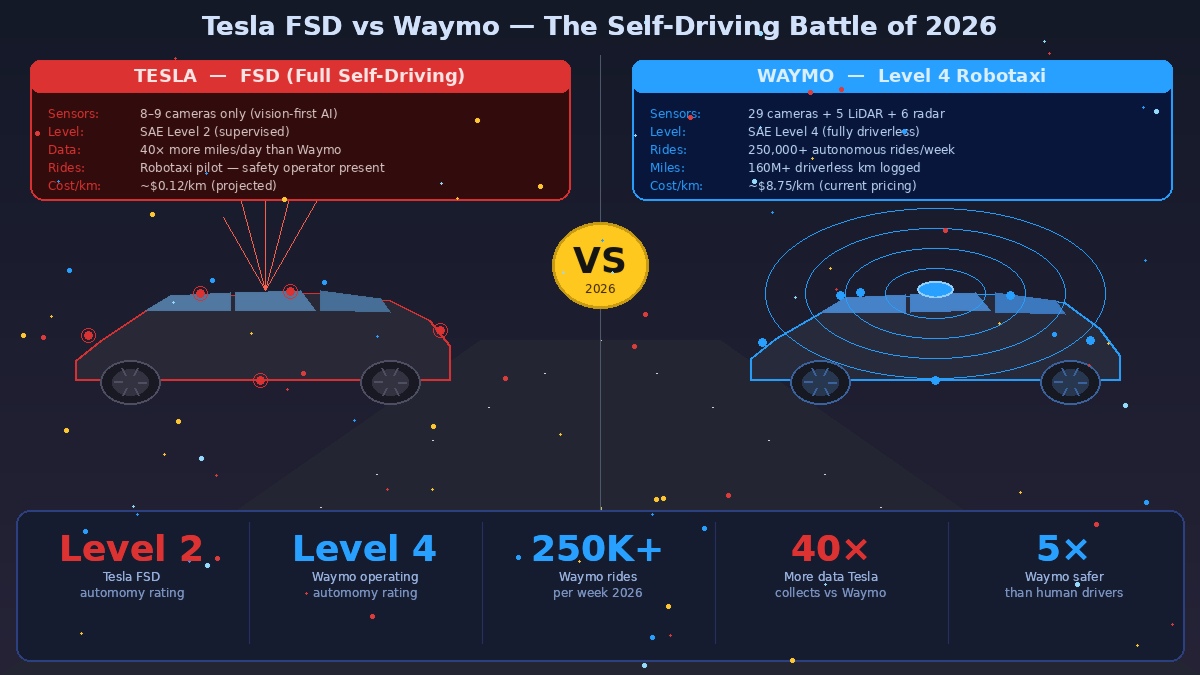
This is where the philosophical split begins. Waymo’s vehicles are covered in hardware. Each car carries 29 cameras, 5 LiDAR sensors, and 6 radars. LiDAR fires laser pulses to build precise 3D maps of the environment — reliable in fog, at night, in rain — and costs thousands of dollars per unit. It’s comprehensive, redundant, and expensive.
Tesla uses cameras only. Eight or nine of them, no LiDAR, no radar. Elon Musk has long argued that LiDAR is a crutch — that humans drive using eyes alone, and a properly trained neural network should be able to do the same. Critics, including a lot of engineers, strongly disagree.
In 2025, Waymo pulled back the curtain on a major shift: it revealed its commercial fleet is now controlled by a foundation model trained end-to-end — essentially the same approach Tesla has used for years. The “modular versus end-to-end” debate that defined the rivalry for half a decade has largely collapsed. Both companies are now building on similar AI architectures. The difference is the sensors feeding that AI.
Where They Actually Stand in 2026
Waymo is the operational leader. Full stop. It has completed over 10 million paid rides, logs more than 250,000 fully autonomous rides per week across San Francisco, Los Angeles, Phoenix, Austin, and Atlanta, and has racked up over 160 million kilometres of fully driverless trips. Nobody sits in the front seat. This is a commercial product that real people use daily.
Waymo claims its vehicles are five times safer than human drivers and twelve times safer for pedestrians based on their operational data.
Tesla is the data leader. Its fleet of millions of consumer vehicles on roads worldwide collects 40 times more driving miles per day than Waymo, and roughly 900 times more from its global presence. The argument is that this data advantage will eventually produce a better-trained AI — one that has seen far more edge cases, unusual road conditions, and unpredictable human behaviour.
Tesla launched its robotaxi pilot in Austin in mid-2025, but safety operators remain in the vehicles. As of early 2026, Tesla’s Full Self-Driving system is still classified as SAE Level 2, meaning it can handle steering and speed but requires a human to supervise and be ready to intervene at any moment. Waymo operates at Level 4 — fully driverless within its geofenced service areas.
The Cost Equation That Changes Everything
Waymo currently charges around $8.75 per kilometre — pricier than a standard Uber in most cities. The sensor hardware alone costs tens of thousands of dollars per vehicle.
Tesla has projected its robotaxi service will cost around $0.12 per kilometre once it launches properly. That’s a 70-fold difference. If Tesla can deliver safe, fully autonomous rides at that price point, Waymo’s business model faces a serious challenge.
Bloomberg Intelligence has estimated Waymo’s per-vehicle setup costs around seven times more than Tesla’s hardware. The camera-only approach, if it works reliably, doesn’t just beat LiDAR on price — it wins so decisively that no sensor-heavy competitor could match it at scale.
Who’s Winning?
Right now, today, Waymo is winning. It is the only company operating a true driverless commercial robotaxi service at scale in the United States. Its safety record is strong, its technology is mature, and real passengers are choosing it over human-driven alternatives.
But the race isn’t over. Tesla’s data moat grows every day its consumer fleet is on the road. If the vision-only AI approach eventually reaches the reliability threshold needed for fully unsupervised operation — a big if, but one a lot of serious people believe in — Tesla could scale to tens of millions of vehicles far faster than Waymo could ever build out its sensor-heavy fleet.
The real question isn’t which company has better technology right now. It’s which philosophy proves out over the next three to five years. The answer will reshape urban transport for a generation.
