
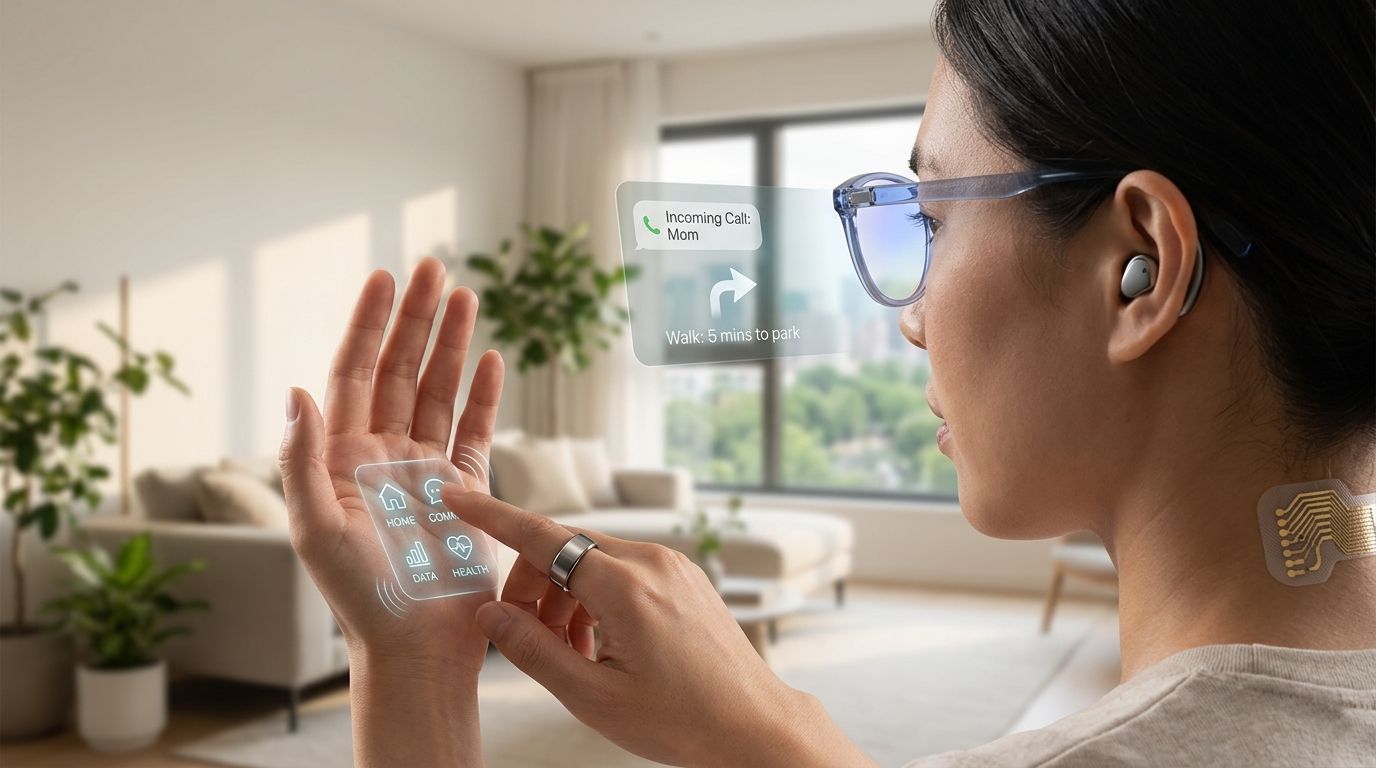
It’s hard to imagine life before the black rectangle. For over two decades, the smartphone has been our portal, our brain, our calendar, and our constant companion. But technology never stands still, and we are now on the cusp of an inflection point. Just as the personal computer was superseded by mobile, and the phone became smart, we are witnessing the emergence of devices that could, in the next ten to fifteen years, make the smartphone an artifact. This shift isn’t just about faster speeds; it’s about a fundamental change in human-computer interaction.
The Reign of Wearables: Intelligence You Don’t Have to Hold
The first phase of the post-smartphone era is already among us: wearable technology. While smartwatches are a common sight, they are currently often tethered to a phone. The real shift happens when these devices achieve full independence.
Leading this charge are independent smart glasses. The market for augmented reality (AR) glasses is projected to explode from a valued $26.6 billion in 2025 to over $111.2 billion by 2034. These are not bulky headsets; they are becoming stylish, all-day-wearable, optical see-through devices with built-in AI. Imagine a lightweight pair of glasses that overlays critical information directly onto your field of vision: a navigation arrow pointing to your next meeting, a real-time translation of a street sign in a foreign country, or the detailed health stats of a patient. These devices will use miniaturized displays, and powerful ‘edge AI’ to minimize latency and manage on-device data.
But the shift goes deeper than just vision. Independent earpieces and smart rings are set to become your primary interface. They work on a ‘voice-first’ and ‘gesture-first’ model. You speak commands and receive answers in your ear, with no screen required. Smart rings can track your health with far more accuracy than a wrist device and enable micro-gestures—a simple pinch in the air to scroll, a wave to ‘like’.
Spatial Computing: The World is Your Screen
The logical conclusion of AR and wearable tech is Spatial Computing. This is the dissolving of the barrier between the physical and the digital. The term, popularized recently by the introduction of high-end headsets, describes an ecosystem where every surface is potentially interactive.
With Spatial Computing, you are no longer limited by a 6-inch screen. You can have multiple virtual monitors floating around your desk, resize an incoming call to fit an entire wall, and play complex 3D games that use your entire home as the map. The spatial web allows information to be anchored to real-world objects. A chef can see an interactive recipe projected directly onto the cutting board, a mechanic can see the schematic overlaid on the engine, and a remote team can collaborate in a shared virtual workspace where their holograms are as good as real.
The Ultimate Shift: Neural Interfaces and Beyond
Looking further into the future, we encounter technologies that seem like science fiction but are already in human trials. Brain-Computer Interfaces (BCIs) offer a direct, seamless link between your thought patterns and digital commands. Early systems focus on restoration—allowing paralyzed users to text, browse, and control devices with thought alone. As this technology matures, non-invasive BCIs, perhaps integrated into headwear, could allow you to interact with your ambient digital ecosystem without ever moving a muscle, making “thought” the final form of interaction.
The post-smartphone world is not defined by one device, but by the convergence of many, designed to be invisible and integrated. The rectangle’s time is almost up.
