Close Menu
TechZappi

    Subscribe to Updates

    Get the latest creative news from FooBar about art, design and business.

    What's Hot

    Quantum Computing Explained – The Technology Rewriting the Rules of What’s Possible

    May 6, 2026

    The Future of Autonomous Vehicles – What the Next Decade Actually Looks Like

    May 6, 2026

    The AI Tools That Are Actually Helping Students in 2026

    May 6, 2026
    Facebook X (Twitter) Instagram
    Facebook X (Twitter) Instagram Vimeo Pinterest YouTube
    TechZappi
    Subscribe Login
    • Home
    • AI

      The AI Tools That Are Actually Helping Students in 2026

      May 6, 2026

      8 AI Startups Quietly Reshaping the World in 2026

      April 22, 2026

      Beyond the Hype: How AI is Actually Changing Productivity, 2024 Edition

      April 16, 2026

      AI Is Already Changing the World – Here’s How It’s Actually Playing Out

      April 8, 2026

      The AI Tools Actually Worth Your Time in 2026

      April 1, 2026
    • Technology
      1. AI
      2. Cybersecurity
      3. Crypto
      4. App
      5. Security
      6. View All

      The AI Tools That Are Actually Helping Students in 2026

      May 6, 2026

      8 AI Startups Quietly Reshaping the World in 2026

      April 22, 2026

      Beyond the Hype: How AI is Actually Changing Productivity, 2024 Edition

      April 16, 2026

      AI Is Already Changing the World – Here’s How It’s Actually Playing Out

      April 8, 2026

      The Most Dangerous Malware Active Right Now – 2026 Report

      May 1, 2026

      Don’t Take the Bait – How to Spot and Stop Phishing Attacks in 2026

      April 22, 2026

      Your Bank Details Aren’t as Safe as You Think – Here’s How Hackers Get Them

      March 31, 2026

      They Stole Billions — The Cyber Attacks That Changed Everything

      March 25, 2026

      Robinhood Acquires Bitstamp for $200M to Bolster Crypto Presence

      July 18, 2024

      CoinDCX Expands Globally with Acquisition of BitOasis

      July 4, 2024

      IRS Finalizes New Regulations for Crypto Tax Reporting

      July 4, 2024

      EU Privacy Decision Looms for Worldcoin Amid Ongoing Controversy

      June 4, 2024

      The Best Antivirus Software in 2026 – Tested, Ranked, and Worth Your Money

      April 7, 2026

      Google Expands Gemini AI Across Docs, Sheets, Slides, and Drive

      March 10, 2026

      William Shatner Helps Launch X Money Beta With Charity Auction

      March 4, 2026

      Nearby Glasses App Warns You if Someone Close Is Wearing Smart Glasses

      March 2, 2026

      The Best Antivirus Software in 2026 – Tested, Ranked, and Worth Your Money

      April 7, 2026

      Kaspersky to Cease US Operations and Lay Off Employees Following Government Ban

      July 17, 2024

      Data Breach Exposes Millions of mSpy Customers’ Data

      July 12, 2024

      HealthEquity Describes Data Breach as an ‘Isolated Incident’

      July 4, 2024

      Quantum Computing Explained – The Technology Rewriting the Rules of What’s Possible

      May 6, 2026

      The Future of Autonomous Vehicles – What the Next Decade Actually Looks Like

      May 6, 2026

      The AI Tools That Are Actually Helping Students in 2026

      May 6, 2026

      The Most Dangerous Malware Active Right Now – 2026 Report

      May 1, 2026
    • Contact
    TechZappi
    Home » Quantum Computing Explained – The Technology Rewriting the Rules of What’s Possible
    Technology

    Quantum Computing Explained – The Technology Rewriting the Rules of What’s Possible

    May 6, 20265 Mins Read
    Facebook Twitter Pinterest LinkedIn Tumblr WhatsApp VKontakte Email
    Share
    Facebook Twitter LinkedIn Pinterest Email

    Most explanations of quantum computing either oversimplify it into magic or drown you in physics. Let’s try something different: explaining what it actually does, why it matters right now in 2026, and what all the recent headlines from Google, IBM, and Microsoft actually mean.


    Start Here: Why Normal Computers Hit a Wall

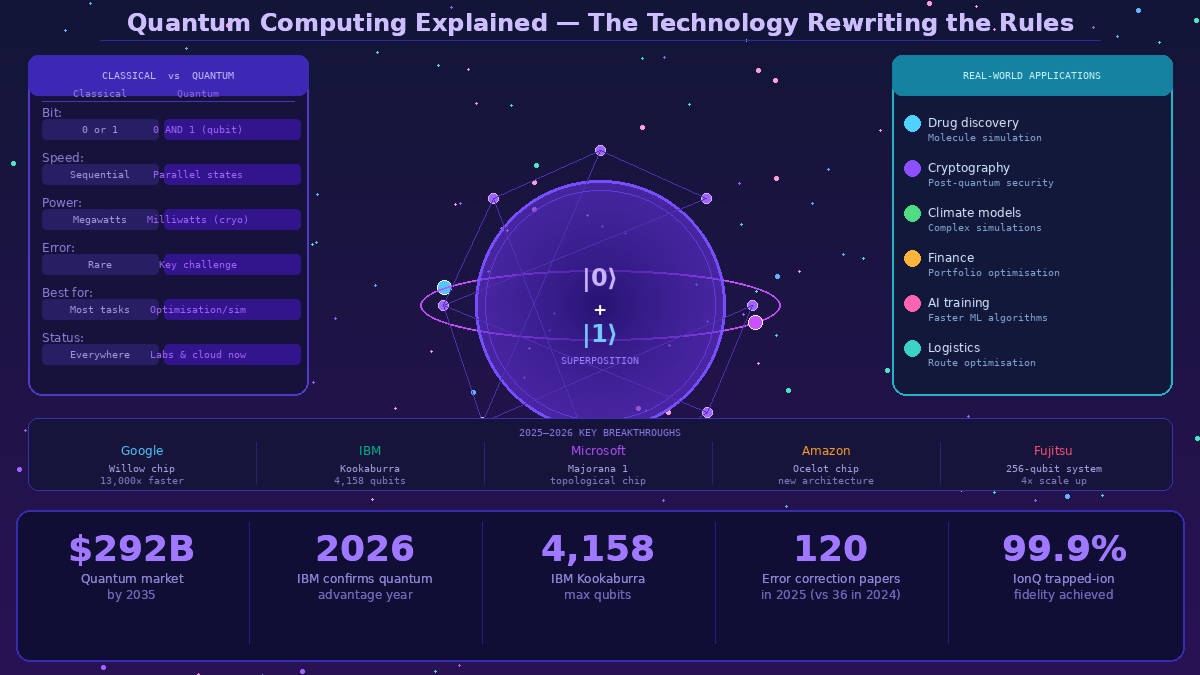
    Classical computers — the one you’re reading this on — process information as bits. A bit is either a 0 or a 1. Everything your computer does, from displaying this page to running a financial model, boils down to billions of those binary choices happening very fast.

    For most problems, this works beautifully. But certain problems don’t get easier with more computing power — they get exponentially harder. Simulating how a drug molecule interacts with a protein receptor involves tracking the behaviour of every electron in every atom simultaneously. The number of possible states is so enormous that even the most powerful classical supercomputer can only approximate the answer. For the exact solution, you’d need a computer running for longer than the age of the universe.

    Quantum computers approach this differently.


    What a Qubit Actually Does

    Instead of a bit that’s either 0 or 1, a quantum computer uses qubits. A qubit can exist in a superposition of 0 and 1 simultaneously — exploring multiple states at once rather than one at a time. Two qubits can represent four states simultaneously. Ten qubits can represent 1,024 states. Scale that up and you start to see why quantum computers are genuinely different rather than just faster.

    The second key property is entanglement. Two qubits can be quantum-entangled, meaning the state of one instantly affects the state of the other regardless of the distance between them. This allows quantum computers to correlate information across qubits in ways that have no classical equivalent.

    The third is interference. Quantum algorithms are designed to amplify correct answers and cancel out wrong ones using wave-like interference patterns — similar in concept to how noise-cancelling headphones work.

    Together, these three properties allow quantum computers to tackle specific classes of problems — particularly optimisation, simulation, and cryptography — with an efficiency that classical computers physically cannot match.


    Where It Stands in 2026

    This isn’t speculative. The milestones are real and they’re accelerating.

    In late 2024, Google announced its Willow quantum chip, which runs a specific algorithm — the out-of-time-order correlator — 13,000 times faster than classical supercomputers. In November 2025, IBM unveiled its roadmap toward the Kookaburra processor: a multi-chip system connecting three quantum chips into a 4,158-qubit configuration via quantum communication links. IBM confirmed it anticipates the first verified quantum advantage — meaning a quantum computer outperforming classical systems on a commercially relevant problem — will be confirmed by the end of 2026.

    Microsoft released its Majorana 1 chip, using a completely different approach called topological qubits that are theoretically more stable. Amazon released its Ocelot chip with a novel architecture for error correction. Fujitsu and RIKEN in Japan unveiled a 256-qubit superconducting system in April 2025 — four times the scale of their 2023 system — with a 1,000-qubit machine planned for 2026.

    The error correction problem, which has been quantum computing’s central obstacle for years, is also moving fast. 120 peer-reviewed papers on quantum error correction were published in the first ten months of 2025, compared to 36 in all of 2024. IonQ’s trapped-ion systems achieved 99.9993% accuracy — a level that makes fault-tolerant computation genuinely plausible rather than theoretical.


    What It Will Actually Be Used For

    The applications that are closest to commercial reality aren’t the ones that grab headlines.

    Drug discovery is probably the most immediate. IBM partnered with RIKEN in 2025 to simulate molecules using the IBM Quantum Heron processor alongside the Fugaku supercomputer — achieving results beyond the capability of classical-only systems. Finding molecules that fit specific biological targets underpins all pharmaceutical development. Quantum simulation could compress drug discovery timelines from a decade to a fraction of that.

    Cryptography is urgent in the opposite direction. Much of the encryption protecting internet traffic today — including HTTPS — relies on mathematical problems that quantum computers will eventually be able to solve quickly. The National Institute of Standards and Technology published its first post-quantum cryptography standards in 2024, and organisations that handle sensitive long-term data need to start transitioning now, because data stolen today could be decrypted once sufficiently powerful quantum machines arrive.

    Optimisation problems — logistics routing, supply chain design, financial portfolio management, energy grid balancing — are the third major category. These problems involve finding the best solution among an astronomical number of possibilities. Quantum computers, even at current capability, can find near-optimal solutions to versions of these problems faster than classical approaches.


    What It Isn’t — Yet

    The honest caveat is important. Quantum computers don’t replace classical computers. For the vast majority of tasks — running software, sending emails, browsing the web — a classical computer does the job perfectly and a quantum computer would be slower and far more expensive. Quantum computers need to operate at temperatures close to absolute zero, which requires cryogenic cooling infrastructure. They’re still fragile, expensive, and accessible mainly through cloud platforms.

    Full fault-tolerant, general-purpose quantum computing — capable of running any algorithm without errors — is IBM’s target for 2029 at the earliest. General availability for commercial applications is probably a 2030s story.

    But the “someday” framing no longer fits. The UN named 2025 the International Year of Quantum Science. The market is projected to reach $292 billion by 2035. The breakthroughs are happening now, not in fifteen years.

    The question isn’t whether quantum computing matters. It’s whether your industry will be ready when it arrives at scale.

    Trends
    Share. Facebook Twitter Pinterest LinkedIn Tumblr WhatsApp Email
    Previous ArticleThe Future of Autonomous Vehicles – What the Next Decade Actually Looks Like
    admin
    • Website

    Related Posts

    The Future of Autonomous Vehicles – What the Next Decade Actually Looks Like

    May 6, 2026

    The AI Tools That Are Actually Helping Students in 2026

    May 6, 2026

    The Most Dangerous Malware Active Right Now – 2026 Report

    May 1, 2026

    The Best Password Managers of 2026 – Tested, Ranked, No Fluff

    May 1, 2026
    Leave A Reply Cancel Reply

    Our Picks

    The Future of Autonomous Vehicles – What the Next Decade Actually Looks Like

    May 6, 2026

    The AI Tools That Are Actually Helping Students in 2026

    May 6, 2026

    The Most Dangerous Malware Active Right Now – 2026 Report

    May 1, 2026

    Are Driverless Cars Actually Safe? The Data Says Yes – Mostly

    April 22, 2026
    • Facebook
    • Twitter
    • Pinterest
    • Instagram
    • YouTube
    • Vimeo
    Don't Miss
    Technology

    Quantum Computing Explained – The Technology Rewriting the Rules of What’s Possible

    May 6, 2026

    Most explanations of quantum computing either oversimplify it into magic or drown you in physics.…

    The Future of Autonomous Vehicles – What the Next Decade Actually Looks Like

    May 6, 2026

    The AI Tools That Are Actually Helping Students in 2026

    May 6, 2026

    The Most Dangerous Malware Active Right Now – 2026 Report

    May 1, 2026

    Subscribe to Updates

    Get the latest creative news from SmartMag about art & design.

      About Us
      About Us

      TechZappi is your go-to source for the latest tech news, digital trends, and innovation stories. We cover topics ranging from AI and apps to cybersecurity and online tools, helping readers stay informed about what’s happening in the technology world.

      Our Picks

      The AI Tools That Are Actually Helping Students in 2026

      May 6, 2026

      The Most Dangerous Malware Active Right Now – 2026 Report

      May 1, 2026

      8 AI Startups Quietly Reshaping the World in 2026

      April 22, 2026

      Subscribe to Updates

      Get the latest creative news from Techzappi about Ai, Apps and Cybersecurity.

        Facebook X (Twitter) Instagram Pinterest Vimeo YouTube
        • Home
        • AI
        • App
        • Cybersecurity
        © 2026 TechZappi. All Rights Reserved.

        Type above and press Enter to search. Press Esc to cancel.

        Sign In or Register

        Welcome Back!

        Login to your account below.

        Lost password?