



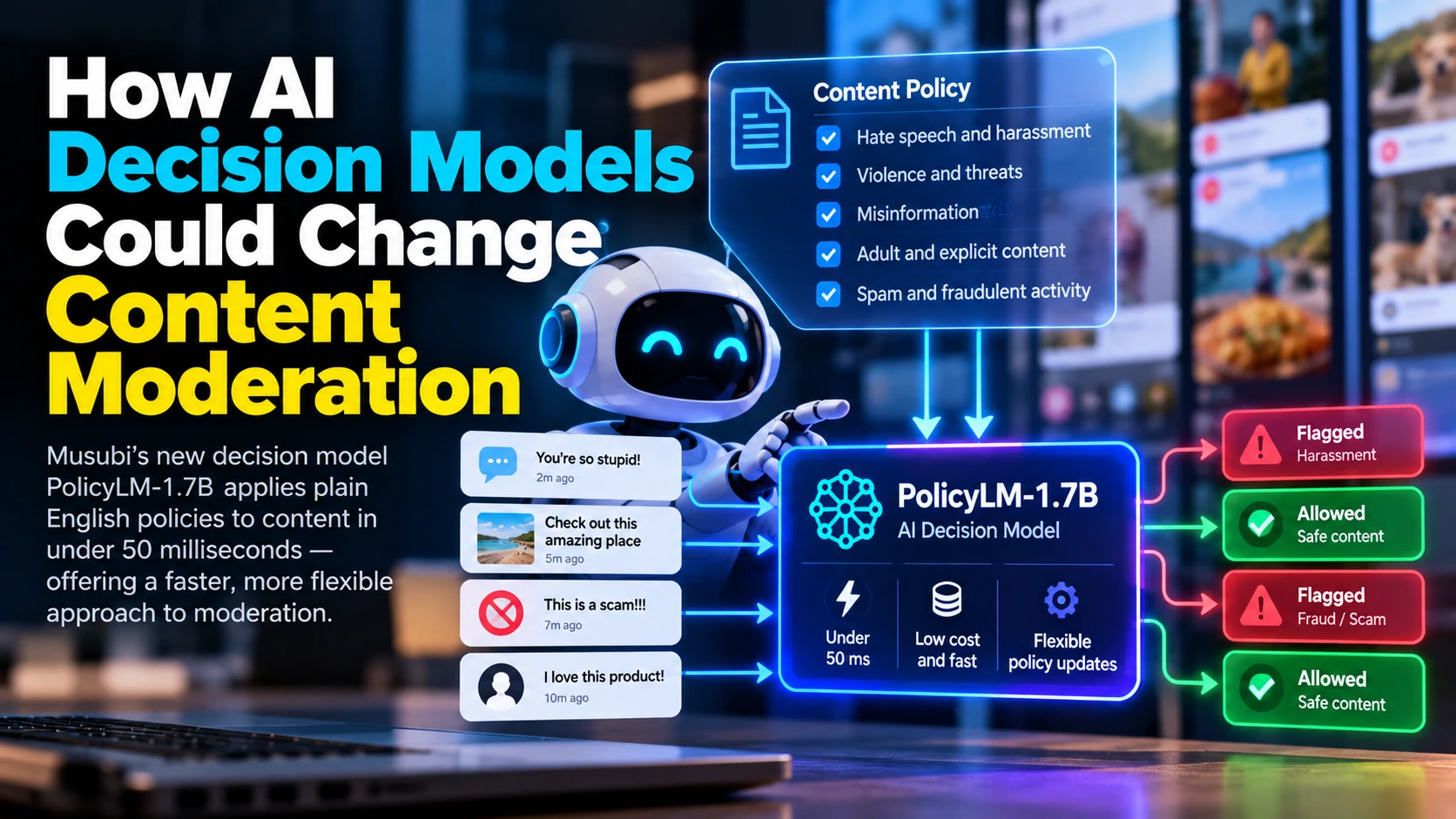
AI companies are increasingly experimenting with decision models that are designed to make fast, structured judgments instead of generating text. Now, startup Musubi is applying the technology to one of the internet’s biggest challenges: content moderation.
The company has introduced PolicyLM-1.7B, a lightweight decision model released with open weights that is designed to evaluate online content in real time.
Turning Written Policies Into Automated Decisions
PolicyLM-1.7B is designed to take a content policy written in plain English and apply it to individual messages in less than 50 milliseconds.
That could make it useful for social platforms that need to process huge volumes of posts, messages, and other user-generated content.
Traditional moderation systems often rely on relatively simple AI classifiers that are fast and inexpensive but can struggle when policies become complicated. Larger language models can understand more nuanced instructions, but they are generally more expensive and slower to operate at massive scale.
Musubi is attempting to combine some of the advantages of both approaches.
Its model is designed to interpret complex policies while maintaining the speed and cost characteristics expected from moderation classifiers.
Policies Can Change Without Retraining
One of the more interesting aspects of the system is that platforms wouldn’t necessarily need to retrain the model every time their moderation rules change.
Instead, human policy teams could update the written rules and have the decision model apply the revised policy.
That could give moderation teams more flexibility to experiment with policies and respond quickly when new types of harmful or unwanted content appear.
Musubi co-founder and chief AI officer Filip Jankovic says the goal is to help platforms understand and label increasingly large amounts of content in a customizable way.
As platforms generate more user content—and increasingly have AI agents producing content as well—the ability to classify that material quickly could become increasingly important.
Why Decision Models Are Gaining Attention
Decision models have attracted considerable interest in the AI industry following the release of TypeSafe AI’s Jev in September, followed by similar systems from OpenAI and Amazon.
Unlike conventional chatbots and generative AI systems, decision models aren’t primarily designed to produce paragraphs of text. Instead, they return structured outcomes or probabilities.
For moderation, that can be as simple as determining whether a piece of content falls into a particular category.
By limiting the possible outputs, these models can potentially operate faster and more cheaply than large language models, while retaining some of the flexibility associated with modern transformer-based architectures.
From AI Agents to Human Content
One early application for decision models has been controlling or monitoring the behavior of AI agents.
Applying similar technology to human-generated content is therefore a natural next step.
Platforms could potentially use models such as PolicyLM to classify messages, identify policy violations, and help moderation teams understand what is happening across their services without sending every piece of content through a large general-purpose AI model.
Jankovic says his interest in this type of technology actually predates the recent surge in decision models. He points to GLiNER, a 2024 project focused on general-purpose named-entity recognition, as an earlier example of techniques that influenced his thinking.
Open Weights Could Make the Approach More Accessible
Musubi is releasing PolicyLM-1.7B with open weights, allowing organizations to run and experiment with the model themselves.
That could be particularly useful for companies that don’t want to send sensitive user content to an external AI provider for moderation.
The broader appeal of decision models may ultimately come from their ability to sit between simple machine-learning classifiers and large language models: more flexible than traditional moderation systems, but potentially faster and cheaper than using a full-scale LLM for every decision.
As online platforms deal with growing volumes of human and AI-generated content, that middle ground could become an increasingly important part of the moderation stack.


