


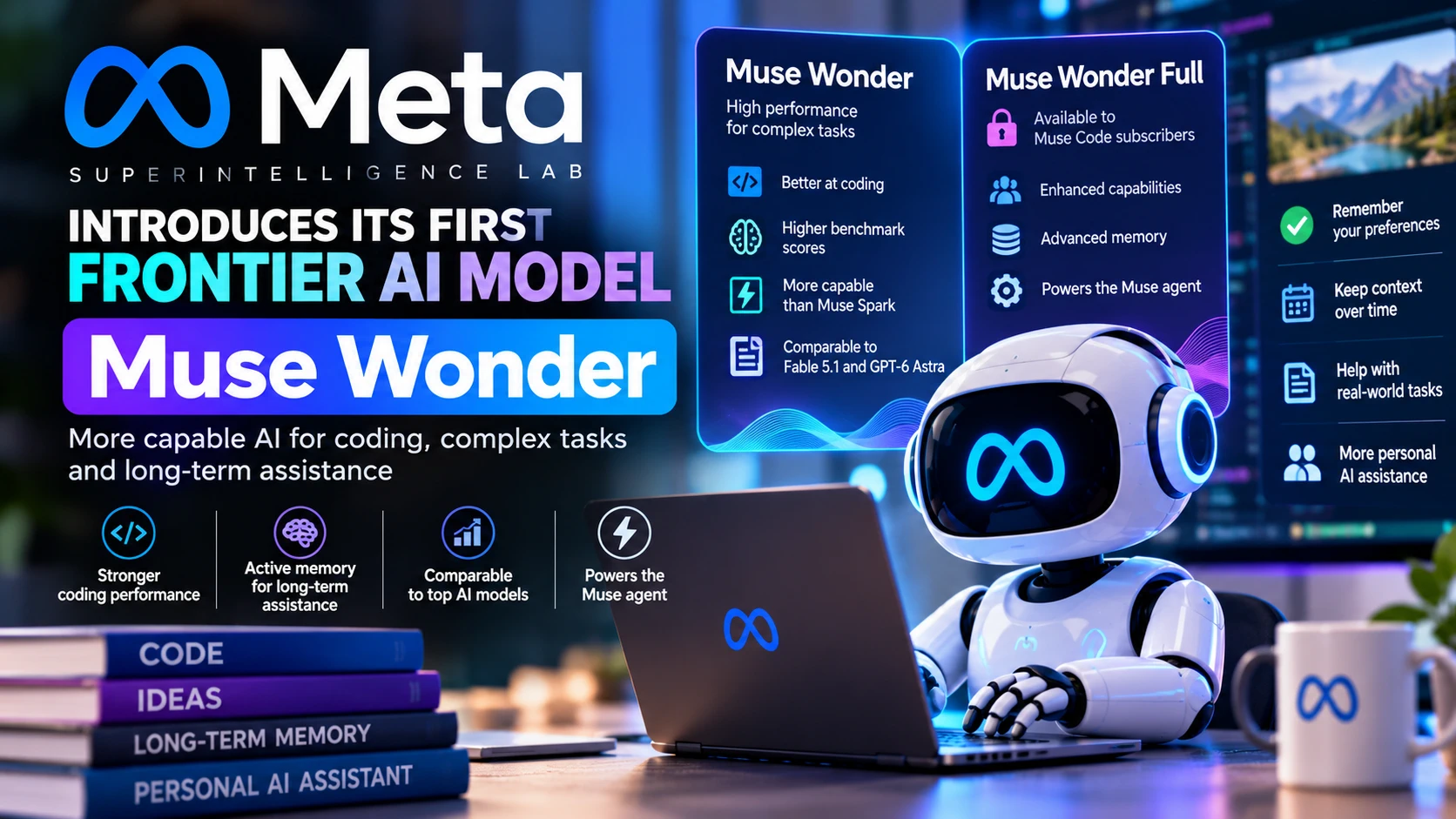
Meta is stepping up its artificial intelligence ambitions with the launch of Muse Wonder and Muse Wonder Full, two advanced AI models that mark the company’s first major move into the frontier-model category.
Released by Meta’s Superintelligence Lab, the models are designed to deliver stronger performance than the company’s earlier, lightweight Muse Spark model, particularly when handling demanding tasks such as software development, complex reasoning, and long-running interactions.
Bigger Models Target More Complex Tasks
Muse Spark was built with speed and low latency in mind. The new Wonder models take a different approach, prioritizing greater capabilities and improved performance on demanding workloads.
According to Meta’s published evaluations, Muse Wonder and Wonder Full achieve benchmark results comparable to those of competing models, including Fable 5.1 and GPT-6 Astra.
Meta describes the release as another step toward its broader ambition of developing personal superintelligence—AI systems capable of understanding users and helping them accomplish increasingly complex tasks.
The company has also introduced a pricing structure for API access to Muse Wonder. Through the Meta Model API, the model costs $4 per million input tokens and $20 per million output tokens.
Wonder Full, meanwhile, will be available exclusively to Muse Code subscribers rather than through the API. Both models are also intended to power Meta’s Muse AI agent.
Active Memory Is a Major Focus
One of the most notable features Meta is emphasizing is what it calls active memory.
The concept centers on an AI model’s ability to retain, organize, and synthesize information supplied by a user over extended periods. Rather than treating every interaction as an isolated conversation, the models are designed to remember relevant details across days, weeks, and months.
This capability could be especially important for personal AI assistants that manage ongoing projects, learn individual preferences, and help users with tasks that require context from previous interactions.
Meta highlighted the MemoryBench evaluation, which tests how well AI systems handle continual learning and memory construction. According to the company’s results, Muse Wonder outperformed Fable, Opus, and Astra on this benchmark.
Research scientist Kavya Kopparapu said the team invested considerable effort in helping the model retain the information that matters to users over longer periods.
Meta Is Expanding Its Frontier AI Efforts
The release represents a significant milestone in Meta’s evolving AI strategy.
Following a restructuring of its AI operations led by Alexandr Wang, the company introduced Muse Spark and its Muse agent but had not yet delivered a model release intended to compete directly with the leading frontier systems.
Muse Wonder and Wonder Full suggest Meta is now placing greater emphasis on advanced model capabilities alongside its consumer-facing AI products.
The company is also investing heavily in the computing infrastructure needed to train increasingly sophisticated systems.
Training Took Place at Meta’s Prometheus Data Center
Meta says the new models were trained at its Prometheus data center in central Ohio, a major infrastructure project that came online earlier this year.
Large-scale computing facilities are becoming increasingly important as AI companies compete to build models with stronger reasoning, coding, memory, and agent capabilities.
For Meta, the combination of larger models, improved memory, and its existing consumer ecosystem could help it develop AI assistants that are more personalized and capable over time.
The key test will be how Muse Wonder performs in real-world use, beyond benchmark scores. If its memory capabilities translate into more useful long-term assistance, Meta could strengthen its position in an increasingly competitive frontier AI market.


