



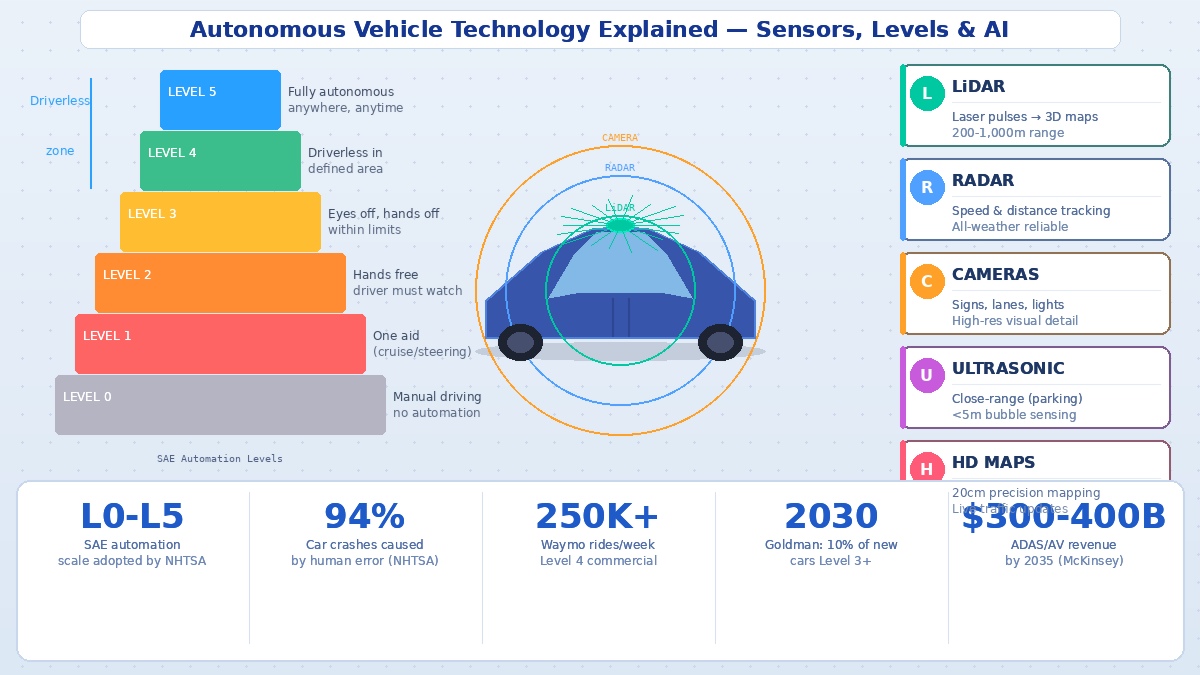
Self-driving cars generate more headlines than almost any other technology, but the coverage tends to cluster around dramatic crashes or ambitious predictions rather than the underlying mechanics. If you’ve ever wanted a clear, jargon-free explanation of how these vehicles actually work — what the sensors do, what the levels mean, and where the technology genuinely stands in 2026 — this is it.
Why This Technology Exists at All
Let’s start with the reason. NHTSA, the US road safety agency, estimates that 94% of serious car crashes involve human error — distraction, fatigue, impairment, misjudgement. Forty thousand people die on American roads every year. Autonomous vehicles exist because a system that doesn’t get tired, drunk, distracted, or emotionally reactive offers a potentially transformative safety advantage. That’s the entire argument in one paragraph, and it’s why governments, car companies, and technology firms have collectively spent hundreds of billions pursuing it.
The Six Levels of Automation
The Society of Automotive Engineers (SAE) defines six levels of driving automation, adopted as the global standard by the US Department of Transportation and used by regulators worldwide.
Level 0 is a regular car. You control everything.
Level 1 adds a single assistance feature — adaptive cruise control that maintains a set speed and following distance, or lane-keeping assistance that nudges you back into lane. The driver controls everything else.
Level 2 combines multiple assistance features that work simultaneously. The car handles steering, acceleration, and braking together on certain roads, but the driver must stay alert, watch the road, and be ready to take control instantly. Tesla’s Autopilot and Full Self-Driving are Level 2 despite the name — a licensed driver must supervise at all times.
Level 3 is where it gets genuinely different. The system handles driving in defined conditions, and the driver can genuinely look away — but must be available to take back control when the system asks. Mercedes-Benz’s Drive Pilot operates at Level 3 on approved German motorways at speeds up to 130 km/h. Honda offers Level 3 capability in its 0 Series. This is the level where legal responsibility begins shifting from driver to manufacturer.
Level 4 is fully driverless within a defined operational area. No human needed, no steering wheel required, no fallback to human control. Waymo, Zoox, and a handful of others operate commercially at Level 4 today — in specific cities, on mapped routes, within geofenced zones. Outside those zones, Level 4 vehicles stop and call for human assistance rather than attempting roads they haven’t been validated for.
Level 5 is the holy grail: fully autonomous in any condition, anywhere in the world, on any road, in any weather. No steering wheel. No pedals. No human required for any journey, ever. As of 2026, Level 5 does not exist in commercial form and most credible timelines place it well into the 2030s.
Goldman Sachs estimates that by 2030, up to 10% of global new car sales could be Level 3 vehicles. McKinsey projects ADAS and autonomous driving systems could generate $300-400 billion in revenues by 2035.
The Sensors: How a Car Sees the World
An autonomous vehicle builds its understanding of the world by fusing data from multiple sensor types simultaneously. Understanding each one is key to understanding the technology.
LiDAR (Light Detection and Ranging) fires rapid pulses of laser light in every direction and measures how long each pulse takes to return. This creates a precise, real-time 3D point cloud of everything within range — other vehicles, pedestrians, cyclists, road furniture, even fallen debris. Modern LiDAR systems on commercial vehicles have detection ranges of 200-1,000 metres. A 2026 review of sensor technologies published in MDPI Sensors confirmed LiDAR as the most capable single sensor for 3D environmental mapping, though cost and size have historically been limiting factors that newer solid-state designs are steadily reducing.
Radar works by emitting radio waves and measuring how they bounce back from objects. Its strengths are different from LiDAR: radar excels at measuring the speed and distance of moving objects and performs reliably in conditions where other sensors struggle — rain, fog, snow, direct sunlight. It doesn’t produce the detailed 3D picture that LiDAR does, but it’s essentially weatherproof and fast.
Cameras provide the high-resolution visual information that radar and LiDAR cannot — reading road signs, recognising traffic signals, identifying lane markings, detecting brake lights, and classifying objects at distance. Cameras are what Tesla relies on exclusively for its vision-first approach, arguing that humans drive with eyes and a trained neural network should be able to do the same.
Ultrasonic sensors handle close-range detection — typically within five metres. They’re the technology behind parking sensors and the beeping that warns you about objects immediately around the car. At higher speeds they become less useful, but for low-speed manoeuvres they provide the detailed bubble awareness that other sensors can’t match at short range.
HD Maps and GNSS provide the localisation layer — knowing exactly where the car is, not just to GPS accuracy (which can be off by several metres) but to within around 20 centimetres. High-definition maps store information about lane positions, speed limits, intersection geometry, and traffic patterns, updated in real time with live conditions. The vehicle continuously cross-references its sensor data against these maps to confirm its precise position.
Sensor Fusion: Where It All Comes Together
No single sensor is sufficient. Each has weaknesses the others cover. LiDAR can be confused by heavy rain. Cameras fail in darkness or fog. Radar struggles to classify what it’s detecting. Ultrasonic sensors are short-range only.
Sensor fusion — combining data from all of these sources simultaneously in real time — is the core technical challenge and the core technical achievement of modern autonomous systems. The 2026 academic literature review in MDPI Sensors confirmed that achieving Level 4 and Level 5 autonomy requires reliable, real-time integration of sensor data to handle complex driving environments. No single-sensor approach reaches that reliability bar in all conditions.
Tesla disagrees, betting its entire autonomous strategy on cameras only. Most other serious players in the industry — Waymo, Aurora, Zoox, Mobileye — combine multiple sensor types precisely because the redundancy is what enables genuine safety.
The AI That Makes Decisions
Sensors collect data. AI decides what to do with it. The onboard computers running autonomous vehicles perform several cognitive tasks simultaneously and continuously.
Perception identifies every object in the sensor data — this vehicle is a car, that shape is a cyclist, that movement is a child. Prediction models where every identified object is heading over the next few seconds. Planning determines the safest path for the vehicle given what’s around it and where it needs to go. And control translates the planned path into precise instructions — this much steering input, this braking pressure, this throttle position — executed in milliseconds.
Modern autonomous systems use end-to-end AI trained on millions of miles of real-world driving data. Waymo revealed in 2025 that its commercial fleet had transitioned to a single foundation model handling the entire process from sensor input to vehicle output. Tesla has used end-to-end training longest. The industry consensus has converged on this architecture as more capable than earlier modular approaches where each stage was a separate system.
Where Things Stand in 2026
Most vehicles on public roads are Level 0-2. Level 3 vehicles are beginning to enter consumer markets in Germany, Japan, and South Korea, where legal frameworks for Level 3 operation exist. Level 4 commercial robotaxi services operate in specific US cities — Waymo serves San Francisco, Los Angeles, Phoenix, and Austin at over 250,000 rides per week. Level 5 remains a future aspiration.
The technology is real and improving. The constraint in 2026 is not primarily capability — it’s the combination of regulatory frameworks, edge-case reliability, HD map coverage, and the enormous capital required to operate validated fleets at meaningful scale. Each of those gaps is closing, but none has closed yet.
The car that genuinely drives itself, anywhere, in any conditions, without any human involvement — the Level 5 promise — remains the horizon that everything else is moving toward, one tested kilometre at a time.


