



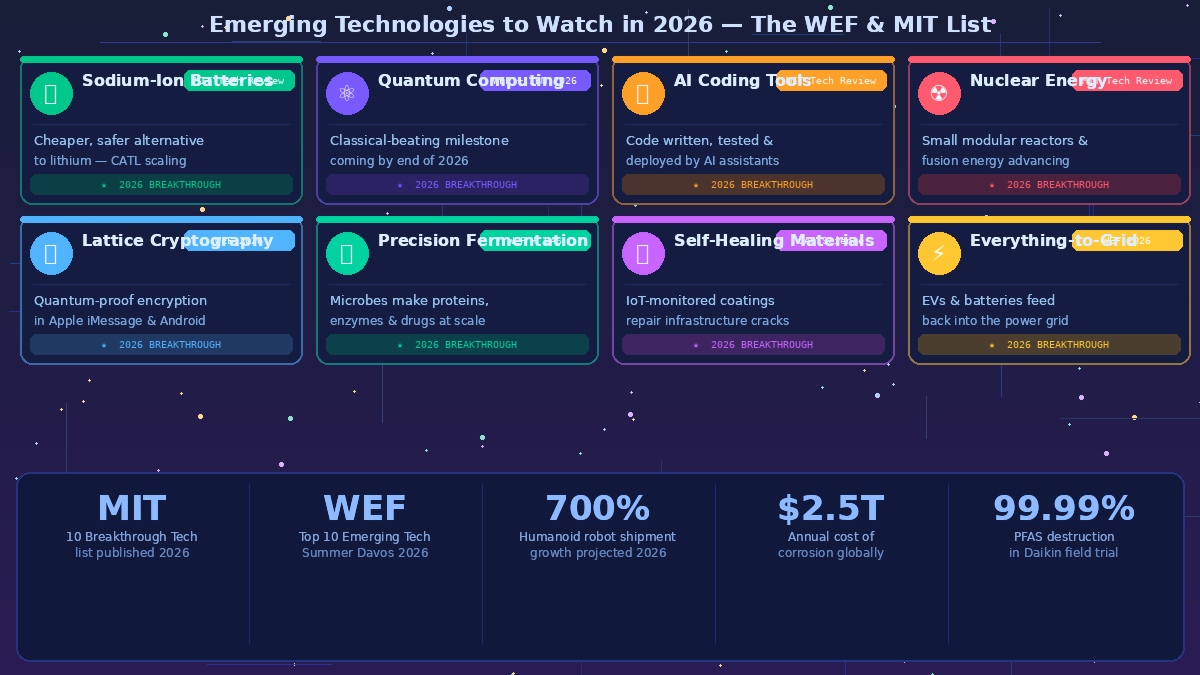
Every year produces hundreds of “emerging technology” lists. Most of them recycle the same ideas dressed up with new statistics. This one is different because it draws directly from the two most credible annual assessments of what’s genuinely moving from research into reality: MIT Technology Review’s 10 Breakthrough Technologies for 2026 and the World Economic Forum’s Top 10 Emerging Technologies, published at its Summer Davos event in June 2026. These aren’t predictions from tech bloggers — they’re selections made by editors, scientists, and researchers who have spent months debating what deserves attention and why.
Here are the eight breakthroughs they agree are worth your attention right now.
1. Sodium-Ion Batteries — The Energy Storage Revolution Nobody’s Talking About
MIT Technology Review named sodium-ion batteries one of its top breakthroughs for 2026, and the WEF included them in its emerging technologies report. The reason is straightforward: lithium-ion batteries are expensive, geographically concentrated, and environmentally costly to produce. Sodium-ion batteries are made from salt — abundant, cheap, and available everywhere.
CATL, the world’s largest battery manufacturer, has commercial deployment plans underway for 2026. The technology delivers slightly less energy density than lithium-ion but with better safety characteristics at high temperatures and dramatically lower production costs. For grid-scale energy storage and affordable electric vehicles in emerging markets, this could be the technology that removes the cost barrier that lithium-ion couldn’t solve.
2. AI Coding Tools — How Software Gets Built Is Changing
MIT Technology Review included AI coding tools on its 2026 list because the shift is already measurable and accelerating. Tools like GitHub Copilot, Cursor, Claude, and ChatGPT are changing not just how fast code gets written but what kinds of people can build sophisticated applications. Job postings for entry-level structured coding roles dropped 13% after ChatGPT launched. Demand for senior and architectural development work grew.
The tools handle the repetitive, pattern-based work of software development — generating boilerplate, writing tests, debugging syntax errors, suggesting refactors. What they can’t yet do is replace the architectural judgement, domain knowledge, and creative problem-solving that makes software genuinely good rather than just functional. But the leverage they give individual developers is unprecedented, and the resulting compression of software development timelines is being felt across every industry that builds digital products.
3. Nuclear Energy — Small Modular Reactors and Fusion
MIT’s list includes nuclear energy not because it’s new — nuclear has powered grids for 70 years — but because two genuinely new forms of it are advancing simultaneously in 2026. Small Modular Reactors (SMRs) are factory-built, smaller nuclear plants that can be deployed faster and more cheaply than traditional installations, with several companies including NuScale and Rolls-Royce moving toward commercial deployment. Fusion energy, which has been “20 years away” for decades, crossed a real milestone with the National Ignition Facility achieving ignition — energy out exceeding energy in — in 2022, and private companies including Commonwealth Fusion Systems are now targeting commercial fusion in the early 2030s.
Nuclear produces no carbon emissions and, in the case of fusion, no long-lived radioactive waste. In a world that needs clean, dispatchable power to replace fossil fuels, these developments matter enormously.
4. Quantum Computing — The Advantage Year
The WEF’s emerging technology report and multiple industry projections identify 2026 as the year quantum computing may deliver its first verified “quantum advantage” — a quantum system outperforming classical computing on a commercially meaningful problem. IBM’s Kookaburra processor targets 4,158 qubits. Google’s Willow chip has already demonstrated speed advantages on specific algorithms. Microsoft’s Majorana 1 topological chip offers a fundamentally different approach to error correction.
The applications closest to commercial reality are drug discovery, materials simulation, and financial portfolio optimisation — problems where the number of possible states is so enormous that classical computers can only approximate solutions. Lattice-based cryptography, which protects against quantum attacks, is already in Apple’s iMessage and planned for Android — a sign that the quantum security threat is being treated as imminent rather than hypothetical.
5. Lattice-Based Cryptography — Securing the Post-Quantum World
The WEF’s 2026 emerging technologies report highlights this specifically because the threat timeline has become concrete. Quantum computers with sufficient power will be able to break most of the encryption protecting internet traffic today — including HTTPS. Lattice-based cryptography is the leading candidate for post-quantum security: it hides data in complex mathematical structures and adds deliberate “noise” that makes the correct solution computationally indistinguishable from millions of false ones. The US National Institute of Standards and Technology published its first post-quantum cryptography standards in 2024. Apple already uses lattice-based approaches in iMessage. Google has announced plans to include it in Android. The window for organisations to transition their security infrastructure is narrowing faster than most IT teams appreciate.
6. Precision Fermentation — Microbes as Factories
The WEF’s June 2026 report includes precision fermentation as a technology crossing from research into commercial scale. Rather than using crops or animals to produce food proteins, enzymes, and pharmaceutical compounds, precision fermentation inserts the genetic instructions for producing these molecules into microbes like yeast or bacteria. The microbes then produce the target compound through controlled fermentation.
The outputs are chemically identical to their natural counterparts but produced without the land use, water consumption, or animal welfare concerns of conventional agriculture. Commercial applications include animal-free dairy proteins, egg proteins, and pharmaceutical compounds. As scaling improves and costs fall, precision fermentation could fundamentally change how we produce both food and medicine.
7. Self-Healing Materials — Infrastructure That Repairs Itself
CAS Science’s 2026 emerging trends report highlights self-healing materials as a breakthrough approaching commercial viability at industrial scale. The problem it addresses is significant: corrosion costs the global economy over $2.5 trillion annually, with bridges, pipelines, and marine infrastructure requiring constant reactive repair.
Self-healing coatings embed microcapsules of healing agents that rupture when damage occurs and polymerise to seal breaches within hours. Combined with IoT sensors that detect damage in real time, these materials enable a shift from reactive maintenance to predictive infrastructure management. Recent advances in microcapsule engineering have made these coatings stable enough to survive industrial application conditions — the technology is moving from laboratory to real-world deployment.
8. Everything-to-Grid Technology — Your Car as a Power Plant
The WEF’s 2026 report identifies vehicle-to-grid (V2G) and broader “everything-to-grid” technology as one of its ten emerging breakthroughs. The idea is straightforward but transformative: rather than large centralised power plants meeting peak electricity demand, distributed assets — electric vehicles, factory batteries, and data centre UPS systems — feed stored electricity back into the grid when demand spikes.
In California, 16,000 solar-equipped homes linked into a distributed electricity network pushed 51 megawatts back to the grid during a single evening demand peak in 2024 — exceeding the capacity of several fossil fuel-powered peaker plants, and without any emissions. As EV adoption grows, the fleet of electric vehicles becomes a distributed storage asset of enormous scale. The technology to coordinate that asset — the grid management software, the bidirectional chargers, the incentive structures — is what’s emerging in 2026.
What These Eight Have in Common
Every technology on this list is already real. None of them require scientific breakthroughs that haven’t happened yet. The question in each case isn’t whether they work — it’s whether they can scale, whether costs can fall far enough fast enough, and whether the regulatory and infrastructure environments develop alongside the technology itself.
That’s the honest meaning of “emerging”: not “speculative” but “past proof of concept and approaching the moment when investment and deployment decisions will determine whether the benefit reaches the world.” These eight technologies are at that moment right now.


