



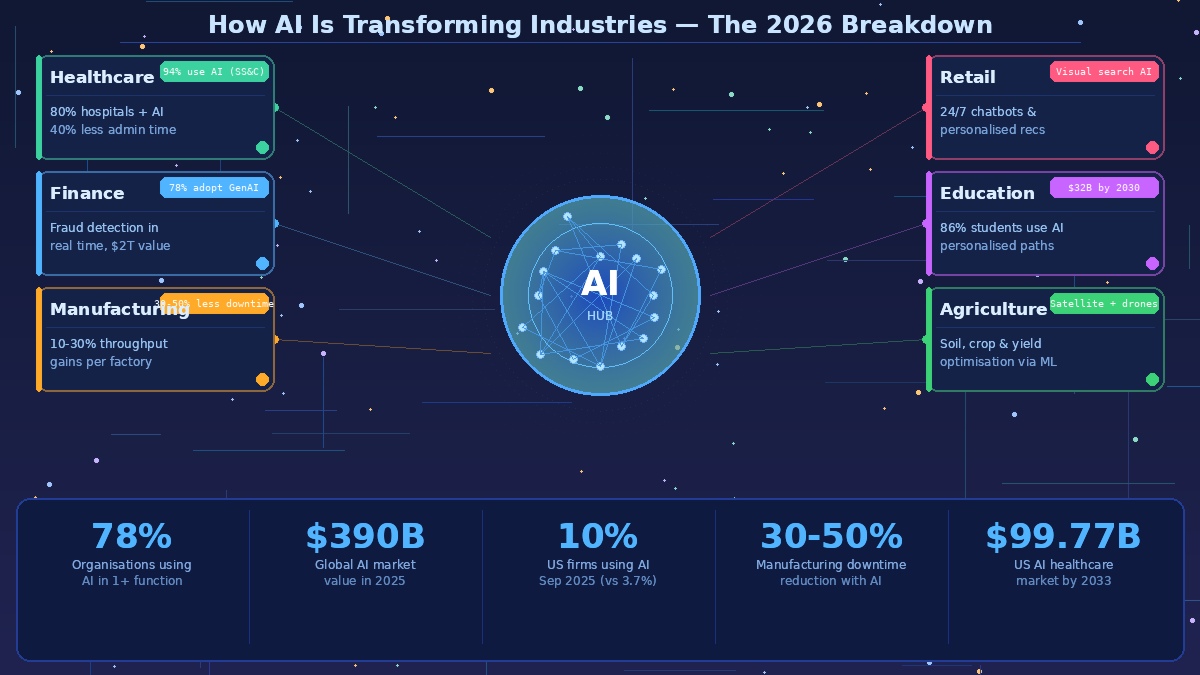
Something shifted in the past eighteen months. AI stopped being something companies were experimenting with and started being something they were running their operations on. McKinsey’s latest survey found that 78% of organisations now use AI in at least one business function — up from 55% just a year earlier. The global AI market reached $390.9 billion in 2025. The share of US firms using AI to produce goods and services jumped from 3.7% in late 2023 to 10% by September 2025.
This is no longer about future disruption. The transformation is already operational. Here’s how it’s playing out across six of the world’s most important industries.
Healthcare — The Highest-Stakes Transformation
94% of healthcare organisations now view AI as core to their operations, with 86% already using it extensively, and 92% of healthcare leaders believe automation helps address staffing shortages. Those numbers, from SS&C Blue Prism’s 2025 survey, reflect a sector that has crossed a threshold. Datarails
The applications are genuinely diverse. AI diagnostic systems are twice as accurate as professionals when examining brain scans of stroke patients in some settings. Microsoft’s Dragon Copilot transcribes clinical consultations and prepares notes, with pilot implementations showing it saves up to 40% of time spent on patient reviews — time clinicians can redirect to actual patient care. AI is accelerating drug discovery and enabling personalised treatment plans built from genomic data, medical records, and predictive analytics.
The US AI healthcare market alone is projected to grow from $7.72 billion in 2024 to $99.77 billion by 2033. The sector has produced more healthcare AI unicorns than any other vertical AI segment, including legal and financial services. The question has shifted from whether to deploy AI to how to integrate it responsibly into clinical workflows where the stakes are genuinely life-or-death.
Finance — The Fastest Adopter
The pace of change in financial services has been extraordinary. While only 8% of banks were developing generative AI systematically in 2024, 78% were adopting it tactically by 2025. The generative AI in banking market jumped from $1.3 billion in 2024 to $1.75 billion in 2025, projected to reach $5.74 billion by 2029.
AI’s clearest applications in finance are fraud detection and risk analysis. Financial services sustained more than 20,000 cyberattacks in 2023 alone, causing $2.5 billion in losses. AI-driven security systems now identify and respond to anomalous transactions in real time rather than hours or days after the fact.
Beyond security, AI is reshaping credit scoring — using broader datasets including real-time financial activity and behaviour patterns to make more accurate and more inclusive lending decisions. AI chatbots handle routine customer service at scale. Algorithmic trading systems process market signals faster than any human team. McKinsey estimates AI will add up to $2 trillion to the global economy through improved investment strategies, customer insight, and operational efficiency in financial services alone.
Manufacturing — Where ROI Is Most Measurable
In digitally enabled factories, AI solutions are delivering 30-50% reductions in machine downtime, 10-30% throughput gains, and 15-30% improvements in labour productivity. These aren’t projections — they’re operational results from factories that have deployed AI predictive maintenance and computer vision quality control. Datarails
The AI-in-manufacturing market was tracked at $33.48 billion in 2024 and is projected to reach $366.24 billion by 2032, growing at 36.12% annually. General Electric and Siemens both use AI to monitor equipment health across global operations, detecting early signatures of failure before they cause costly downtime. Computer vision systems identify production defects in seconds that previously required entire manual inspection teams. AI-powered robots have moved from following fixed instructions to learning, adapting, and improving on the assembly line over time.
The competitive dynamic here is stark: manufacturers adopting AI aggressively are reducing waste and lowering per-unit production costs faster than competitors still relying on manual processes. The gap is widening, not narrowing.
Retail — Personalisation at Every Touchpoint
In retail, AI is transforming how customers find products, how inventory is managed, and how customer service works. Visual search lets shoppers upload an image of something they want and find matching products instantly — brands like ASOS and Home Depot use this to dramatically improve product discovery. AI-powered chatbots handle customer enquiries, order processing, and personalised recommendations 24/7 without human intervention.
Behind the scenes, AI is making supply chains significantly more efficient by analysing historical sales data, market trends, and even weather patterns to forecast demand and prevent stock shortages or overstocks. Retailers deploying AI in demand forecasting consistently reduce both excess inventory costs and the lost sales from running out of popular items.
Education — Personalised Learning at Global Scale
Education AI spending reached $8.30 billion in 2025 and is expected to surpass $32 billion by 2030. The transformation here is centred on personalisation — the ability to deliver genuinely tailored learning experiences at scale that adapt to each student’s pace, gaps, and learning style.
86% of students already use AI tools while learning. The shift that’s happening isn’t students using AI to cheat — it’s AI tutoring systems providing the kind of adaptive, patient, one-on-one instruction that used to be available only to students who could afford private tutors. In higher education, AI is being integrated into curriculum design, administrative workflows, and research assistance. The institutions grappling hardest with this aren’t the ones worrying about cheating — they’re the ones redesigning assessment and teaching methods for a world where the first draft of almost everything can be AI-generated. Unified AI Hub
Agriculture — Precision Farming From Space
Precision agriculture powered by AI is transforming farming through evidence-based decision-making at a scale that would have been impossible even five years ago. Machine learning algorithms analyse satellite imagery, drone data, and soil sensor readings to optimise crop management decisions — when to irrigate, where to apply fertiliser, which areas face disease risk.
AI-powered demand forecasting is improving supply chain efficiency across the agricultural sector, reducing food waste and better connecting production with actual market demand. For a sector that feeds the world while dealing with growing climate pressures, the ability to use data more intelligently is becoming genuinely critical rather than simply incremental.
What These Industries Have in Common
The pattern across healthcare, finance, manufacturing, retail, education, and agriculture is consistent: the industries succeeding with AI aren’t necessarily replacing the most workers. They’re the industries using AI to improve speed, insight, productivity, forecasting, customer experience, and operational scale — while keeping humans where their judgement, empathy, and expertise actually matter.
The organisations moving slowly are beginning to feel measurable disadvantages. In manufacturing, the gap between AI-adopting and non-adopting competitors is visible in cost structures. In finance, the speed advantage of AI-driven fraud detection is material. In healthcare, the institutions that have integrated AI into administrative workflows have meaningfully more clinician time for patients. Datarails
AI has crossed from experimentation into operational infrastructure. The transformation isn’t complete — it’s barely begun in most sectors. But the direction is clear and the pace is accelerating.


