


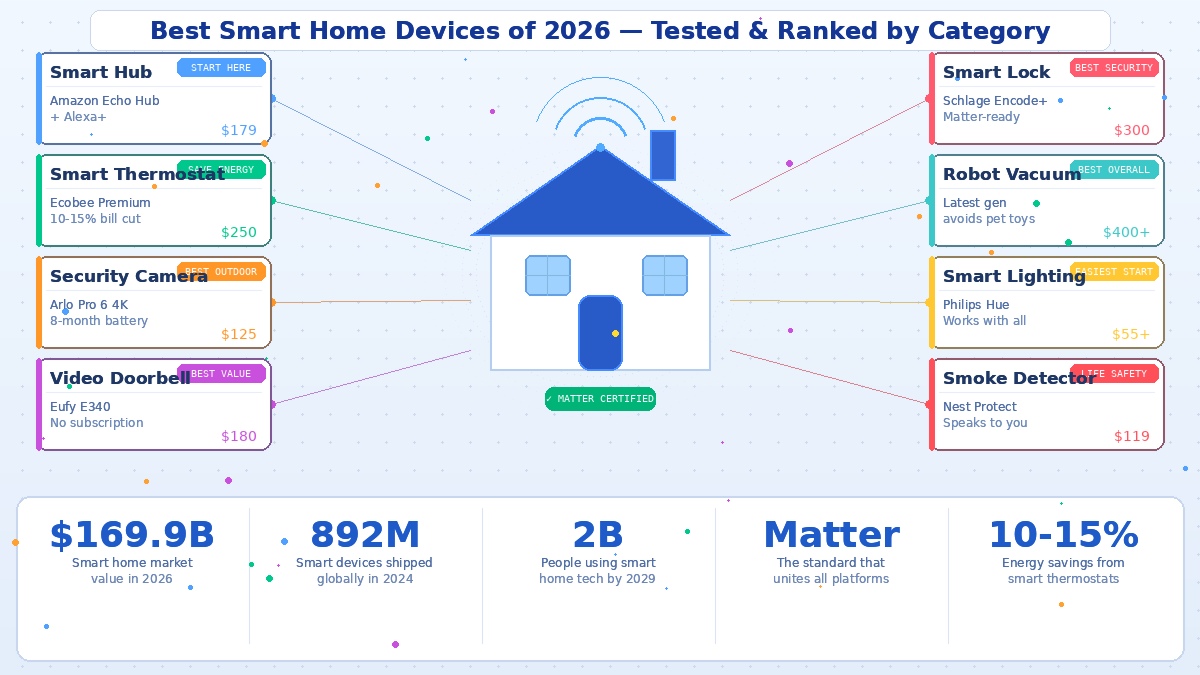
The smart home market has matured past the gimmick phase. The global market is valued at $169.9 billion in 2026, nearly 900 million smart devices shipped worldwide in 2024, and by 2029, close to two billion people are expected to be using smart home technology regularly. That’s not niche adoption. That’s mainstream infrastructure.
What’s also changed is the compatibility headache. The Matter standard — backed by Apple, Google, Amazon, and Samsung — has genuinely simplified the “will this work with that” problem that used to make smart homes frustrating. If you’re buying new devices in 2026, prioritise Matter-certified products. They work with any major platform you choose today and any you switch to later.
Here’s what’s actually worth buying, organised by category.
Smart Hub — Start Here
Before you buy anything else, pick your hub. It’s the platform that ties everything together. Amazon’s Echo Hub is the standout choice in 2026 — an 8-inch touchscreen specifically designed to control your entire smart home from one place, with the upgraded Alexa+ AI adding more natural conversation and proactive suggestions. It natively supports Matter, Zigbee, Z-Wave, and Thread, covering virtually every smart home protocol in one device. With compatibility across 140,000+ devices, no other platform comes close to Alexa’s breadth.
Google Home is the strongest choice if you’re already in Google’s ecosystem — Gmail, Android, Chromecast, and Nest devices integrate seamlessly. Apple HomeKit is the most privacy-focused option, processing many Siri requests on-device, and works particularly well for iPhone households. And for technically inclined users who want full local control with no subscription and complete privacy, Home Assistant Green runs everything locally on your own network — your smart home works even when the internet is down.
Smart Thermostat — The Device That Pays for Itself
The latest smart thermostats genuinely shave 10-15% off energy bills by learning your schedule, integrating weather data, and adjusting automatically when you leave the house. That’s not a marketing figure — it’s the consistent finding across independent testing in 2026.
The Ecobee Smart Thermostat Premium earns consistently top rankings this year. It includes a remote room sensor, has an embedded Alexa speaker, works with Matter, and integrates with every major smart home platform. Google Nest Learning Thermostat remains an excellent alternative, particularly for homes already using Nest cameras or speakers. Both have paid for themselves within a year or two in most climates.
Security Camera — Best Outdoor Pick
The Arlo Pro 6, launched in late 2025, is what multiple reviewers called one of the best wireless outdoor cameras available in 2026. The improvements over its predecessor are meaningful: up to eight months of battery life per charge, USB-C charging, upgraded AI detection, 2K HDR video, a 160-degree field of view, colour night vision, and two-way audio. Its Arlo Intelligence system differentiates people, vehicles, and animals with enough accuracy to significantly reduce nuisance notifications.
For budget-conscious buyers, the TP-Link Tapo C460 delivers 4K video with AI motion detection, 200 days of battery life, and no subscription required for basic alerts — at a considerably lower price point.
Video Doorbell — No Subscription Required
The Eufy Video Doorbell E340 stands out in 2026 for one increasingly rare reason: it doesn’t require a monthly subscription for local storage of footage. It delivers dual-lens coverage — one lens for faces, one for package-level detail — and two-way communication with clear audio. Ring and Nest doorbells remain strong choices for users already in those ecosystems, but if you want to avoid recurring fees, Eufy is the standout pick.
Smart Lock — Peace of Mind at the Door
The Schlage Encode Plus is the smart lock benchmark in 2026. It supports Matter natively, connects directly to your Wi-Fi without requiring a hub, and allows entry via keypad, app, Apple Home Key, or traditional key. The build quality is exceptional and the encryption robust. Yale’s Assure Lock 2 is a strong alternative at a slightly lower price point and similarly wide platform support.
One practical note: buy a Matter-compatible lock. Non-Matter locks tie you to a single ecosystem, and switching later requires replacing the hardware entirely.
Robot Vacuum — Navigation Finally Works
Navigation has improved dramatically. As one tester put it, robot vacuums now “finally avoid pet toys and phone chargers most of the time” — which sounds like a low bar but represents years of genuine progress. The latest generation of high-end vacuums from Roborock and Ecovacs include combined vacuuming and mopping, obstacle avoidance that actually handles cluttered rooms, and mapping that remembers room names and lets you send the vacuum to a specific area on command. They’re not cheap at the top end, but the convenience gains are real and consistent.
Smart Lighting — The Easiest Place to Start
If you want a quick, low-risk introduction to smart home technology, smart lighting is it. Plug in a smart bulb, download an app, and you have voice control, scheduling, and colour temperature adjustment within five minutes. Philips Hue remains the most compatible ecosystem, working with Alexa, Google, Apple, and Matter. Govee and LIFX offer more affordable entry points that cover the basics without the premium cost.
Lighting automations also provide some of the most immediately satisfying smart home experiences — lights that gradually dim in the evening, turn on when you arrive home, or turn off automatically when a room has been empty for ten minutes.
Smoke Detector — The One You Should Never Skip
The Google Nest Protect earns its reputation. Rather than sounding a piercing alarm the moment it detects smoke, it speaks to you first in a calm human voice — “Heads up, there is smoke in the kitchen” — giving you the chance to identify a burnt piece of toast before evacuating the house. It detects both fast-burning and slow-smouldering fires, sends push notifications to your phone when you’re away, and runs self-tests daily. At $119, it’s not cheap for a smoke detector, but it’s the one category where premium hardware has genuine life-safety implications.
The Rule That Matters Most
One principle is consistent across every expert review published in 2026: the magic isn’t in having 100 devices — it’s in having 10 that work together perfectly. Choose your ecosystem first, prioritise Matter-certified products, and build the stack gradually around real needs rather than excitement about new gadgets.
The smart home of 2026 doesn’t have to be complicated. The best version of it is the one that genuinely makes your life easier — not the one with the most devices plugged in.


