


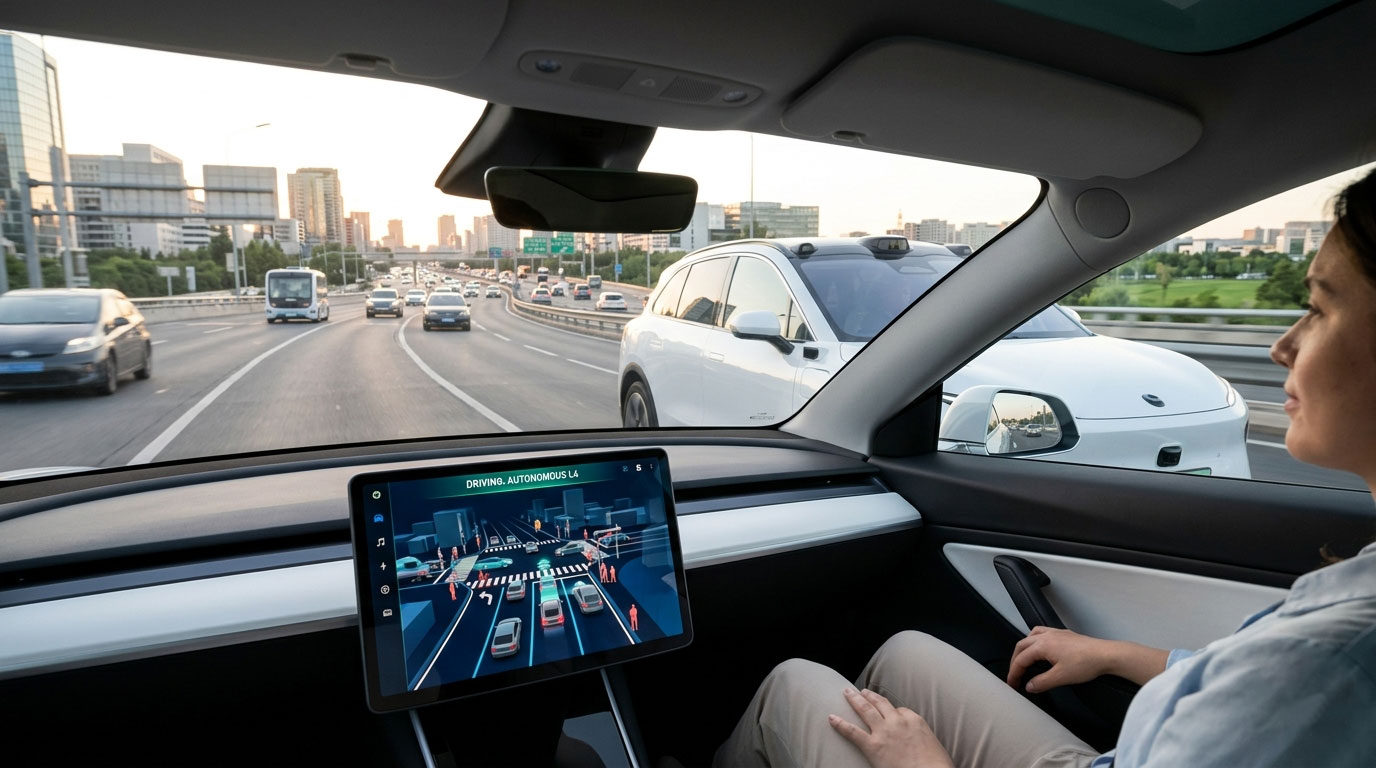
It feels like only yesterday that “self-driving cars” were a niche topic for sci-fi enthusiasts and tech billionaires. But as we move through 2026, the conversation has shifted. It’s no longer a question of if cars can drive themselves, but who is doing it best—and most safely.
The autonomous vehicle (AV) market has officially crossed the $360 billion mark this year, and the landscape is more competitive than ever. Here is a look at the companies currently leading the charge into a driverless future.
1. Waymo (Alphabet’s Crown Jewel)
If there is an undisputed heavyweight champion in 2026, it’s Waymo. While others have faced setbacks, Waymo has quietly scaled its “Waymo One” service to over 20 major U.S. cities.
What sets them apart is their relentless focus on Level 4 autonomy—meaning the car handles everything within a specific area. By early 2026, Waymo surpassed 20 million fully autonomous trips with public riders. Their hardware, which utilizes high-density LiDAR and 360-degree vision, has become the industry benchmark for safety, particularly in complex urban environments like San Francisco and Austin.
2. Tesla: The Data Juggernaut
Tesla’s approach remains the most unique—and the most debated. Unlike Waymo, which uses expensive sensors, Tesla relies entirely on “Vision” (cameras and AI).
With over 4 million Tesla vehicles on the road globally acting as data collectors, their AI learns from billions of real-world miles every month. In 2026, their Full Self-Driving (Supervised) v14 has reached a level of smoothness that many users describe as “human-like.” While it is still technically a Level 2 system requiring a human behind the wheel, its sheer scale makes it a massive player in the race toward consumer autonomy.
3. Mercedes-Benz: The Luxury of Letting Go
While Tesla and Waymo fight for the most miles, Mercedes-Benz has won the regulatory race. They were the first to legally offer Level 3 autonomy in the U.S. and Europe. Their DRIVE PILOT system allows drivers to literally take their eyes off the road during highway traffic jams at speeds up to 40-60 mph.
For the high-end consumer, Mercedes offers something no one else can: the legal right to check your emails or watch a video while the car handles the heavy lifting in stop-and-go traffic.
4. Baidu (Apollo Go): The Titan of the East
We can’t talk about self-driving without looking at China. Baidu’s Apollo Go is currently the world’s largest robotaxi provider by volume of cities served. By the start of 2026, they expanded their fully driverless operations to nearly 30 Chinese cities. Their integration with smart city infrastructure—where the car talks to the traffic lights—gives them an efficiency edge that Western companies are still trying to replicate.
5. Zoox (Amazon’s Bold Bet)
Zoox is the “wild card” that is finally paying off. Instead of retrofitting a standard car, Zoox built a symmetrical, bidirectional carriage where passengers sit facing each other. Owned by Amazon, Zoox has begun rolling out employee shuttles and limited public trials in Las Vegas and California. Their focus isn’t just on the technology, but on reinventing the entire passenger experience.
The Road Ahead
As we look toward the rest of 2026, the “LiDAR vs. Vision” debate is cooling down as safety data starts to speak for itself. Whether you’re hailing a Waymo in Phoenix or letting your Mercedes handle a commute in Berlin, one thing is clear: the steering wheel is becoming an optional accessory.
The companies that win this race won’t just be the ones with the smartest code, but the ones that earn the public’s trust, one mile at a time.


