


Every year brings a new wave of “emerging technology” lists. Most of them say the same things. A lot of it is hype dressed up as insight. So let’s cut through the noise and talk about what’s actually happening in 2026 — the shifts that Gartner, IBM, MIT, and IEEE are all pointing to, backed by real data rather than wishful thinking.
1. Agentic AI — From Assistant to Colleague
This is the big one. We’ve spent three years getting comfortable with AI that answers questions. The next phase is AI that does things. Agentic AI systems can plan, execute multi-step tasks, and adapt when something goes wrong — without a human directing every move.
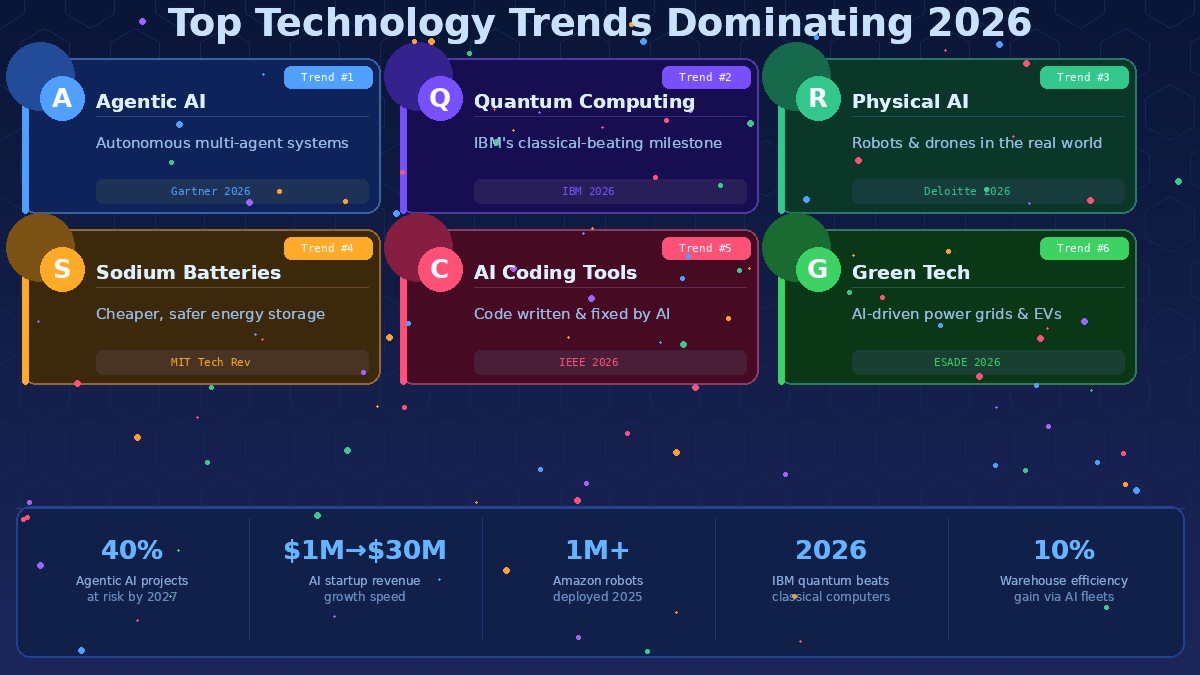
Gartner named multiagent systems one of its top strategic technology trends for 2026. Deloitte’s research found that only 11% of organisations have AI agents in production despite 38% piloting them — which tells you the gap between experimenting and actually deploying is still very real. IEEE’s 2026 Technology Predictions went further, stating that AI agents will become standard in business environments this year, handling the repetitive and routine work that currently eats up so much time. The catch: Gartner also predicts 40% of agentic AI projects will be cancelled by 2027 — not because the technology fails, but because organisations are automating broken processes instead of fixing them first.
2. Quantum Computing — The Milestone Year
IBM has publicly stated that 2026 marks the year a quantum computer will outperform classical computers on a meaningful real-world problem. That’s not a vague prediction — it’s a declared milestone. According to IBM, this will unlock initial breakthroughs in drug development, materials science, and financial optimisation. Fast Company’s technology council echoed this, noting quantum optimization is shifting from “can it work?” to “how fast can we implement it?” This is still early-stage for most businesses, but the implications for industries dealing with genuinely complex problems are significant.
3. Physical AI — Intelligence Leaves the Screen
AI has mostly lived inside software. That’s changing fast. Amazon deployed its millionth robot in 2025, with its DeepFleet AI coordinating the entire fleet and improving warehouse travel efficiency by 10%. BMW factories now have cars driving themselves through kilometre-long production routes. Humanoid robots are moving out of labs and into warehouses, with Xiaomi’s CEO predicting they’ll begin replacing human-held positions this year. Gartner describes “physical AI” as one of its defining 2026 trends — intelligence powering robots, drones, and smart equipment in the real world at operational scale.
4. Sodium-Ion Batteries — The Quiet Energy Revolution
This one doesn’t make headlines the way AI does, but its long-term impact could be just as large. Lithium is expensive, geographically concentrated, and environmentally costly. Sodium-ion batteries are made from salt — cheaper, safer, and increasingly viable. MIT Technology Review named them a breakthrough technology of 2026. Major manufacturers including CATL are scaling production, and ESADE’s tech trends report highlights how sodium batteries will drive down costs for EVs and autonomous trucks, reduce logistics costs, and accelerate the clean energy transition. This is the trend that enables several other trends on this list.
5. AI Coding Tools — Developers Are Already Feeling It
MIT Technology Review listed AI coding tools among its 2026 breakthroughs, and the numbers back it up. Since ChatGPT launched, job postings for repetitive coding roles dropped 13% while demand for senior and analytical development work grew 20%. Tools like GitHub Copilot, Cursor, and Claude are changing how software is built — not replacing developers, but compressing the time from idea to working prototype dramatically. Capgemini’s 2026 tech trends report describes the shift as moving from “writing code” to “expressing intent,” with AI delivering and maintaining systems based on outcomes rather than line-by-line instructions.
6. The Green Tech Infrastructure Build
IEEE’s 2026 predictions include an AI-driven power grid that is predictive, autonomous, and increasingly capable of managing the variable supply from renewables. This matters because the same AI revolution driving everything else on this list is also consuming extraordinary amounts of energy. Data centres are expanding at unprecedented rates. The answer being built right now includes smarter grids, sodium-ion storage at scale, and — looking slightly further ahead — small modular nuclear reactors that can come online faster than traditional plants.
The Thread Running Through All of It
Every one of these trends points to the same underlying shift: technology moving from something we interact with to something that operates around us and on our behalf. The companies and individuals who adapt to that shift — rather than waiting to see how it settles — are the ones who will find 2026 a genuinely exciting year to be working in tech.


