



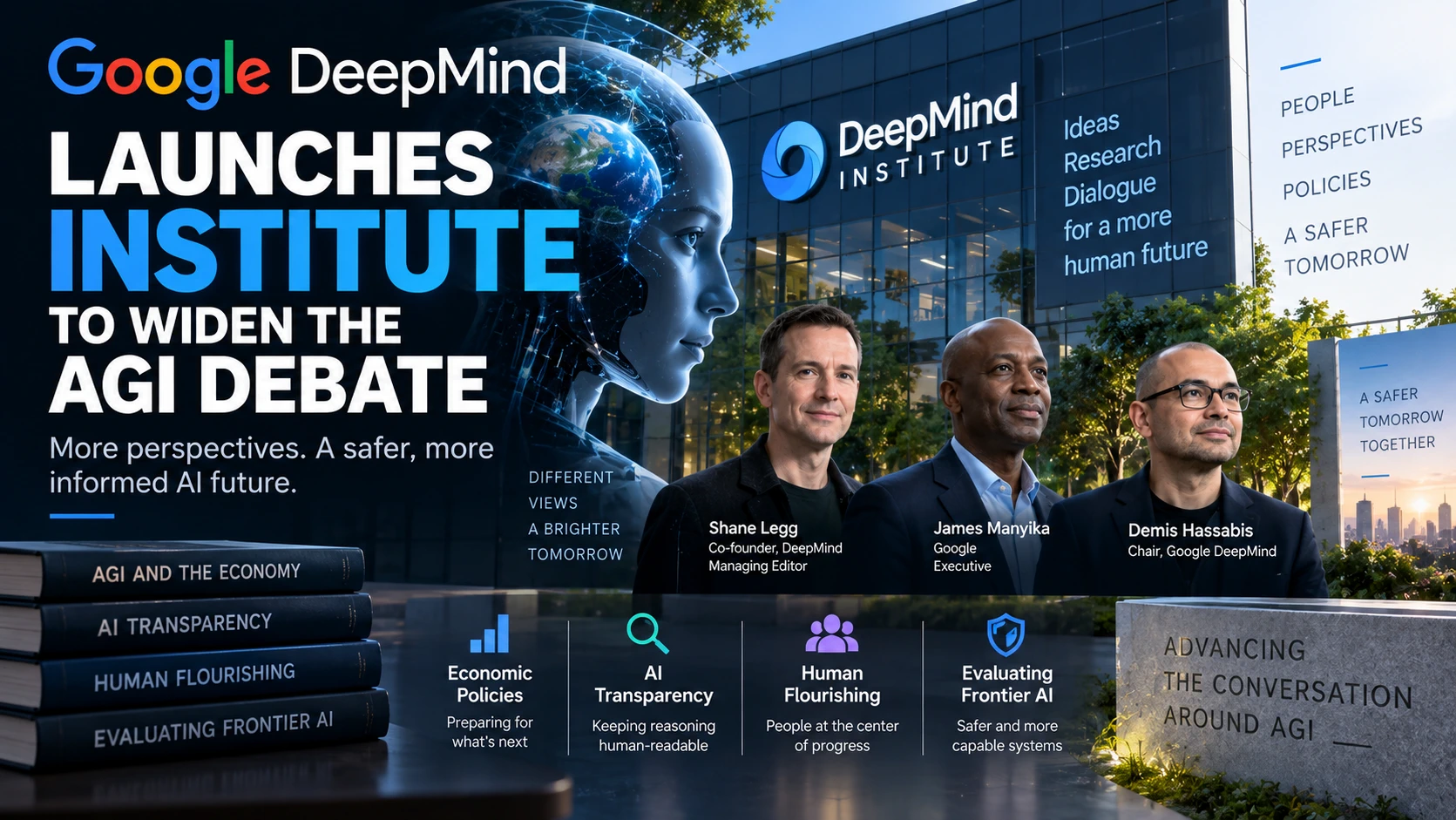
Google and Google DeepMind researchers have launched a new initiative focused on one of the biggest questions in artificial intelligence: how society should approach artificial general intelligence (AGI).
Called the DeepMind Institute, the organization was introduced Wednesday with the goal of bringing together different perspectives on the future of advanced AI. Its leadership includes DeepMind co-founder Shane Legg, Google executive James Manyika, and Google DeepMind chair Demis Hassabis. Legg will serve as the institute’s managing editor.
Rather than presenting a single position on AGI, the institute says it wants to encourage discussion and debate among researchers, policymakers, and technology leaders. Its founding statement acknowledges that experts may disagree and that their views could change as new evidence emerges.
Four essays launch the institute
The DeepMind Institute opened with four research essays covering some of the major challenges surrounding increasingly capable AI systems.
The subjects range from economic policies that could help societies deal with disruption caused by AGI to methods for maintaining transparency in AI reasoning. Other papers explore principles for human well-being and ways to evaluate the capabilities and risks of advanced AI models.
One paper, written by DeepMind safety researchers Rohin Shah and Anca Dragan, focuses on the growing difficulty of understanding how advanced AI systems arrive at their conclusions.
As newer model architectures become increasingly sophisticated, researchers may have less access to clear, human-readable reasoning processes. The authors argue that this loss of transparency should be treated as an important safety consideration rather than an unavoidable consequence of progress.
Among the ideas discussed is limiting what the researchers describe as “opaque serial depth” — essentially, how much sequential computation an AI system can perform without producing a reasoning trail that humans can meaningfully inspect.
They also suggest that developers could be required to demonstrate that highly capable but less transparent models can still be monitored effectively.
Hassabis proposes AI testing standards
Another essay comes directly from Demis Hassabis and proposes the creation of a U.S.-led organization for evaluating frontier AI models.
Under the proposal, AI companies would initially be able to submit upcoming models voluntarily for testing before release. Hassabis suggests that evaluations could eventually become mandatory for the deployment of the most advanced AI systems in the United States if the framework proves effective.
The proposed organization would initially work with AI companies to develop suitable tests. Eventually, however, it could introduce independent evaluations whose details remain hidden from developers.
These so-called held-out tests would make it more difficult for AI laboratories to specifically optimize their models for known benchmarks.
Hassabis also suggests that the system could become stricter if the risks associated with advanced AI increase. In a more serious scenario, coordinated limits on the pace of frontier AI development could become part of the framework.
AI safety debate moves toward practical rules
The institute’s launch comes at a time when discussions around AI safety are increasingly moving beyond general warnings about potential risks.
Researchers and industry leaders are now debating practical measures involving independent testing, transparency, government oversight, and limits on how quickly increasingly powerful AI systems should be developed.
The DeepMind Institute appears designed to contribute to that discussion by publishing different perspectives rather than presenting AGI as a problem with a single answer.
As AI capabilities continue advancing, questions about who should evaluate these systems, how their behavior should be monitored, and when additional safeguards should be required are likely to remain central to the broader AGI debate.


