


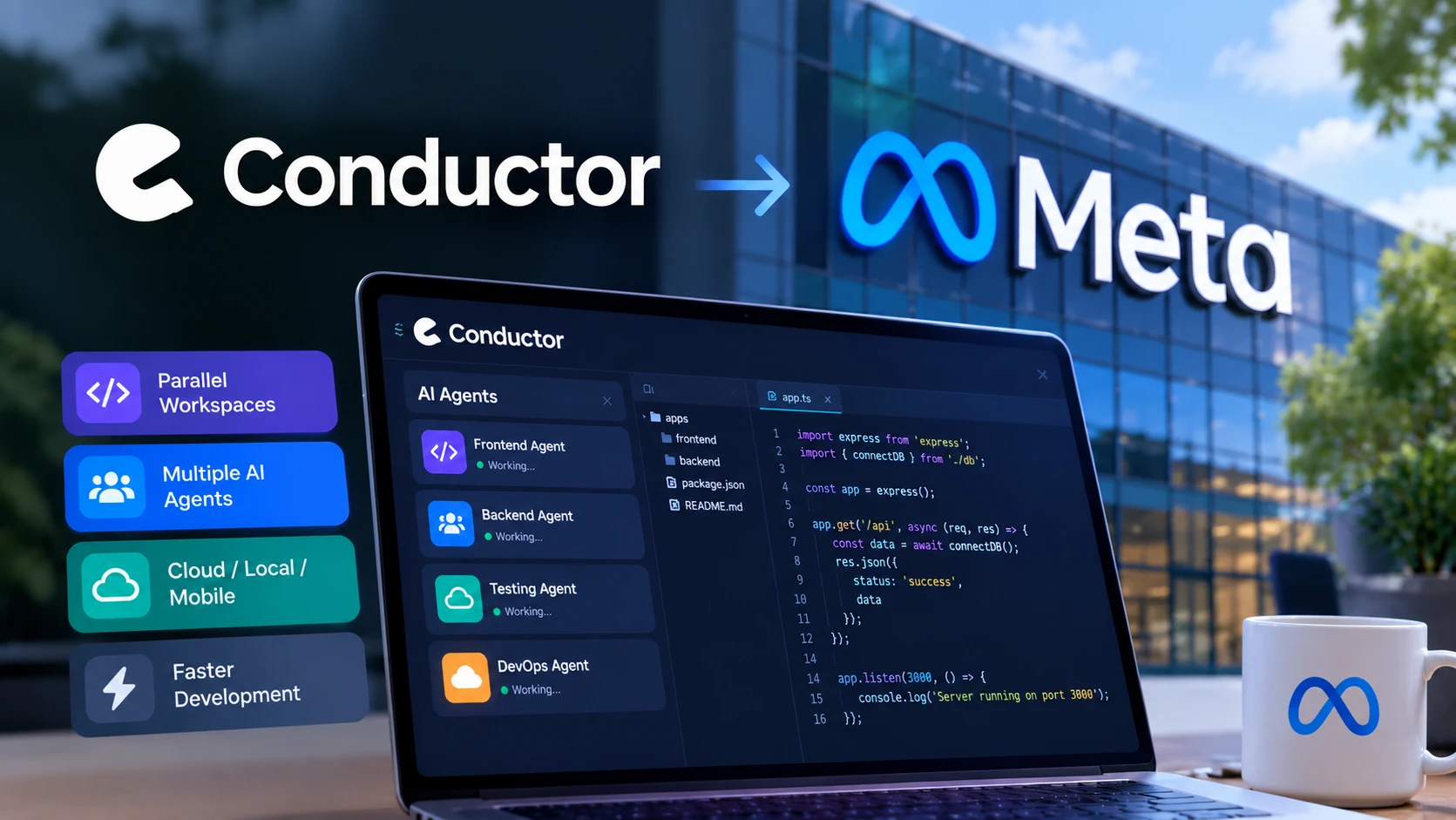
Meta is expanding its artificial intelligence ambitions with the acquisition of Conductor, a startup developing AI-powered tools that allow software developers to manage multiple coding agents working on different parts of a project simultaneously.
The acquisition was announced by Conductor founder and CEO Charlie Holtz, who confirmed that the company is joining Meta. Although financial details have not been disclosed, the deal adds another AI-focused startup to Meta’s growing portfolio.
Holtz also hinted that the team is already working on something new, with plans to introduce its next product early next year.
What Does Conductor Actually Do?
Founded in 2024, Conductor has developed a platform designed to make software development faster through coordinated AI agents.
Instead of relying on a single AI assistant to handle an entire coding project, developers can launch multiple agents that work independently on different tasks.
For example, one agent might handle frontend development while another works on backend functionality, database integration, or testing.
These agents operate in separate workspaces but can contribute to the same overall project.
Conductor supports different deployment options, allowing developers to run agents through cloud infrastructure, local environments, or mobile devices.
Interestingly, the company doesn’t develop its own underlying AI models. Instead, it integrates technology from major AI providers, including Anthropic and OpenAI.
Meta Wants to Strengthen Its AI Coding Capabilities
The acquisition comes as Meta increases its investment in AI-powered developer tools.
The company launched Muse Code earlier this year, an AI coding agent designed to help developers work with large software projects.
Meta has also been expanding its Superintelligence Labs, bringing in experienced AI researchers and executives to accelerate its development efforts.
Conductor’s technology could complement these initiatives by giving Meta additional expertise in coordinating multiple AI agents and managing complex software development workflows.
Conductor founder Charlie Holtz specifically expressed enthusiasm about working with Alexandr Wang, Meta’s chief AI officer, and Nat Friedman, who leads product efforts at Meta’s Superintelligence Labs.
What Happens to Existing Conductor Users?
Conductor says its main product will continue operating as it currently does until early next year.
However, there is one important change for existing customers: the company’s cloud service will shut down on November 20.
After that date, Conductor will begin deleting data stored in its cloud infrastructure.
Users should therefore review the company’s instructions and export any information they want to keep before the shutdown.
The founder has also suggested that customers can expect a new product experience from the team in early 2027.
Meta Is Building a Bigger AI Ecosystem
The acquisition is another sign that Meta is determined to become a stronger competitor in the AI industry.
Over recent months, the company has introduced new AI models, expanded its Muse assistant, and invested in tools designed for developers and everyday consumers.
Its Muse AI assistant has also gained considerable traction, reportedly surpassing 10 million downloads in the United States within 40 days of its launch.
Meta has made several other AI-related acquisitions, including Moltbook, the AI agent-focused social platform that attracted widespread attention.
AI Agents Could Change How Software Is Built
The Conductor acquisition reflects a growing shift in software development.
AI coding tools are moving beyond simple code suggestions and autocomplete features. Increasingly, they can plan projects, write code, troubleshoot errors, run tests, and coordinate multiple development tasks.
By bringing Conductor into its AI organization, Meta could strengthen its ability to build tools where several AI agents collaborate on complex projects.
The bigger question is what Meta plans to do with this technology.
With a new product reportedly expected in early 2027, developers may soon get a clearer picture of how Meta intends to compete in the rapidly evolving AI coding market.


