The conversation about AI and jobs has quietly changed shape. For a couple of years, the dominant question was binary: will AI take our jobs or not? In 2026, the people actually studying this for a living — the World Economic Forum, BCG, PwC, Deloitte — have largely moved past that question, because the honest answer was never going to be yes or no. The real question is how jobs are changing, how fast, and who’s prepared for it.
Here’s what the most current research actually says, including a genuinely useful framework for thinking about where this goes from here.
Four Possible Futures, Not One
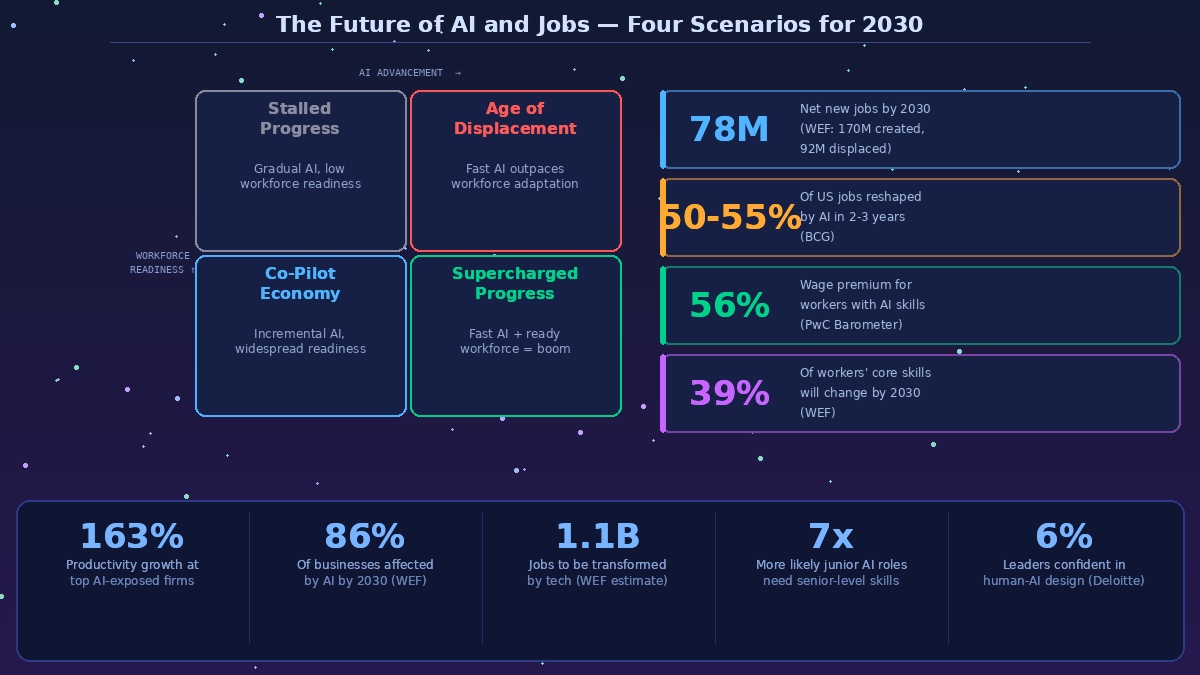
The World Economic Forum’s “Four Futures for Jobs” report, published for the 2026 Davos meeting, lays out something more useful than a single prediction: four plausible scenarios, built from the intersection of two variables — how fast AI advances, and how ready the workforce is to adapt.
In Supercharged Progress, AI advances rapidly and the workforce is genuinely ready for it. Many jobs disappear, but new occupations emerge and scale quickly, with humans increasingly taking on roles as “agent orchestrators” — directing and managing AI systems rather than competing with them. Productivity and innovation boom, though social safety nets and governance struggle to keep pace.
In the Age of Displacement, AI advancement outpaces workforce readiness. Businesses race to automate because talent is scarce, displacing workers faster than education and reskilling systems can respond. This scenario produces a genuine productivity surge alongside real social fracture — unemployment spikes, consumer confidence erodes, and governments face mounting instability.
The Co-Pilot Economy describes a world where AI progress is more incremental and most of the workforce already has AI-ready skills. Rather than mass automation, the focus shifts to pragmatic augmentation — AI assisting human work rather than replacing it wholesale, with gradual, manageable transformation across most industries.
And Stalled Progress combines gradual AI advancement with a workforce that lacks the critical skills to use it well. Productivity gains concentrate among the firms and regions with AI expertise, while everyone else falls further behind, deepening rather than closing existing inequalities.
These aren’t predictions. They’re a framework for understanding that the outcome isn’t fixed — it depends heavily on choices being made right now by businesses, educators, and governments.
The Number Everyone Quotes, and What It Actually Means
The WEF’s headline figure — 92 million jobs displaced, 170 million created, a net gain of 78 million by 2030 — gets repeated constantly, and it’s real. But the more useful insight sits underneath it: this isn’t a story of jobs simply disappearing and reappearing elsewhere. It’s a story of jobs changing shape while people stay in them.
BCG’s 2026 analysis of the US labour market found that 50% to 55% of jobs will be reshaped by AI over the next two to three years — meaning the role still exists, but the tasks within it, the tools required, and what success looks like change substantially. This is a fundamentally different proposition than mass replacement. Most people won’t lose their jobs to AI. They’ll do a noticeably different version of the job they already have, and the gap between those who adapt well and those who don’t will widen quickly.
The Two-Track Labour Market
PwC’s 2026 Global AI Jobs Barometer, built from analysis of over a billion job postings across six continents, surfaces something genuinely important: AI is creating a two-track labour market, and the divide isn’t simply “automatable jobs versus safe jobs.”
Jobs that get “professionalised” by AI — where the technology raises the skill bar rather than lowering it — are growing twice as fast as jobs that get “democratised” by AI, with 42% faster wage growth since 2021. Workers with AI skills now command wage premiums up to 56% higher than peers without them. And strikingly, the most AI-exposed junior roles are seven times more likely than the least-exposed junior roles to demand traditionally senior skills like leadership and judgement.
What this means in practice: AI isn’t simply automating away entry-level work. In many cases, it’s compressing the early career ladder, requiring junior employees to demonstrate capabilities that used to take years to develop. This is genuinely difficult news for new graduates, even as it’s good news for the overall productivity of companies that get it right.
Productivity Gains Are Real — And Concentrated
PwC’s data shows productivity growth is 40% higher at AI-exposed companies than at the least exposed ones, with a pronounced “superstar effect” — the top fifth of most AI-exposed companies are achieving 163% average productivity growth. Importantly, these companies aren’t just cutting costs. Headcount and wages are both growing faster at the most AI-exposed companies than at companies that have stayed on the sidelines, suggesting that when AI is used to expand into new markets and amplify human work rather than simply replace it, the gains get shared rather than hoarded.
The catch is concentration. These benefits are not evenly distributed. The IMF’s January 2026 analysis found that countries investing heavily in tertiary education and lifelong learning — Finland, Ireland, and Denmark rank highest on relevant skill-readiness measures — are best positioned to capture AI’s economic upside. Countries and companies that don’t make that investment risk falling into exactly the “Stalled Progress” scenario the WEF describes.
The Skills That Are Actually Changing
The World Economic Forum estimates that 39% of workers’ core skills will change by 2030 — not their job titles, their actual skills. The IMF’s analysis of millions of job postings found that one in ten job ads in advanced economies now requires at least one genuinely new skill, with professional, technical, and managerial roles — particularly in IT — seeing the most demand.
But there’s a subtlety worth understanding: high demand for new IT and AI-related skills doesn’t necessarily translate one-for-one into demand for IT specialists. Many of those tasks will themselves be progressively automated by AI. The durable skills sitting underneath the technical churn are leadership, analytical thinking, and socio-emotional intelligence — capabilities that remain valuable precisely because AI struggles to replicate them convincingly.
Why Most Organisations Are Behind
Here’s the uncomfortable finding tying all of this together: Deloitte’s 2026 Global Human Capital Trends report found that 85% of leaders say building organisational adaptability is critical, but only 7% believe they’re actually leading on it. Just 6% of leaders say they’re making real progress designing how humans and AI should actually work together.
Microsoft’s research describes this gap as the “Transformation Paradox” — organisations are adopting AI tools at speed, but most haven’t redesigned the structures, workflows, or decision rights around them. The result: companies are layering new technology onto old organisational charts and wondering why the productivity gains haven’t materialised. Organisational factors like culture, management support, and governance account for more than twice the variance in AI’s impact compared to individual skill or mindset.
What This Means If You’re Trying to Navigate It
The future of AI and jobs isn’t a single fixed outcome arriving on a schedule. It’s an open set of possibilities being shaped right now by specific, knowable choices — how much companies invest in reskilling, how thoughtfully workflows get redesigned around AI rather than just AI being added to existing workflows, and how seriously education systems take the shift toward judgement, leadership, and analytical skills over narrowly technical ones.
The data is consistent on one point across every single source: the workers, companies, and countries that treat this as a deliberate transition to manage — rather than a wave to either resist or passively ride out — are the ones ending up in the “Supercharged Progress” version of 2030 rather than the “Age of Displacement” version. The technology is moving fast either way. The outcome depends on what happens around it.
