
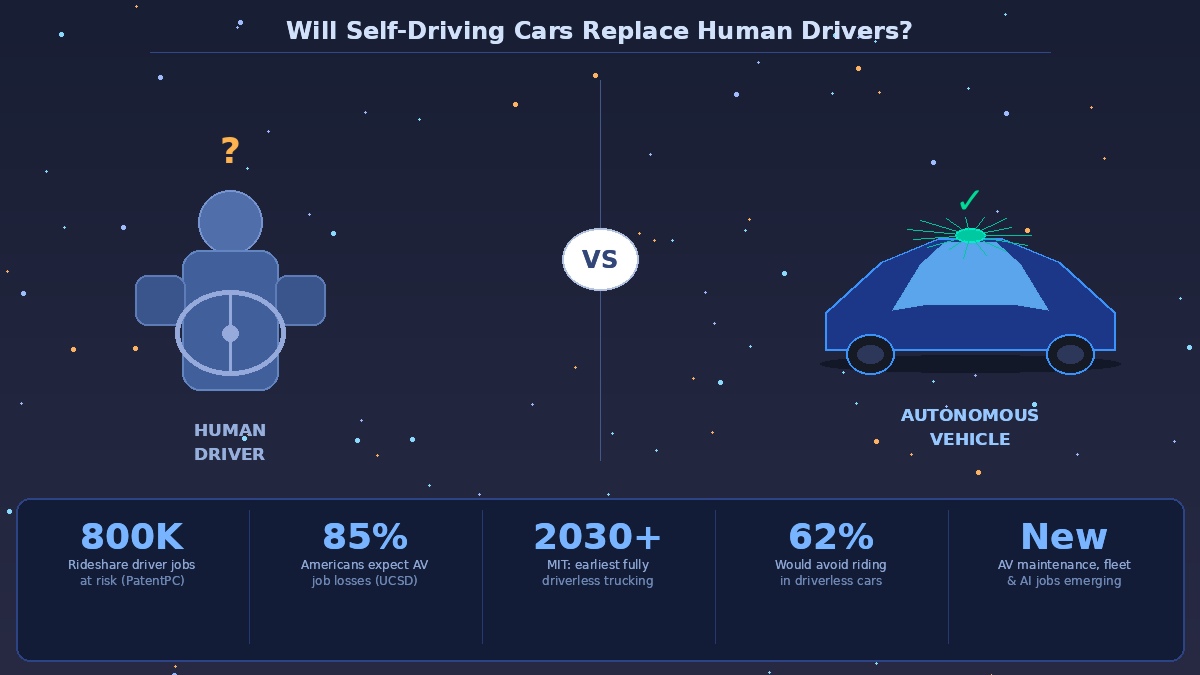
This question makes people nervous for a reason that goes beyond technology. A 2024 UC San Diego study found that more than 60% of Americans would probably or definitely avoid riding in a driverless car — and the researchers discovered something interesting: the hesitation isn’t mainly about safety. About 85% of respondents said widespread autonomous vehicles would cause job losses for ride-hailing, rideshare, and delivery drivers. Nearly half believed the technology would widen the income gap between higher and lower earners.
So let’s separate the two real questions buried inside this one. Can the technology drive without a human? Increasingly, yes, in specific conditions. Will it eliminate driving as a profession? That’s a much messier, slower, and more human story than the headlines suggest.
The Jobs Genuinely at Risk
Some numbers here are sobering and worth being honest about. Estimates suggest around 800,000 rideshare drivers could lose their jobs as autonomous vehicle adoption gains traction in the United States. Uber and Lyft’s entire business model currently depends on human drivers, and that dependency is the first thing companies are working to remove — Waymo is already operating robotaxi services in multiple cities without any driver at all.
Trucking faces a similar trajectory, though on a longer timeline than rideshare. Long-haul freight is one of the largest employment sectors in the US, and as autonomous trucking technology matures on highway corridors, many of those jobs are genuinely at risk over the coming decade. Taxi driving, in its traditional form, faces the most direct threat of all — it’s essentially the same service Waymo and its competitors are already replacing at scale in several cities.
Why It Won’t Happen Overnight
Here’s where the more careful research adds important nuance. MIT’s analysis of autonomous vehicle impact found that fully automated driving systems without any human safety presence on board won’t be available at meaningful scale until at least 2030 — and that timeline lengthens further in regions with cold winters or rural geography, where the technology faces harder conditions.
MIT’s researchers make a point that’s easy to overlook: drivers do more than just drive. A truck driver also inspects cargo, handles paperwork, communicates with dispatch and customers, and manages unexpected situations at delivery sites. A taxi driver helps passengers with luggage, provides local knowledge, and handles edge cases that don’t fit a predefined route. These secondary tasks mean that even in trucks and cars where the driving itself is automated, human presence often remains useful for the tasks surrounding it.
The transition is also expected to happen region by region rather than everywhere simultaneously. Specific corridors, specific cities, and specific use cases will go driverless years before the technology generalises broadly — which is exactly the pattern we’re already seeing with Waymo’s expansion city by city and Aurora’s trucking limited to particular highway routes.
The Jobs This Creates
The job losses are real, but they’re only half the picture. The growth of autonomous vehicles is creating substantial new demand in artificial intelligence, robotics, data analytics, and machine learning — fields that barely existed in their current form a decade ago. Someone has to build, train, test, and maintain these systems, and that workforce is growing quickly.
New categories of employment are emerging directly from the transition: AV safety operators who monitor vehicles during testing and limited deployment phases, fleet management roles overseeing growing autonomous vehicle operations, AV maintenance technicians who service increasingly complex vehicle technology, and logistics coordinators managing the handoff between automated and human-operated transport. For displaced drivers willing to retrain, some of these roles offer a genuine path forward — particularly fleet supervision and logistics coordination, which build on existing industry knowledge rather than requiring an entirely new skill set.
There’s also a less obvious economic effect: fewer accidents caused by distracted, impaired, or fatigued driving could reduce certain other categories of employment too — insurance claims adjusters, auto body technicians, and emergency responders may all see reduced demand if autonomous vehicles deliver on their safety promise at scale.
Some Driving Jobs Won’t Disappear — They’ll Get Better
Qualitative research interviewing transport and technology sector professionals found a perspective worth taking seriously: many existing driving jobs are physically unhealthy and personally unsatisfying. Long-haul trucking has some of the highest rates of sleep apnoea and obesity of any profession, largely due to the sedentary, isolating, irregular nature of the work. Researchers in this space have argued that converting these roles — rather than simply eliminating them — into adjacent positions focused on customer interaction, delivery coordination, and exception handling could produce jobs that are more diverse and more enjoyable than the driving jobs they replace.
This reframing matters because it shifts the conversation from “will jobs disappear” to “what should the jobs become.” Receiving deliveries, communicating with recipients, assisting passengers with specific needs, and handling the parts of transportation that genuinely benefit from human judgement and interpersonal skill are all tasks that remain valuable even as the core act of driving becomes automated.
The Real Risk Isn’t the Technology — It’s the Transition
The most important finding across this research isn’t about whether AVs will displace driving jobs. Nearly everyone studying this agrees they will, at least partially, over time. The real risk is whether the transition is managed in a way that doesn’t devastate the people caught in the middle of it.
The UC San Diego research is blunt about this: a purely technical approach to autonomous vehicle adoption is unlikely to build genuine public trust or acceptance. The researchers argue for a “socio-technical” approach that pairs the technology rollout with proactive policy — wage subsidies for retraining, incentives for companies that hire displaced workers into emerging technical roles, and genuine investment in upskilling programs rather than leaving workers to navigate the shift alone.
Lower-income and non-metropolitan workers — who are statistically less likely to have access to retraining resources or alternative employment in their region — face the steepest version of this transition. Without deliberate policy intervention, the same study found, nearly half of Americans believe the income gap will widen rather than narrow as a result.
So, Will They Replace Drivers?
Partially, gradually, and unevenly — yes. Rideshare and traditional taxi driving face the most direct and immediate threat. Long-haul trucking will follow on a longer timeline, likely well into the 2030s for broad deployment. But “replace” overstates how complete and instant this shift will be. Driving as a profession is being restructured rather than erased overnight — some roles will vanish, some will transform into adjacent positions, and entirely new categories of work will emerge to support the technology itself.
The honest answer isn’t a number or a date. It’s that the technology is moving faster than most people expected, and the policy response needed to manage that transition fairly is moving considerably slower than it should.
