We’re at a strange moment with AI. The hype says superintelligence is imminent and everything is about to change overnight. The skeptics say it’s an overinflated bubble that will pop. Both camps are loud, confident, and probably wrong. The reality, as usual, is more interesting and more nuanced than either extreme — and the data from 2026 gives us a clearer picture than we’ve ever had of where this is genuinely going.
Here’s what the future of AI actually looks like, based on what’s happening right now.
The AGI Question Everyone’s Arguing About
Artificial General Intelligence — AI that matches or exceeds human capability across essentially all tasks — is the holy grail and the great debate. And the timelines have compressed dramatically. The Metaculus prediction community moved its AGI forecast from 2041 to 2031 in a single year.
The experts are genuinely split. Anthropic’s Dario Amodei predicts AI systems “broadly better than all humans at almost all things” by 2026-2027. OpenAI’s Sam Altman has suggested AGI could arrive even sooner. DeepMind’s Demis Hassabis says “within the next decade.” On the other side, Meta’s Yann LeCun is blunt: “If someone claims AGI is just around the corner, do not believe them.”
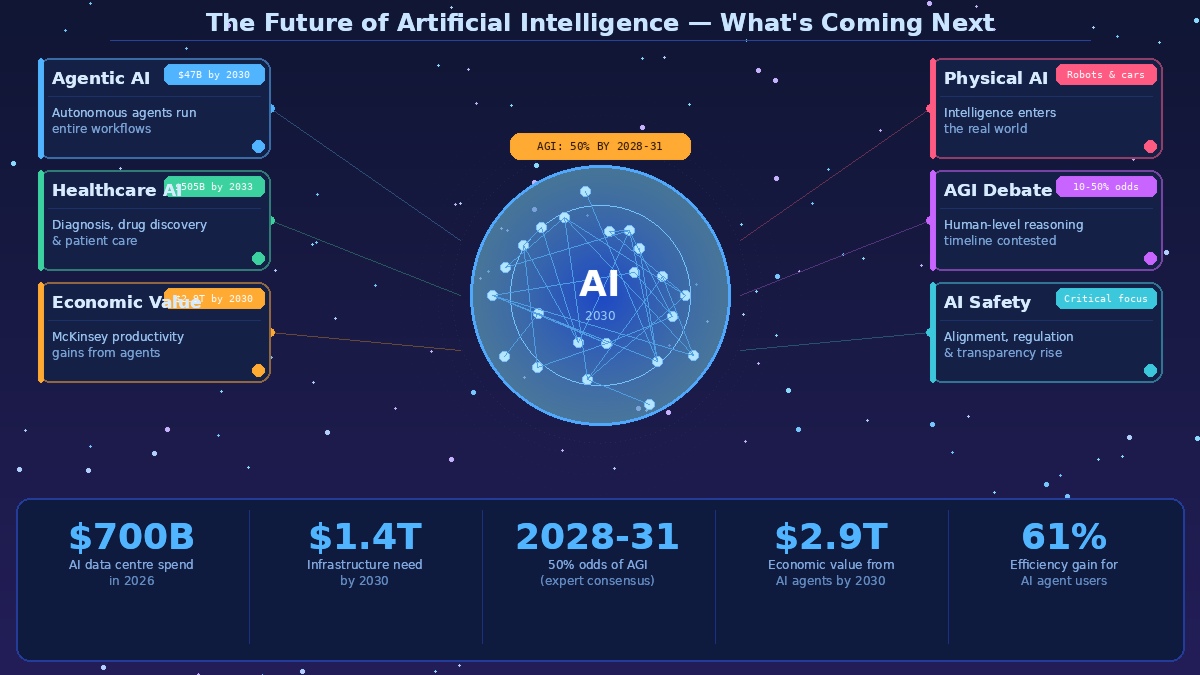
The aggregate view sits somewhere in between. Prediction markets put only a 10% probability on pure AGI arriving in 2026, with roughly 50% odds by 2028-2031 and 90% odds stretching toward mid-century. Geoffrey Hinton — one of the field’s founders — assigns a sobering “10 to 20 percent chance” of AI causing human extinction within three decades. The honest answer is that nobody knows, and the people claiming certainty in either direction should be treated with caution.
The Real Story Is Agents, Not AGI
While everyone argues about AGI, the actual transformation happening right now is more practical: AI agents. These are systems that don’t just answer questions but plan, execute multi-step tasks, and act autonomously on your behalf.
The global AI agents market is expected to be worth around $10.69 billion in 2026, growing to approximately $47 billion by 2030. McKinsey estimates that agentic AI productivity gains could unlock up to $2.9 trillion in economic value by 2030. Employees using AI agents already report a 61% increase in efficiency. By 2028, one-third of user experiences are expected to shift from native apps to agentic AI front ends — meaning you’ll increasingly interact with an AI that does things for you rather than apps you operate yourself.
This is the near-term future that’s already arriving: not a single superintelligence, but a proliferation of specialised, capable agents handling the routine and complex work of daily business and life.
Healthcare: The Most Transformative Application
If you want to see where AI delivers the clearest human benefit, look at medicine. The AI in healthcare market was valued at $36.67 billion in 2025 and is projected to reach $505.59 billion by 2033, growing at nearly 39% annually. The AI agents in healthcare segment alone is forecast to grow from $1.11 billion in 2025 to $6.92 billion by 2030.
Around 70% of healthcare organisations already use AI agents to support clinical workflows, diagnostics, and patient engagement. AI is accelerating drug discovery, improving medical image analysis with detection rate improvements of up to 15%, and reducing the administrative burden that drives clinician burnout. Between 2026 and 2030, AI will shift from an experimental add-on to foundational infrastructure in global healthcare. The biggest barriers aren’t technical — they’re trust, regulation, and integrating AI into established clinical workflows safely.
Physical AI: Intelligence Leaves the Screen
For most of its history, AI has lived inside software. That’s changing. Physical AI — intelligence embedded in robots, autonomous vehicles, drones, and smart equipment — is one of the defining frontiers of the coming years. Amazon now operates over a million warehouse robots. Humanoid robots are entering commercial production. Self-driving cars are completing hundreds of thousands of rides per week.
The convergence is the key point: the same AI advances powering chatbots are now powering machines that move, manipulate objects, and operate in the unpredictable physical world. This is where AI stops being something you talk to and becomes something that acts in the environment around you.
The Money Behind It All
The scale of investment is staggering and slightly terrifying. Projected funding needs for AI data centres reached approximately $700 billion in 2026 alone. By 2030, infrastructure funding needs are expected to exceed $1.4 trillion — a figure analysts warn will surpass current market financing capabilities and require new funding mechanisms.
The United States has effectively bet its economic momentum on scaling AI, pouring capital into data centres, energy infrastructure, cooling systems, and semiconductor manufacturing. This is both the engine of AI’s progress and its biggest risk. If the productivity gains don’t materialise fast enough to justify the spending, the correction could be severe. Only around 25% of AI initiatives are currently delivering the return on investment organisations expected — a gap that 2026 and 2027 will need to close.
The Risks We Can’t Ignore
A clear-eyed look at AI’s future has to include its dangers. Current systems still hallucinate — generating confident, false information — at rates of 15-40% in some critical applications. Algorithmic bias affects millions in hiring and lending decisions. Deepfake fraud is projected to reach $40 billion by 2027. And the deeper questions of AI alignment — ensuring advanced systems pursue goals compatible with human wellbeing — remain genuinely unsolved.
This is why AI safety has moved from a fringe academic concern to a central focus of the field. Regulation is tightening, with frameworks like the EU AI Act setting precedents. Developers are pivoting toward “human-aware AI” — systems designed to be transparent, explainable, and collaborative rather than opaque black boxes.
What This Means for You
Here’s the most useful framing. The future of AI isn’t something that happens to you — it’s something you adapt to. The skills that retain value in an AI-saturated world are precisely the ones AI struggles with: creative thinking, emotional intelligence, complex judgement, and the ability to direct AI tools effectively rather than compete with them.
The future of artificial intelligence won’t be a clean arrival of superintelligence or a sudden collapse of the hype. It will be a messy, uneven, transformative decade where AI becomes embedded in healthcare, business, transport, and daily life — delivering enormous value while creating genuine risks that we’ll spend years learning to manage.
The technology is moving faster than our institutions, our regulations, and frankly our understanding. The people and organisations who thrive won’t be the ones who predicted the timeline correctly. They’ll be the ones who stayed adaptable, informed, and clear-eyed about both the promise and the peril.
