
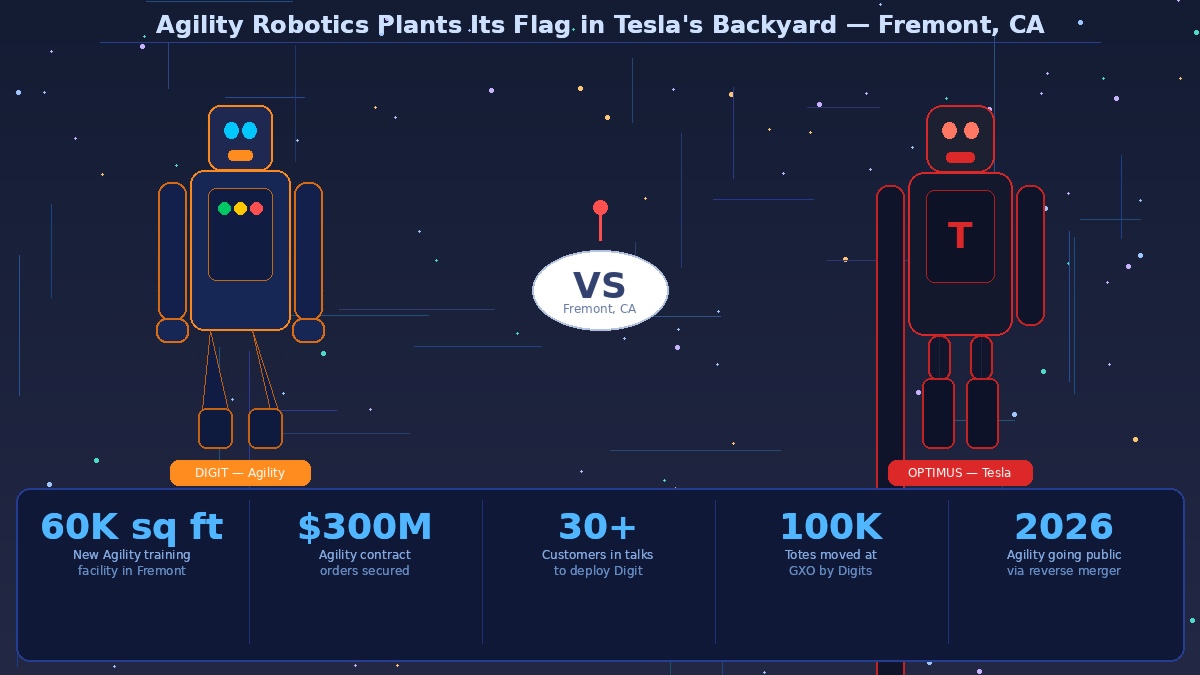
The humanoid robot race just got a very deliberate geographic statement. Agility Robotics is opening a 60,000-square-foot facility in Fremont, California — just a short drive up the highway from the factory where Tesla is expected to begin manufacturing its Optimus robots later this year.
It’s a bold move, and it’s intentional.
Two Robots, Very Different Timelines
Tesla has placed an enormous bet on Optimus. Elon Musk has described it as potentially “the biggest product ever” once it becomes useful outside Tesla’s own factories — though that commercial availability is still projected to be at least a year away.
Agility’s position is more grounded, and by many measures more advanced in practical deployment. Its robot, Digit, is already working. It’s already generating revenue. Digit is actively carrying totes and bins in manufacturing and warehouse settings for a roster of serious commercial customers including Amazon, GXO, Schaeffler, and Toyota Motor Manufacturing Canada. The company says it has secured $300 million in contract orders.
“It’s great to have them in the same area as us, because really, for a long time Agility was out there alone, and it’s good to have others in the humanoid space,” CEO Peggy Johnson said. “We have commercialised. We now know what it takes to walk into these facilities and meet their safety bars, their regulatory bars, compliance, plug into their IT infrastructure, plug into their warehouse management system.”
That commercial knowledge — the hard-won understanding of what enterprise deployment actually requires beyond a working robot — is Agility’s real differentiator right now.
What Digit Has Already Done
Agility hasn’t disclosed total units built or deployed, but third-party observers estimate dozens of Digit robots have operated in pilot or revenue-generating deployments. The company has confirmed that its robots moved over 100,000 totes at a GXO logistics facility — a real milestone that transforms the technology from a lab curiosity into an operational asset.
More than 30 customers are currently in active discussions about deploying Digit. The new Fremont facility is where those deployments will be prepared for: a purpose-built environment where the six-foot-tall robot learns new skills in conditions that mirror what it will encounter in the field.
Going Public as the Market Heats Up
Agility is also navigating a significant corporate milestone. Johnson is leading the company through a reverse merger that is expected to make it the first pure-play humanoid robot company to reach public markets later this year — giving it access to capital at a moment when the competitive field is rapidly expanding.
Founded in 2015 by researchers who developed new techniques for bipedal walking, Agility is trying to capitalise on its real-world lead over a newer wave of AI-driven robotics startups including Figure, 1X, the Bot Company, and Sunday Robotics. These newer entrants are impressive technically, but they’re still catching up on the operational expertise that Agility has earned through actual commercial deployments.
The Smart Approach to AI in Robotics
One of the most interesting aspects of Agility’s philosophy is how it thinks about the role of AI in its robots — and where generative AI should and shouldn’t be applied.
“When you think about self-driving cars, you really don’t want the anti-lock brake controller under AI control,” said co-founder and chairman Damion Shelton. “The analogy with humanoids is that all the safety stuff needs to go through a path that’s not generative AI. You don’t want to get creative with your safety stack.”
The distinction matters. Generative AI isn’t being used to run low-level safety systems or physical control loops where reliability is critical. But it does solve a problem that has limited robotics for decades: the sheer number of things you could want a robot to do vastly outstrips the number of engineers capable of programming each behaviour individually.
“The number of things you can imagine a robot doing is far larger than the number of engineers who can program robots,” Shelton said. “And generative AI answers that question definitively.”
Not Heading Into Homes Any Time Soon
Unlike some of the more aspirational humanoid robot narratives circulating in the industry, Agility is explicitly not targeting consumer home use in the near term. The company’s view aligns with that of most independent robotics experts, who believe current robot capabilities fall well short of what safe in-home operation would require.
Digit currently operates in human-free zones — areas where workers aren’t present. That changes with the next generation. Version 5 of Digit, expected to be unveiled this autumn, will introduce the ability to sense humans and operate in environments where people are present, removing the need for dedicated robot-only spaces.
Co-founder and chief robot officer Jonathan Hurst is blunt about the scale of opportunity that exists in manufacturing and logistics alone — without ever setting foot in a family home.
“Let’s start with the bins and the totes, and then let’s do the picking and the kitting,” Hurst said. “And then let’s start working on cardboard, which is really hard, and loading and unloading tractor trailers. Okay, now we’re at 100 million robots. A trillion-dollar company.”
It’s an ambitious roadmap — but one grounded in a robot that’s already doing real work, in real warehouses, for real customers. In an industry full of impressive demos and optimistic timelines, that distinction carries significant weight.
