
Close Menu
TechZappi

    Subscribe to Updates

    Get the latest creative news from FooBar about art, design and business.

    What's Hot

    How Driverless Trucks Actually Work – Inside the Autonomous Freight Revolution

    June 9, 2026

    The Future of Artificial Intelligence — Where It’s Actually Heading

    June 9, 2026

    The Dark Web Explained – What It Actually Is, and Why It Matters to You

    June 9, 2026
    Facebook X (Twitter) Instagram
    Facebook X (Twitter) Instagram Vimeo Pinterest YouTube
    TechZappi
    Subscribe Login
    • Home
    • AI

      The Future of Artificial Intelligence — Where It’s Actually Heading

      June 9, 2026

      The AI Tools That Quietly Give You Back Hours Every Week

      May 28, 2026

      AI vs Human Intelligence – Who Wins, Who Leads, Who Decides

      May 13, 2026

      The AI Tools That Are Actually Helping Students in 2026

      May 6, 2026

      8 AI Startups Quietly Reshaping the World in 2026

      April 22, 2026
    • Technology
      1. AI
      2. Cybersecurity
      3. Crypto
      4. App
      5. Security
      6. View All

      The Future of Artificial Intelligence — Where It’s Actually Heading

      June 9, 2026

      The AI Tools That Quietly Give You Back Hours Every Week

      May 28, 2026

      AI vs Human Intelligence – Who Wins, Who Leads, Who Decides

      May 13, 2026

      The AI Tools That Are Actually Helping Students in 2026

      May 6, 2026

      The Dark Web Explained – What It Actually Is, and Why It Matters to You

      June 9, 2026

      How Ransomware Attacks Actually Work – Inside the 6 Stages of a Modern Attack

      June 3, 2026

      Top Cybersecurity Tools in 2026 – The AI-Powered Security Stack

      May 28, 2026

      What Hackers Can Do With Just Your Email Address – More Than You Think

      May 13, 2026

      Robinhood Acquires Bitstamp for $200M to Bolster Crypto Presence

      July 18, 2024

      CoinDCX Expands Globally with Acquisition of BitOasis

      July 4, 2024

      IRS Finalizes New Regulations for Crypto Tax Reporting

      July 4, 2024

      EU Privacy Decision Looms for Worldcoin Amid Ongoing Controversy

      June 4, 2024

      The Best Antivirus Software in 2026 – Tested, Ranked, and Worth Your Money

      April 7, 2026

      Google Expands Gemini AI Across Docs, Sheets, Slides, and Drive

      March 10, 2026

      William Shatner Helps Launch X Money Beta With Charity Auction

      March 4, 2026

      Nearby Glasses App Warns You if Someone Close Is Wearing Smart Glasses

      March 2, 2026

      The Best Antivirus Software in 2026 – Tested, Ranked, and Worth Your Money

      April 7, 2026

      Kaspersky to Cease US Operations and Lay Off Employees Following Government Ban

      July 17, 2024

      Data Breach Exposes Millions of mSpy Customers’ Data

      July 12, 2024

      HealthEquity Describes Data Breach as an ‘Isolated Incident’

      July 4, 2024

      How Driverless Trucks Actually Work – Inside the Autonomous Freight Revolution

      June 9, 2026

      The Future of Artificial Intelligence — Where It’s Actually Heading

      June 9, 2026

      The Dark Web Explained – What It Actually Is, and Why It Matters to You

      June 9, 2026

      How Ransomware Attacks Actually Work – Inside the 6 Stages of a Modern Attack

      June 3, 2026
    • Contact
    TechZappi
    Home » How Ransomware Attacks Actually Work – Inside the 6 Stages of a Modern Attack
    Cybersecurity

    How Ransomware Attacks Actually Work – Inside the 6 Stages of a Modern Attack

    June 3, 20265 Mins Read
    Facebook Twitter Pinterest LinkedIn Tumblr WhatsApp VKontakte Email
    Share
    Facebook Twitter LinkedIn Pinterest Email

    There’s a popular image of ransomware: you open a bad email attachment, your screen suddenly locks up, and a skull demands Bitcoin. That image is about a decade out of date. Modern ransomware is not a single moment of misfortune — it’s a carefully orchestrated, multi-stage intrusion that often unfolds over days or weeks before you ever see a ransom note.

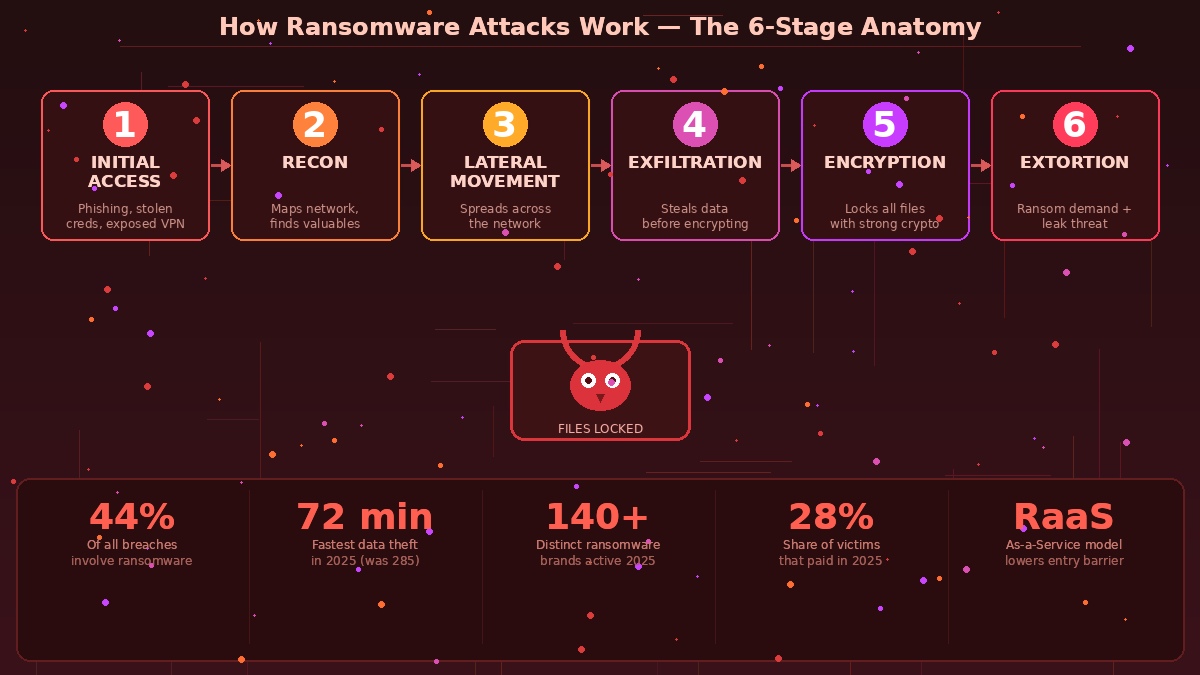
    Understanding how it actually works matters, because the encryption everyone fears is one of the last stages, not the first. By the time your files lock, the attackers have usually already been inside your network for some time, quietly stealing your data. And the numbers are sobering: ransomware accounts for 44% of all recorded data breaches according to the 2025 Verizon Data Breach Investigations Report, with more than 140 distinct ransomware brands active during 2025.

    Here’s how a modern attack actually unfolds.


    Stage 1: Initial Access

    Every ransomware attack begins with a way in. In 2026, the dominant entry point is no longer the classic email attachment — it’s stolen credentials. Bitdefender’s analysis found that ransomware groups are increasingly prioritising identity-first compromise, stealing usernames and passwords rather than relying on active exploitation.

    The common entry routes are compromised VPN accounts, exposed remote services, unpatched applications, and AI-generated phishing emails that convincingly impersonate trusted senders. Once an attacker has valid credentials, they don’t need to “break in” at all — they simply log in, looking exactly like a legitimate user. This is why the old advice of “don’t click suspicious links” is necessary but no longer sufficient.


    Stage 2: Reconnaissance

    Once inside, attackers don’t immediately start encrypting. They look around. This reconnaissance stage involves mapping the network, identifying where the valuable data lives, locating backups, and understanding the security tools in place. They want to know what’s worth stealing, where the crown jewels are, and what might stop them.

    This stage is where the attack is most detectable — and most often missed. The activity looks like normal network behaviour because the attacker is using legitimate credentials and built-in tools. Organisations with strong visibility into identity, access, and behavioural anomalies can catch attackers here. Most organisations don’t.


    Stage 3: Lateral Movement

    Having mapped the environment, attackers spread. Lateral movement is the process of expanding from the initial foothold to other systems across the network — escalating privileges, compromising additional accounts, and working toward the high-value targets identified during reconnaissance.

    A concerning 2026 development is the weaponisation of “EDR-blinding” techniques. Attackers now use vulnerable drivers — a tactic called Bring Your Own Vulnerable Driver, or BYOVD — to disable the endpoint detection and response tools that would otherwise catch them. Where this used to take two or three separate stages, ransomware groups have started embedding the vulnerable driver directly into their malware, collapsing defence evasion and execution into a single rapid step.


    Stage 4: Data Exfiltration

    This is the stage most people don’t know about, and it’s arguably the most damaging. Before encrypting anything, modern ransomware operators steal your sensitive data — copying it to their own servers. This enables what’s called double extortion: even if you have perfect backups and can restore everything, the attackers still hold your stolen data and threaten to publish it unless you pay.

    The speed here has increased dramatically. The Palo Alto Networks Global Incidents Report of 2026 found that the fastest attacks reached data exfiltration in just 72 minutes in 2025 — down from 285 minutes in 2024. That’s roughly an hour from initial access to your data being stolen. There is very little time to react.

    In fact, a growing 2026 trend is extortion without any encryption at all. With more victims refusing to pay for decryption keys, some groups now skip encryption entirely — they steal the data and threaten disclosure as their sole leverage. They’ve literally taken the “ware” out of ransomware.


    Stage 5: Encryption

    When encryption does happen, it’s fast and comprehensive. Modern ransomware locks files across the entire network using strong cryptographic algorithms that are effectively impossible to break without the decryption key. Attackers specifically target backups first to remove your ability to recover, then encrypt production systems to maximise disruption.

    Notably, ransomware developers are now future-proofing their encryption. Some 2026 variants use post-quantum cryptographic algorithms like Kyber1024 — designed to remain unbreakable even against future quantum computers. The criminals are thinking long-term.


    Stage 6: Extortion

    Finally, the ransom note appears. The demand typically combines two threats: pay to get the decryption key, and pay to prevent your stolen data from being published. Modern operations are remarkably professionalised — some groups offer “customer support” and even, as seen with the Qilin group, a “Call Lawyer” feature to pressure victims during negotiation.

    Encouragingly, the share of victims who paid dropped to 28% in 2025, as more organisations improve their backup strategies and refuse to fund criminal operations. But the shift toward pure data-theft extortion is partly a response to that resistance — attackers adapting their model to maintain leverage.


    Why This Matters for Defence

    Understanding ransomware as a multi-stage process rather than a single event completely changes how you defend against it. If your only protection is at the encryption stage, you’ve already lost — your data is stolen and the attackers are deep in your network.

    The most resilient organisations in 2026 focus on early-stage detection: monitoring for unusual login patterns, credential abuse, and lateral movement before encryption ever happens. The core defences that actually work are phishing-resistant multi-factor authentication to stop credential-based initial access, network segmentation to limit lateral movement, behavioural monitoring to catch reconnaissance, and immutable offline backups so encryption loses its leverage.

    Ransomware has evolved into a repeatable business process — the criminals have playbooks, supply chains, and service models. The defenders who succeed are the ones who understand that playbook stage by stage, and intervene before the attack reaches the part everyone fears.

    cybersecurity
    Share. Facebook Twitter Pinterest LinkedIn Tumblr WhatsApp Email
    Previous ArticleThe Best Cloud Storage Services in 2026 – Tested, Ranked, and Compared
    Next Article The Dark Web Explained – What It Actually Is, and Why It Matters to You
    admin
    • Website

    Related Posts

    How Driverless Trucks Actually Work – Inside the Autonomous Freight Revolution

    June 9, 2026

    The Future of Artificial Intelligence — Where It’s Actually Heading

    June 9, 2026

    The Dark Web Explained – What It Actually Is, and Why It Matters to You

    June 9, 2026

    The Best Cloud Storage Services in 2026 – Tested, Ranked, and Compared

    June 3, 2026
    Leave A Reply Cancel Reply

    Our Picks

    The Future of Artificial Intelligence — Where It’s Actually Heading

    June 9, 2026

    The Dark Web Explained – What It Actually Is, and Why It Matters to You

    June 9, 2026

    How Ransomware Attacks Actually Work – Inside the 6 Stages of a Modern Attack

    June 3, 2026

    The AI Tools That Quietly Give You Back Hours Every Week

    May 28, 2026
    • Facebook
    • Twitter
    • Pinterest
    • Instagram
    • YouTube
    • Vimeo
    Don't Miss
    Driveless Cars

    How Driverless Trucks Actually Work – Inside the Autonomous Freight Revolution

    June 9, 2026

    For years, “driverless trucks” sounded like a futurist’s fantasy — something perpetually a decade away.…

    The Future of Artificial Intelligence — Where It’s Actually Heading

    June 9, 2026

    The Dark Web Explained – What It Actually Is, and Why It Matters to You

    June 9, 2026

    How Ransomware Attacks Actually Work – Inside the 6 Stages of a Modern Attack

    June 3, 2026

    Subscribe to Updates

    Get the latest creative news from SmartMag about art & design.

      About Us
      About Us

      TechZappi is your go-to source for the latest tech news, digital trends, and innovation stories. We cover topics ranging from AI and apps to cybersecurity and online tools, helping readers stay informed about what’s happening in the technology world.

      Our Picks

      The Future of Artificial Intelligence — Where It’s Actually Heading

      June 9, 2026

      The Dark Web Explained – What It Actually Is, and Why It Matters to You

      June 9, 2026

      How Ransomware Attacks Actually Work – Inside the 6 Stages of a Modern Attack

      June 3, 2026

      Subscribe to Updates

      Get the latest creative news from Techzappi about Ai, Apps and Cybersecurity.

        Facebook X (Twitter) Instagram Pinterest Vimeo YouTube
        • Home
        • AI
        • App
        • Cybersecurity
        © 2026 TechZappi. All Rights Reserved.

        Type above and press Enter to search. Press Esc to cancel.

        Sign In or Register

        Welcome Back!

        Login to your account below.

        Lost password?