The dark web has a reputation problem. To most people, it’s a vague, sinister place where hackers and criminals lurk — a digital underworld they’ll never touch and don’t need to understand. That picture is partly true, partly wrong, and missing the most important part: your personal data is probably already on it, whether you’ve ever visited or not.
Let’s clear up what the dark web actually is, how it works, and why it matters for anyone who uses the internet.
First, the Three Layers of the Internet
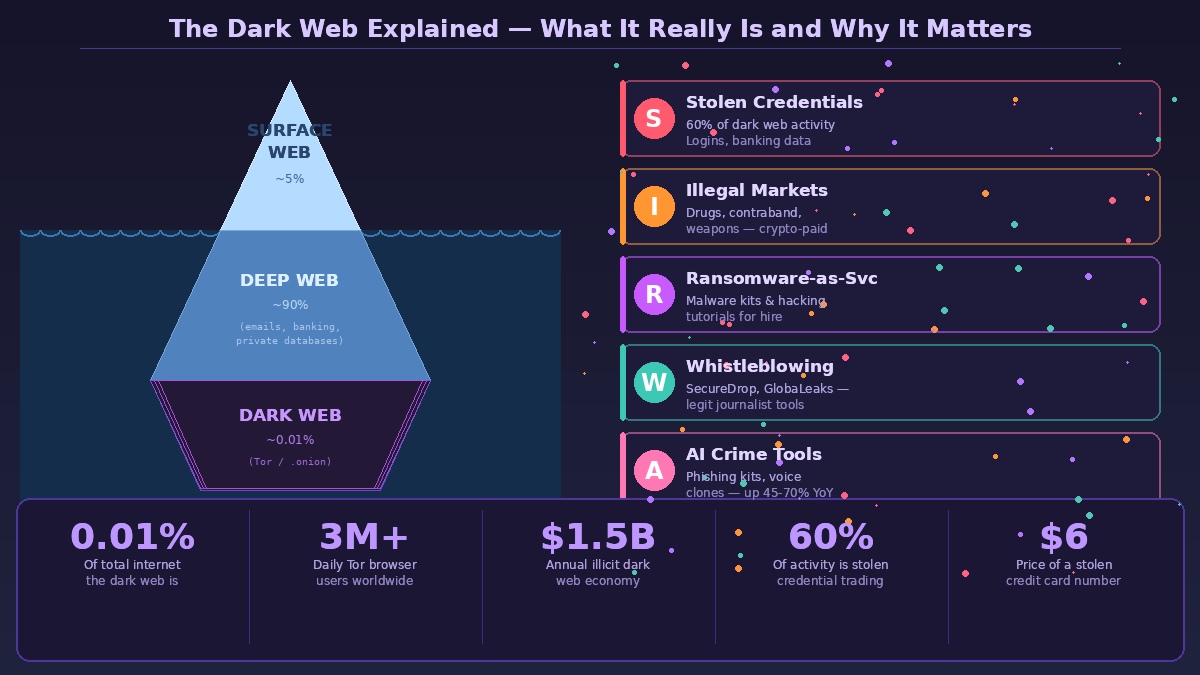
The internet you use every day — Google, news sites, YouTube, online shops — is the surface web. It’s everything search engines can find and index. And here’s the surprising part: it’s only about 5% of the total internet.
Below that is the deep web, which makes up roughly 90% of everything online. This isn’t sinister at all — it’s just content that search engines can’t index because it’s behind logins or paywalls. Your email inbox, your online banking dashboard, private company databases, medical records, subscription content — all of that is the deep web. You access it every day. It’s just not publicly searchable.
The dark web is a small, deliberately hidden corner of the deep web — around 0.01% of the total internet. It consists of websites intentionally concealed on privacy-focused networks, most commonly Tor, that can’t be reached through normal browsers and don’t appear in any search engine. To get there, you need specialised software.
How the Dark Web Actually Works
The dark web runs primarily on Tor — short for “The Onion Router,” a technology originally developed by the US Naval Research Laboratory. Tor works by routing your internet traffic through multiple layers of encryption across volunteer-run servers around the world, peeling away one layer at each hop, like the layers of an onion. This makes it extremely difficult to trace who is communicating with whom.
Dark web addresses don’t end in .com or .org. They use “.onion” addresses — long strings of seemingly random characters that exist only within the Tor network. These addresses change frequently as site operators rotate their cryptographic keys for security, which is why dark web links “die” constantly. The Tor browser now serves between 2.5 and 3 million daily users worldwide.
What’s Actually On the Dark Web
This is where the reputation comes from, and a lot of it is deserved. Around 60% of dark web activity in 2025 involved trading stolen credentials and breached data. The illicit dark web economy generates an estimated $1.5 billion annually.
The main categories include stolen data marketplaces, where login credentials, credit card numbers, and personal information from data breaches are bought and sold. Illegal goods markets trade drugs, weapons, and contraband, paid for with cryptocurrency. Cybercrime services offer Ransomware-as-a-Service kits, malware, and hacking tutorials for hire. And one of the fastest-growing categories is AI-based criminal tooling — phishing scripts, voice impersonation kits, and AI-assisted malware, with year-over-year growth of 45% to 70% in some categories.
There are also genuinely dark and criminal corners involving child exploitation networks, which law enforcement actively pursues. This is the part of the dark web that justifies its worst reputation.
But It’s Not Only Criminal
Here’s the nuance that gets lost in the headlines: the dark web isn’t inherently illegal, and not everyone on it is a criminal. The same anonymity that protects criminals also protects people who genuinely need it.
Journalists use the dark web to communicate securely with sources. Platforms like SecureDrop and GlobaLeaks let whistleblowers share sensitive documents anonymously — tools used by major news organisations. Activists and dissidents living under oppressive regimes use it to communicate without surveillance. People in countries with heavy internet censorship use it to access the open internet. Privacy-conscious individuals use it simply because they don’t want their browsing tracked.
In most countries, including the US, simply accessing the dark web is not illegal. It’s what you do there that determines legality.
How Your Data Ends Up There
This is the part that affects everyone, even people who’ve never heard of Tor. When a company you use suffers a data breach — and these happen constantly — your personal information often ends up for sale on dark web marketplaces. The pricing is sobering in its ordinariness: a single stolen credit card number sells for around $6, while full card details with a high balance can fetch around $110. Online banking logins with a balance of $2,000 or more often list for around $60. PayPal credentials with spendable balances appear for around $100.
Your data could be on the dark web right now from a breach you never even heard about. This is why dark web monitoring has become a standard feature of identity protection services — they scan these marketplaces for your email, passwords, and financial details, and alert you if they appear.
Why the Dark Web Keeps Growing Despite Crackdowns
Law enforcement has scored real victories. Major marketplaces — Hydra, AlphaBay, Genesis Market, and Archetyp among them — have been dismantled in coordinated international operations, leading to genuine arrests. But none of these takedowns reduced overall dark web activity. Each time a marketplace falls, its users migrate to successor platforms within weeks, and aggregate underground commerce continues climbing.
In 2026, the dark web is more active than ever — not because law enforcement failed, but because the ecosystem has restructured to be more decentralised and resilient. Ransomware groups publish new victims on dark web leak sites every week. Some groups have even formed alliances, sharing infrastructure to blur attribution and make themselves harder to track.
Should You Worry?
You don’t need to visit the dark web, and for most people there’s no good reason to. But you should care that it exists, because it’s where the consequences of data breaches play out. The practical takeaways are simple: use unique passwords so one breach doesn’t cascade, enable multi-factor authentication, and consider a dark web monitoring service that alerts you if your data appears for sale.
The dark web isn’t the boogeyman of internet myth, nor is it harmless. It’s a tool — one that protects journalists and dissidents while also enabling significant criminal activity. Understanding what it actually is, rather than what the headlines suggest, is the first step to protecting yourself from the part of it that genuinely affects you.
