Something fundamental shifted in 2026. It’s not just that cyberattacks got worse — though they did. It’s that the tools defending against them finally caught up to the speed of the threat. The cybersecurity category has been quietly undergoing a structural overhaul, driven by one thing: AI moving from a marketing label into genuine core functionality.
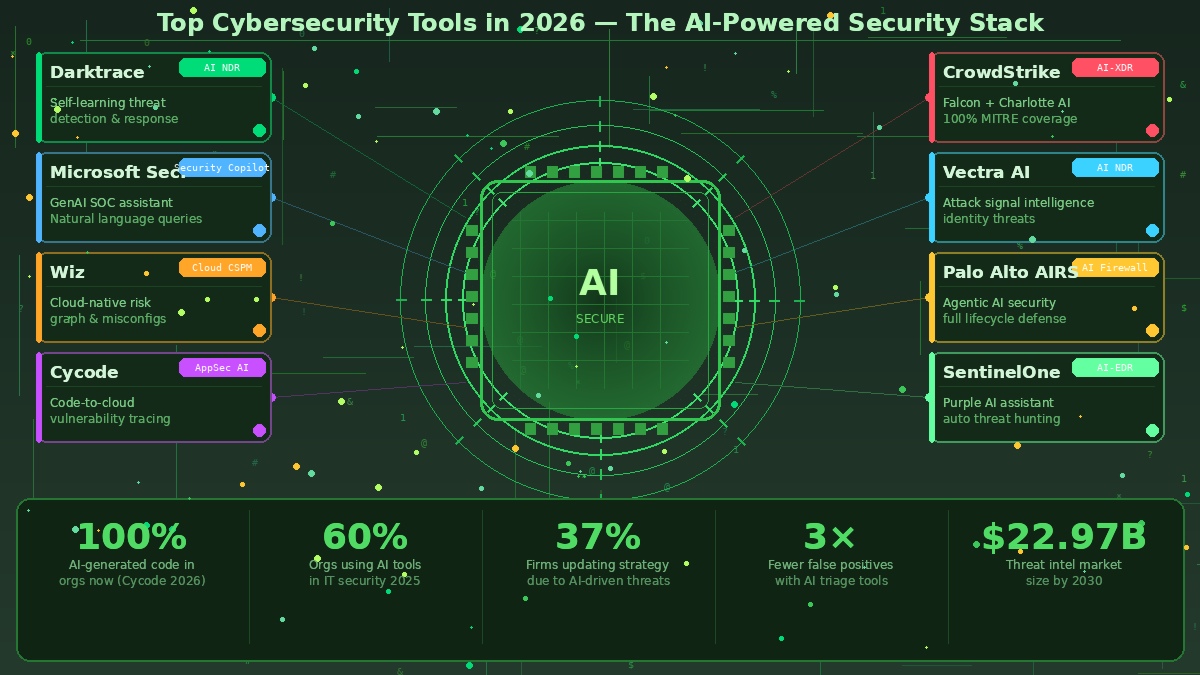
According to Cycode’s 2026 State of Product Security report, 100% of surveyed organisations now have AI-generated code in their codebases. Sixty percent are already using AI tools in their IT security operations. And 37% say AI-driven threats have forced them to fundamentally change how they approach security. The implication is clear: if your security stack isn’t AI-native, it’s already behind.
Here are the tools defining the 2026 landscape — and what makes each one worth understanding.
Darktrace — The Self-Learning Network
Darktrace pioneered AI-driven network detection and response, and in 2026 it remains the reference standard for organisations that want security that operates without depending on human-defined rules. Its core technology — the Self-Learning AI — builds a baseline of normal behaviour across every device, user, and connection in your environment, then identifies deviations without needing a signature or a pre-configured alert rule. When it detects an anomaly, its Autonomous Response capability can take precision actions in seconds — blocking a specific connection, pausing an account, slowing data transfer — without waiting for a human to review an alert. For organisations that can’t staff a 24/7 SOC, this kind of autonomous response is the difference between containing an incident and losing a weekend to a breach.
Microsoft Security Copilot — AI for the SOC Team
Microsoft’s Security Copilot puts a generative AI assistant directly inside the security workflow. Instead of querying dashboards, analysts can ask natural language questions — “What alerts have been triggered by this IP in the last 30 days?” or “Summarise this incident and suggest remediation steps” — and get structured, contextual answers drawn from Microsoft’s security data. It integrates natively with Microsoft Defender, Sentinel, Entra, and Intune, which means organisations already in the Microsoft ecosystem get meaningful AI augmentation without a separate integration project. For mid-market security teams stretched thin across too many tools, Copilot reduces the cognitive load of incident triage dramatically.
Wiz — Cloud Security That Actually Maps the Risk
Cloud misconfiguration is the leading cause of cloud data breaches. Wiz addresses this with a graph-based approach that maps relationships between cloud resources, identities, network exposure, and vulnerabilities to show the actual path an attacker would take — not just a list of issues. Its State of AI in the Cloud 2026 report found that roughly one in five organisations using AI-powered development platforms had applications affected by widespread security flaws. Wiz has become the default CSPM choice for cloud-native organisations, particularly those running multi-cloud environments where traditional perimeter tools have no visibility.
Cycode — Securing the AI-Generated Codebase
In 2026, most organisations are shipping code written at least partly by AI. That creates a new security problem: AI-generated code follows patterns, and when those patterns contain vulnerabilities, they get repeated at scale across codebases rather than appearing as isolated issues. Cycode’s platform maps relationships between code, infrastructure, identities, and runtime environments to deliver what it calls code-to-cloud traceability. Its AI Exploitability Agent doesn’t just flag vulnerabilities — it determines whether each one is actually reachable by an attacker, cutting noise by up to 3x compared to traditional static analysis. Its AI Guardrails intercept secrets in real time across IDE prompts and file reads before they reach any external service.
CrowdStrike Falcon + Charlotte AI — AI That Talks Back
CrowdStrike’s Charlotte AI transforms the Falcon platform from a detection engine into a security assistant. Security analysts can ask questions in plain English, investigate threats conversationally, and receive contextual recommendations rather than raw telemetry. The platform achieved 100% detection coverage in the 2025 MITRE ATT&CK Enterprise evaluation and its AI-native architecture now extends across endpoint, cloud, identity, and data. For enterprise security teams managing complex environments, the combination of best-in-class detection and a generative AI interface that surfaces insights rather than raw data is a significant operational upgrade.
Vectra AI — Catching What Others Miss
Vectra AI focuses specifically on detecting attacker behaviour that has already bypassed perimeter defences — the lateral movement, privilege escalation, and command-and-control activity that happens after the initial breach. Its Attack Signal Intelligence correlates signals across network, cloud, identity, and endpoints to distinguish genuine threats from the noise that overwhelms most SIEM deployments. For organisations dealing with identity-based attacks — which now account for a significant proportion of all breaches — Vectra’s dedicated identity threat detection and response (ITDR) capability fills a gap that endpoint tools alone don’t cover.
Palo Alto Prisma AIRS — Securing the AI Itself
This is the newest category in the 2026 security landscape: AI security. With its Prisma AIRS 3.0 platform released in early 2026, Palo Alto now spans the full agentic AI lifecycle — from pre-deployment model discovery through real-time runtime defence against prompt injection, model manipulation, and data leakage. Every AI agent, model, and pipeline your organisation deploys expands your attack surface. Prisma AIRS is built specifically to address that expansion. For any organisation running autonomous AI agents or LLM-powered workflows, this represents a security domain that most traditional tools simply weren’t designed to handle.
SentinelOne Purple AI — Autonomous Threat Hunting
SentinelOne’s Purple AI functions as an AI threat hunter that proactively searches for indicators of compromise rather than waiting for alerts to fire. Analysts can describe what they’re looking for in natural language, and Purple AI translates that into structured queries across the Singularity platform’s telemetry. Its autonomous investigation capability can take a single alert and automatically build a complete incident timeline — correlating endpoint data, cloud activity, and identity events — in the time it would take a human analyst to open a ticket. The threat intelligence market is projected to reach $22.97 billion by 2030, and SentinelOne is positioning Purple AI as the interface layer for all of it.
The New Standard: Integrated, AI-Native, Context-Aware
The pattern across every tool on this list is the same: they don’t just detect, they reason. They don’t just alert, they prioritise. And increasingly, they don’t just surface findings — they take action. The security teams getting ahead in 2026 aren’t the ones with the most tools. They’re the ones who’ve built a coherent, integrated stack where each layer feeds context to the others — and where AI is doing the correlation work that used to take human analysts days.
The threat landscape has professionalised. The defence has to match it.
