



Remember when the metaverse was going to change everything overnight? Companies rebranded, billions were invested, and the headlines promised we’d all be living, working, and shopping in virtual worlds within a couple of years. Then the hype collapsed, the funding cooled, and a lot of people wrote the metaverse off as a failed experiment.
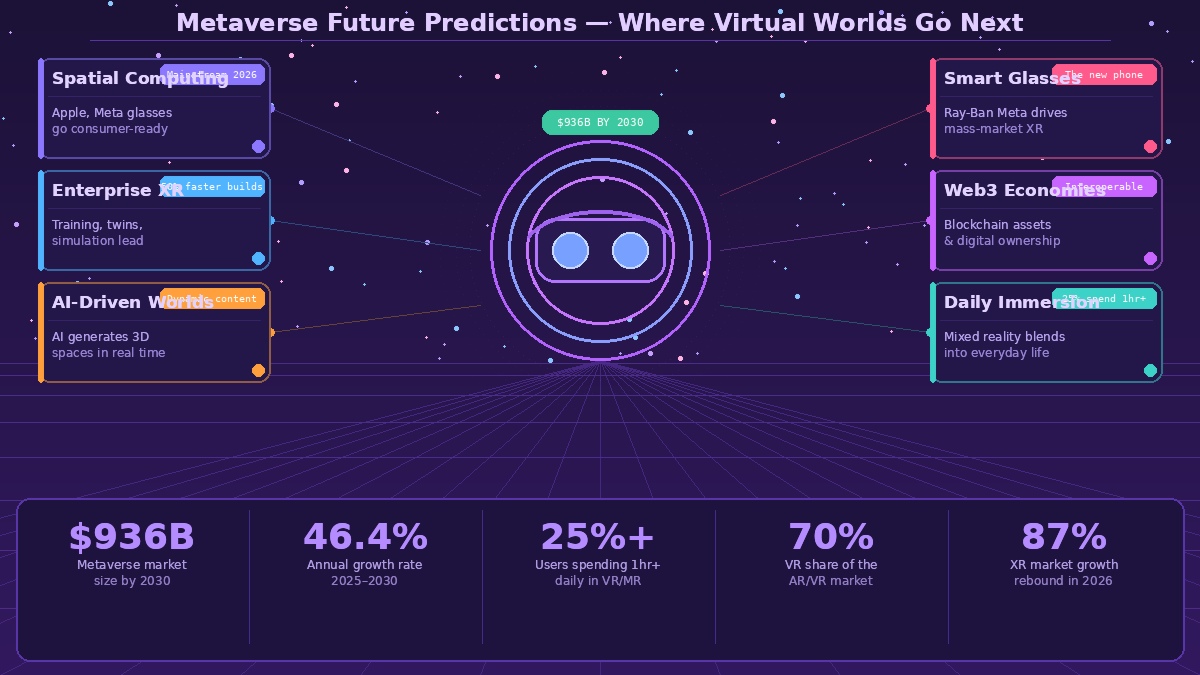
Here’s the thing the obituaries got wrong: the metaverse didn’t die. It just stopped being a fantasy and started being a tool. In 2026, the global metaverse market is projected to reach $936.57 billion by 2030, growing at a remarkable 46.4% compound annual growth rate. The technology is quietly succeeding in exactly the ways nobody put on a billboard.
Here’s where it’s actually heading.
Prediction 1: The Metaverse Becomes a Collection of Worlds, Not One World
The original vision — a single, open, shared virtual universe that everyone accesses — proved far more complicated than anyone anticipated. Questions around security, moderation, infrastructure, and interoperability slowed large-scale implementation dramatically.
What’s emerged instead is more practical and, frankly, more useful. By 2026, the metaverse has evolved into a collection of structured, purpose-built virtual environments rather than one monolithic digital world. Enterprises run closed or semi-closed platforms designed for specific objectives: training programs, engineering simulations, digital twins, collaborative design reviews. The grand unified metaverse may never arrive. But the practical, fragmented version is already here and working.
Prediction 2: Spatial Computing Goes Mainstream
This is the big shift for 2026. Spatial computing — the umbrella term for AR, VR, and mixed reality that lets you interact with computers in three-dimensional space — is moving from niche to central technology. GlobalData predicts spatial computing adoption will accelerate sharply in 2026, with consumers enjoying immersive entertainment and social experiences while industries deploy it for operations and training.
The hardware is driving this. Apple’s Vision Pro M5, the Meta Quest 3 and affordable 3S, and the Samsung Galaxy XR are pushing immersive computing toward genuine usability. More significantly, smart glasses like Meta’s Ray-Ban line signal where the real mass market lies — stylish, lightweight wearables that overlay digital information onto the real world rather than replacing it entirely.
Prediction 3: Enterprise Adoption Outpaces Consumer
The most significant metaverse growth in 2026 isn’t happening in gaming or social media. It’s happening inside businesses. Enterprises are leveraging VR and AR for simulation, training, and remote collaboration — and the results are measurable, with development timelines reportedly reduced by up to 50%.
IDC flags industrial maintenance and training as the major AR use cases, and training plus collaboration as the leading VR commercial applications. Digital twins — virtual replicas of physical assets that enable real-time monitoring and predictive analytics — became a major enterprise use case in late 2025. For most organisations, VR is no longer an experiment. It’s a practical tool deployed where it makes genuine sense.
Prediction 4: AI Makes Virtual Worlds Dynamic
One of the biggest limitations of early metaverse experiences was that everything had to be hand-built. Every environment, every interaction, every scenario required manual creation. AI is removing that bottleneck. GlobalData predicts that AR and VR experiences will move past pre-scripted narratives in 2026, with AI generating 3D spaces, characters, and content in real time.
This changes the economics entirely. When AI can generate immersive environments on demand, the cost and time of building metaverse experiences drops dramatically. Combined with large language models powering intelligent virtual agents, the worlds become responsive and adaptive rather than static and pre-programmed.
Prediction 5: Daily Immersion Is Already Rising
The engagement data tells a quieter but important story. More than 25% of VR and mixed reality users now spend an hour or more interacting with these environments daily. That’s not a fringe behaviour — it’s a meaningful shift in how a growing segment of people spend their time. As headsets get lighter, screens get sharper, and experiences get more compelling, that daily engagement is expected to keep climbing.
VR is projected to represent around 70% of the AR/VR market through 2026, with spending split almost evenly between consumer and commercial applications. The XR market overall is forecast to rebound with approximately 87% growth in 2026 as new product cycles resume and accumulated demand is released.
Prediction 6: Web3 Quietly Powers the Economy Layer
The interoperable economy piece of the metaverse vision is maturing in the background. Blockchain-based digital assets and NFTs — once synonymous with speculation and hype — are increasingly being used for practical digital ownership and interoperable value within virtual environments. The convergence of metaverse platforms with Web3 infrastructure enables organisations to deploy scalable, value-driven virtual experiences where digital goods, identities, and assets can move between environments rather than being locked into a single platform.
The Honest Outlook
The metaverse of 2026 is not the one we were sold in 2021. There’s no single virtual universe where we all live. There’s no overnight transformation of daily life. What there is instead is something more durable: a steadily growing collection of immersive tools that are genuinely useful for training, collaboration, simulation, entertainment, and an increasing share of daily digital interaction.
Future improvements will depend less on bold promises and more on practical implementation, infrastructure, and long-term support. That’s not as exciting as the original pitch. But it’s real, it’s growing at nearly 50% a year, and it’s quietly becoming part of how we work, learn, and play — exactly the way most transformative technologies actually arrive.


