Here’s the honest version of this conversation: most “best AI writing tools” lists in 2026 are ranking tools based on affiliate payouts, not actual output quality. The tool that pays a 40% commission appears at the top of every roundup, regardless of whether its writing is any good.
So let’s do this differently. Reviewers who tested 29+ tools on identical real-world writing tasks in 2026 found something clear: the right tool depends entirely on what you’re trying to write. There’s no single winner. There’s the right tool for your specific job. Here’s what that actually looks like.
Claude — Best for Long-Form Quality
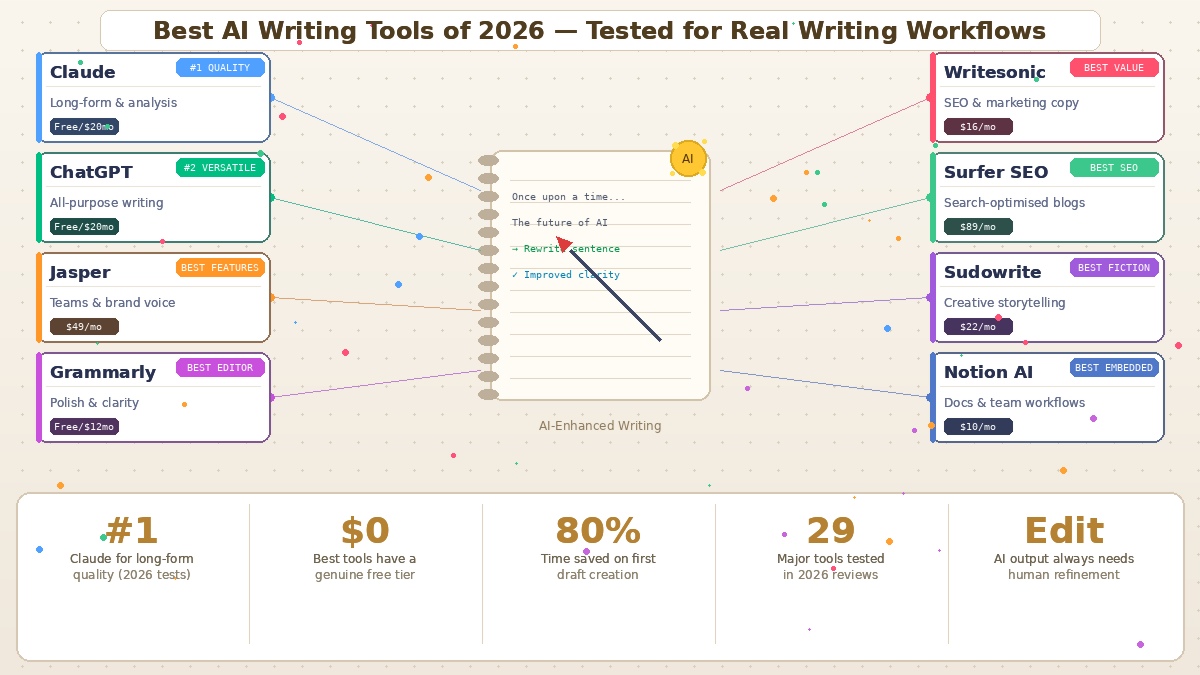
Multiple independent 2026 tests — including hands-on evaluations from zPlatform, The Software Scout, and Amrytt — placed Claude at the top for raw writing quality. The consistent finding: in long-form articles, technical documentation, analysis pieces, and marketing copy, Claude produces longer, more coherent, and more nuanced output than ChatGPT or Gemini. The prose sounds genuinely human rather than templated, requires less editing to reach publishable standard, and handles complex reasoning better than most competitors.
If your priority is content that doesn’t read like a robot wrote it — blogging, thought leadership, journalism, detailed analysis — Claude is the current quality standard. The free tier covers substantial daily use; Pro is $20/month.
ChatGPT — Best All-Purpose Tool
ChatGPT is the Swiss Army knife. It handles the widest range of writing formats — blog posts, emails, social copy, summaries, code documentation, brainstorming, scripts — with a consistency that makes it genuinely useful for almost any content task. In structured testing it produces strong results on clarity and practical content development. The output is less nuanced than Claude on deep analysis, but the breadth and speed of what it handles make it the default choice for professionals who need a reliable writing assistant across everything. Free tier is genuinely capable; Plus at $20/month unlocks better models and web access.
Jasper — Best for Content Teams and Brand Voice
Jasper is not the best writer in isolation, but it’s the most complete content platform. Templates, brand voice training that enforces your company’s tone across every output, team collaboration workflows, direct CMS integrations, and workflow automation make it genuinely powerful for marketing teams publishing at scale. Where Claude and ChatGPT are tools you prompt, Jasper is a platform built around a content operation. For a solo writer, its $49/month starting price is hard to justify. For a content team producing dozens of pieces a week, the consistency and speed gains earn it back quickly.
Grammarly — Best for Editing and Polish
Grammarly is the tool you use after the others. Its 2026 upgrades made it significantly more than a spellchecker — it now suggests structural improvements, adjusts tone for professional or casual contexts, checks for plagiarism, and provides clarity rewrites for ambiguous sentences. The key value is real-time editing as you write: it catches the mistakes you stop seeing after reading your own draft three times. The free tier handles most grammar and spelling needs; Premium at around $12/month adds the deeper editing, rewriting, and tone features that make it genuinely transformative.
Writesonic — Best Value for SEO and Marketing Copy
For teams producing SEO content, landing pages, ad copy, and product descriptions, Writesonic strikes the best balance of capability and price in 2026. Its AI Article Writer produces content structured for search, it integrates with Surfer SEO for real-time optimisation, and its Chatsonic tool provides a ChatGPT-style interface with real-time web access. Plans start around $16/month — significantly cheaper than Jasper for broadly similar marketing copy capabilities. In independent testing it doesn’t match Claude or ChatGPT for writing quality, but for volume SEO content it’s one of the most cost-effective options available.
Surfer SEO — Best for Search-Optimised Content
Surfer isn’t an AI writer in the traditional sense — it’s an SEO intelligence layer that analyses top-ranking articles for any keyword and tells you exactly what topics, headings, questions, and keyword densities your content needs to compete. Its Content Editor scores your writing in real time against these benchmarks. For anyone publishing content intended to rank in search engines, Surfer is the gold standard. It’s expensive at $89/month, but for SEO-focused content teams, the traffic returns typically justify it.
Sudowrite — Best for Fiction and Creative Writing
Every other tool on this list was built primarily for business and marketing content. Sudowrite was built specifically for fiction writers, and in that category it’s in a different league. Its Story Engine handles plot structure, its Describe feature generates sensory details, and its Beat Sheet functionality maintains narrative consistency across longer projects. For novelists and short story writers who want AI assistance that understands how stories work rather than how blog posts work, Sudowrite is the clear recommendation. Plans start around $22/month.
Notion AI — Best for Embedded Team Writing
Notion AI isn’t the best writer. But it’s the only AI writing tool that works inside Notion — where many teams already write, plan, and collaborate. For teams that live in Notion, the ability to draft, summarise, rewrite, and generate content directly in your workspace without switching apps removes the friction that makes other tools less useful in practice. At $10/month per user (or included in the Notion AI plan), it’s the pragmatic choice for Notion-native teams.
The Bottom Line on Choosing
The most repeated finding across 2026 reviews is simple: for most individual writers, Claude or ChatGPT plus Grammarly covers the vast majority of writing tasks. That combination is free or costs $20/month, and the editing layer ensures the output actually reaches the standard you need.
Standalone specialist tools earn their cost when they add something the base models can’t. Jasper earns its price through brand voice enforcement. Surfer earns its through SEO intelligence. Sudowrite earns its through fiction-specific AI. Everything else is only worth paying for if you have a specific, measurable need it addresses better than the general-purpose alternatives.
One rule applies regardless of which tool you use: treat the output as a first draft, not a final product. The gap between “generated” and “publishable” is where your judgement, expertise, and voice go in — and that gap is where most of the value gets created.
