
More than half the world’s population lives in cities. By 2050, that figure will reach two-thirds. The pressure that creates — on transport networks, energy grids, water systems, housing, emergency services, and public safety — is one of the defining challenges of the coming decades. Smart city technology is the attempt to solve it before it overwhelms us.
In 2026, the model smart city integrates renewable energy grids, AI-driven traffic management, IoT sensors, digital twins, and citizen engagement platforms to create more sustainable, efficient urban environments. It’s no longer just a concept. It’s infrastructure that real cities are deploying right now, and the results are measurable.
The Foundation: IoT and the Networked City
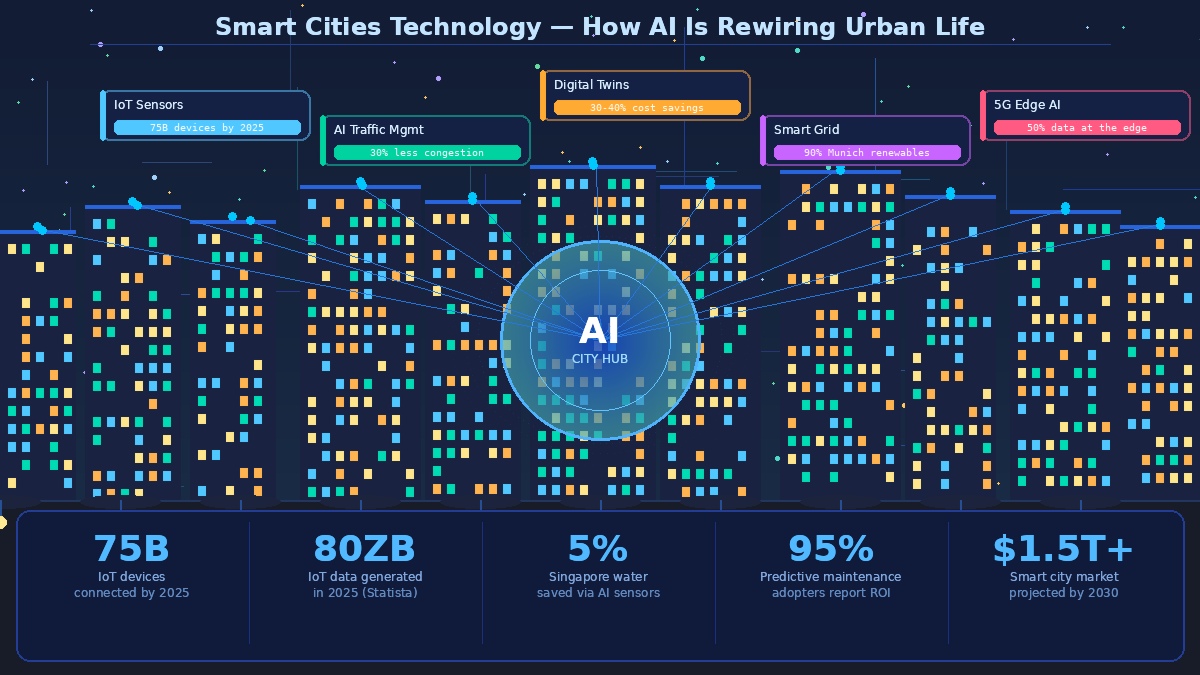
Everything in a smart city starts with data, and data starts with sensors. The Internet of Things — the network of connected physical devices that measure, monitor, and communicate — has reached a scale that would have seemed implausible a decade ago. There were approximately 75 billion IoT devices connected globally in 2025, generating around 80 zettabytes of data — a number so large it’s almost meaningless until you think about what it represents: every road, building, water pipe, electricity cable, and vehicle in a city can now feed real-time information into a central system that can act on it.
Eighty-four percent of enterprises now identify AI as a fundamental enabler for their IoT projects. The combination — AIoT — is where smart city technology becomes genuinely powerful, because collecting data without the ability to analyse it instantly and act on it autonomously is only half of the equation.
AI Traffic Management: Cities That Don’t Jam
Traffic congestion costs cities billions in lost productivity and pumps unnecessary carbon into the atmosphere. AI traffic management systems analyse real-time flow data from cameras, loop sensors, and connected vehicles to dynamically adjust signal timing, reroute traffic, and predict bottlenecks before they form.
The results are measurable. Cities deploying adaptive traffic management systems consistently report 20-30% reductions in congestion. Singapore uses AI to coordinate its network of signals with public transport scheduling, reducing both waiting times and overall journey lengths. Barcelona’s smart traffic system has cut bus journey times by 23% through dynamic lane assignment and priority signals.
In 2026, the integration goes further. As autonomous vehicles enter city fleets, V2X communication — where vehicles talk directly to infrastructure — allows traffic lights to know exactly which vehicles are approaching and at what speed, enabling optimisation impossible with human-driven traffic alone.
Digital Twins: A Virtual Copy of the Entire City
One of the most powerful emerging tools in smart city management is the urban digital twin — a real-time virtual replica of the city’s physical infrastructure, updated continuously by sensor data. A digital twin doesn’t just show you what’s happening now; it lets you simulate what would happen if you changed something.
Cities using digital twins for capital planning are achieving 30-40% more efficient infrastructure investment decisions. Helsinki has built a 3D digital twin that models the entire metropolitan area, used by planners to simulate everything from new transport corridors to emergency response scenarios. Singapore’s Virtual Singapore platform runs urban scenarios before any physical construction begins. The ability to test changes virtually — and see the downstream effects on traffic, energy use, air quality, and emergency access — before committing capital expenditure is transforming how cities plan and build.
Smart Grids and Clean Energy: Munich and Copenhagen
The smart city revolution is inseparable from the clean energy transition. AI-powered smart grids don’t just distribute electricity — they predict demand, integrate variable renewable sources, and balance supply in real time in ways that rule-based systems simply can’t.
Munich’s municipal utility Stadtwerke München uses Microsoft Azure IoT and AI to optimise electric bus operations, forecast energy demand, and reduce waste. Ninety percent of Munich’s electricity already comes from renewable sources, and AI is helping the city move toward full carbon neutrality. Copenhagen, targeting the status of world’s first carbon-neutral capital, employs AI algorithms to predict heating demand based on weather patterns, occupancy data, and historical consumption, optimising its district heating network across millions of endpoints.
The emerging trends in 2026 include energy-positive districts that generate more power than they consume, vehicle-to-grid integration where parked electric vehicles feed surplus energy back to the grid, and hyperlocal renewable microgrids that give neighbourhoods genuine energy independence.
Smart Water: Singapore’s 5% Savings
Water infrastructure is one of the least glamorous and most critical areas of smart city technology. Singapore’s Smart PUB initiative uses thousands of sensors and AI analytics to detect leaks in real-time and optimise water distribution across the city’s entire network — achieving 5% water savings and near-zero pipe bursts. In a water-stressed world, those numbers matter enormously at city scale.
France’s Société du Canal de Provence uses AI to combat water stress through real-time monitoring of agricultural and industrial demand, dynamically adjusting distribution to prevent waste. For cities facing climate-driven water scarcity, this kind of predictive management is becoming existential infrastructure rather than a nice-to-have.
AI Predictive Maintenance: Fixing Problems Before They Happen
Cities are built on infrastructure that ages — water pipes, road surfaces, bridges, electrical cables, railway lines. Traditional maintenance is either reactive (fix it when it breaks) or time-based (inspect on a schedule). Both approaches are expensive and miss failures that occur between inspections.
AI predictive maintenance uses sensor data to detect the early signatures of failure before it happens. The adoption statistics are striking: 95% of predictive maintenance adopters report positive ROI, with 27% achieving full platform payback within the first year of deployment. With 50% of enterprise data now processed at the edge — in local pumping stations, substations, and transport hubs rather than centralised data centres — the latency constraints that previously made real-time maintenance monitoring difficult have been largely eliminated.
Governance: The Smart City Needs Smart Oversight
Technology without governance produces outcomes nobody intended. Seattle’s 2025-2026 AI Plan has become a benchmark for responsible smart city deployment — it mandates human oversight of AI decisions, bans harmful applications of facial recognition, and introduces a Proof of Value Framework that requires AI projects to demonstrate responsible impact before scaling.
The World Economic Forum’s position is clear: digital platforms, IoT devices, and AI are essential components of urban innovation, but they alone cannot constitute the complex machine that is a modern city. Smart city infrastructure must be governed by city institutions with democratic accountability, not outsourced entirely to technology vendors. The infrastructure captures, analyses, and acts on some of the most sensitive data about residents’ daily lives. Who controls that data, under what legal framework, and with what oversight, matters as much as the technology itself.
The cities getting this right are demonstrating that smart and sustainable aren’t in tension — they’re the same goal. The ones that aren’t will learn that lesson the hard way.
