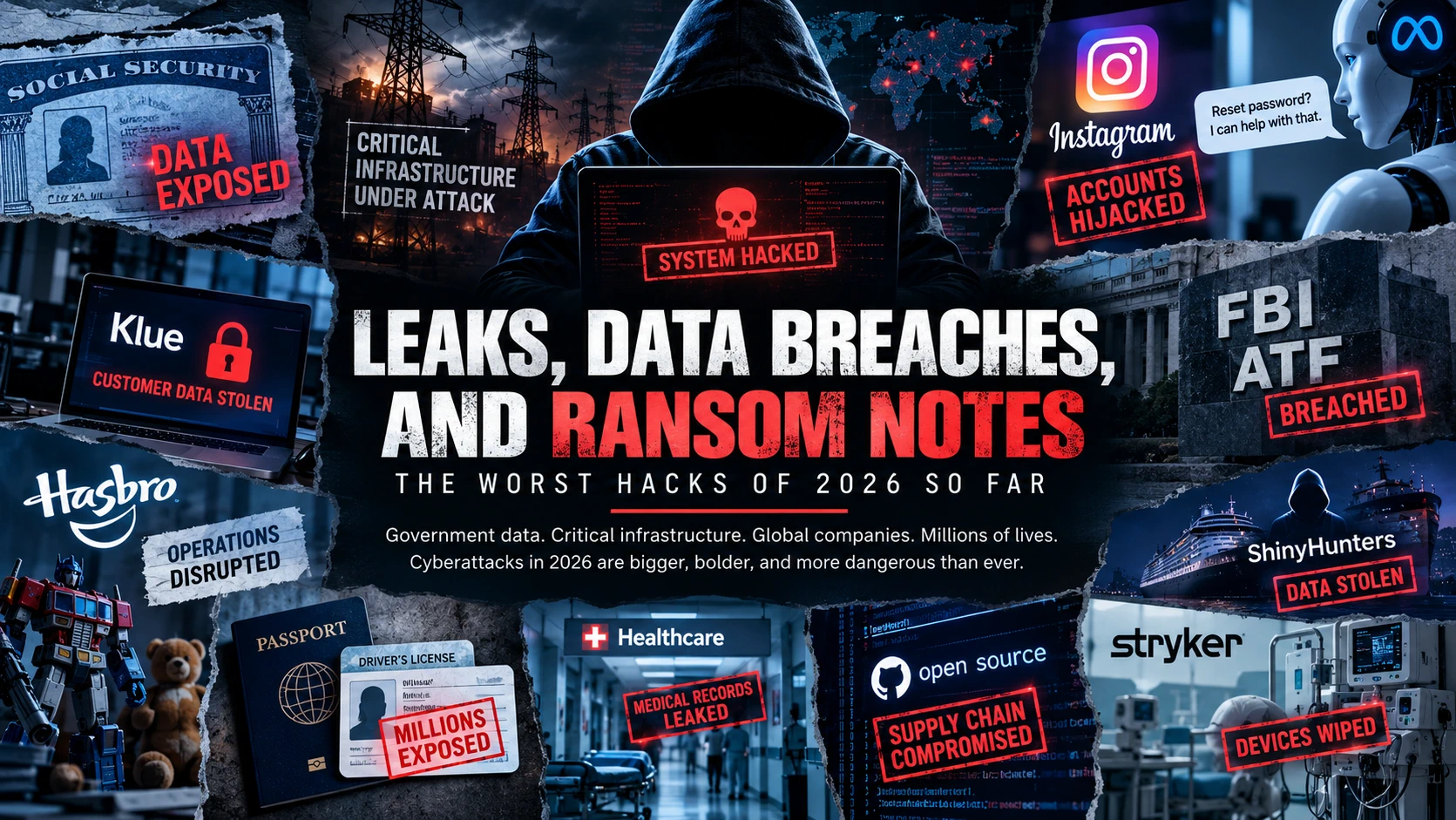
Cybersecurity has become one of the defining technology stories of 2026. Attacks this year have affected government databases, healthcare providers, technology companies, critical infrastructure and millions of ordinary users.
The threats are also becoming more varied. Criminal groups continue to rely on ransomware and stolen credentials, while nation-state-linked hackers are targeting essential services. At the same time, weaknesses in AI systems and software supply chains are creating new opportunities for attackers.
Here are some of the most significant cybersecurity incidents reported so far in 2026.
Social Security Data Raises Major Privacy Questions
The handling of Social Security data by the Department of Government Efficiency (DOGE) continues to generate questions and legal disputes.
Following DOGE’s involvement with the Social Security Administration, concerns emerged over whether sensitive information had been copied to an unsecured external server. A whistleblower alleged that a live copy of the Social Security database had been transferred to a third-party system.
The database was reportedly capable of containing Social Security numbers and other personal information belonging to a huge portion of the U.S. population.
The issue remains tied up in legal proceedings, while lawmakers continue to investigate how the data was handled and who may have gained access to it.
Critical Infrastructure Becomes a Bigger Target
Cyberattacks against essential infrastructure have also increased. Energy facilities, water utilities and other civilian systems across Europe and the United States have faced attacks linked by authorities and researchers to groups associated with geopolitical conflicts.
Poland’s infrastructure has been repeatedly targeted, while attacks have also affected energy facilities and water-related systems in other European countries.
In the United States, officials warned that Iranian-linked hackers had targeted more than 100 water systems during the summer. Many smaller utilities have limited cybersecurity budgets, making them particularly attractive targets.
These incidents demonstrate that a cyberattack does not necessarily remain confined to computers. A successful intrusion into operational technology can potentially affect electricity, water supplies and other services people depend on every day.
Klue Breach Exposed Customer Data
Market intelligence company Klue experienced one of the year’s broader breaches after attackers obtained access through an old credential.
The incident eventually affected information belonging to nearly 200 organizations, including several major technology and cybersecurity companies.
Investigators found that the compromised credential had originally been issued years earlier for a limited pilot project. Attackers used access obtained through Klue to reach customer cloud environments, creating a much larger chain of potential compromises.
Klue later said it had reached an agreement with the attackers regarding the stolen information, although another group subsequently claimed to possess some of the same data.
The incident highlights the risks associated with old credentials and third-party software providers that maintain access to customer systems.
Instagram Accounts Were Hijacked Through an AI Chatbot
One of the more unusual incidents involved Meta’s AI chatbot and Instagram password recovery.
Attackers reportedly impersonated account owners and persuaded the chatbot to help with password-reset requests. By directing recovery codes toward email addresses controlled by the attackers, they were able to gain access to other people’s accounts.
The problem reportedly affected tens of thousands of accounts before the vulnerability was addressed.
The episode demonstrated how adding AI to existing account-recovery systems can introduce unexpected security risks if the AI has access to sensitive functions.
FBI and ATF Systems Suffered Major Incidents
Federal law enforcement agencies were also affected.
The FBI disclosed a major cybersecurity incident involving one of its surveillance systems. Reports suggested that information associated with surveillance targets may have been exposed.
Several months later, the Bureau of Alcohol, Tobacco, Firearms and Explosives disclosed another major cyber incident. A ransomware operation claimed responsibility and said it had accessed information connected to ATF investigations.
The incidents raised concerns because systems operated by federal law enforcement agencies can contain particularly sensitive information.
Software Supply Chains Remain a Major Weakness
Attackers have increasingly turned their attention toward software developers and open-source projects rather than attacking their ultimate targets directly.
Several widely used security and development tools were compromised during 2026. Malicious versions of software were distributed to users, potentially allowing attackers to steal passwords, credentials and authentication tokens.
The danger of supply-chain attacks is their ability to spread beyond the original victim. A compromised developer tool can potentially provide access to companies that trust and automatically install its software.
Some attacks ultimately affected major technology companies and their customers, demonstrating how one compromised project can create a much wider security crisis.
Driver’s Licenses and Passports Exposed
Identity verification has become another major security concern.
A breach involving identity-document verification company IDScan reportedly exposed an enormous collection of driver’s license and passport information. Attackers claimed that their database contained photographs and personal details belonging to approximately 150 million drivers in the United States and Canada.
The incident is particularly concerning because stolen identity documents can be reused for fraud, impersonation and attempts to bypass identity-verification systems.
Other breaches during the year have exposed passports and driver’s licenses through hotel systems, financial applications, prison communication services and visa platforms.
As more websites demand government-issued identification for age and identity verification, protecting this information becomes increasingly important.
Healthcare Data Breaches Affect Millions
Healthcare organizations remain among the most attractive targets for cybercriminals because medical records contain valuable personal and financial information.
DentaQuest suffered one of the largest reported healthcare breaches of the year, with health information involving approximately 15 million people reportedly stolen.
CareCloud also suffered a major incident involving electronic medical records. At least 3.7 million patients were reportedly affected.
Another healthcare technology provider, Aesto Health, disclosed that a breach initially discovered the previous year ultimately affected millions of patients connected to numerous healthcare organizations.
These incidents show why healthcare companies remain a prime target: a single technology provider can hold information belonging to millions of patients.
Hasbro Struggled to Recover From Its Cyberattack
Toy manufacturer Hasbro experienced a prolonged disruption after discovering attackers inside its network.
The company remained partially offline for weeks, affecting its website and normal business operations. Hasbro also had to delay a regulatory filing while dealing with the consequences of the attack.
Although the company later said the attackers had been removed from its systems and recovery was underway, the incident showed that the financial impact of a cyberattack can continue long after hackers are gone.
ShinyHunters Continue Large-Scale Extortion Campaigns
The ShinyHunters cybercrime group has also remained active, using social engineering and voice-phishing techniques to gain access to corporate systems.
Education technology company Instructure was among the victims. Attackers accessed its Canvas platform and reportedly obtained information involving more than 30 million students and employees.
After the company initially refused to meet the attackers’ demands, the criminals reportedly returned and disrupted Canvas login pages during an important examination period.
ShinyHunters has also been linked to major breaches involving telecommunications, cruise travel, education, finance and government organizations.
Medical Technology Companies Face Destructive Attacks
Cyberattacks against medical-device manufacturers have demonstrated how digital incidents can affect physical operations.
Stryker was targeted in March by hackers linked by U.S. authorities to Iran. The attack reportedly resulted in large numbers of employee devices being remotely wiped and caused significant operational disruption.
Later in the year, Boston Scientific experienced another major cyber incident that disrupted its global network. The company said the outage affected operations, including shipping and order processing, and that some patients were impacted.
What 2026 Has Shown
The major attacks of 2026 reveal a common pattern: attackers do not always need sophisticated zero-day exploits. Old credentials, poor access controls, exposed systems, social engineering and vulnerable third-party software can be enough.
At the same time, the scale of these incidents is growing. A single compromised vendor can expose hundreds of organizations, while a healthcare or identity provider can hold information belonging to millions of people.
For businesses and governments, the lesson is increasingly clear: cybersecurity cannot be treated as a one-time investment. Regular monitoring, strong authentication, limited access, rapid patching, vendor security checks and well-tested recovery plans are becoming essential parts of operating in a connected world.
