
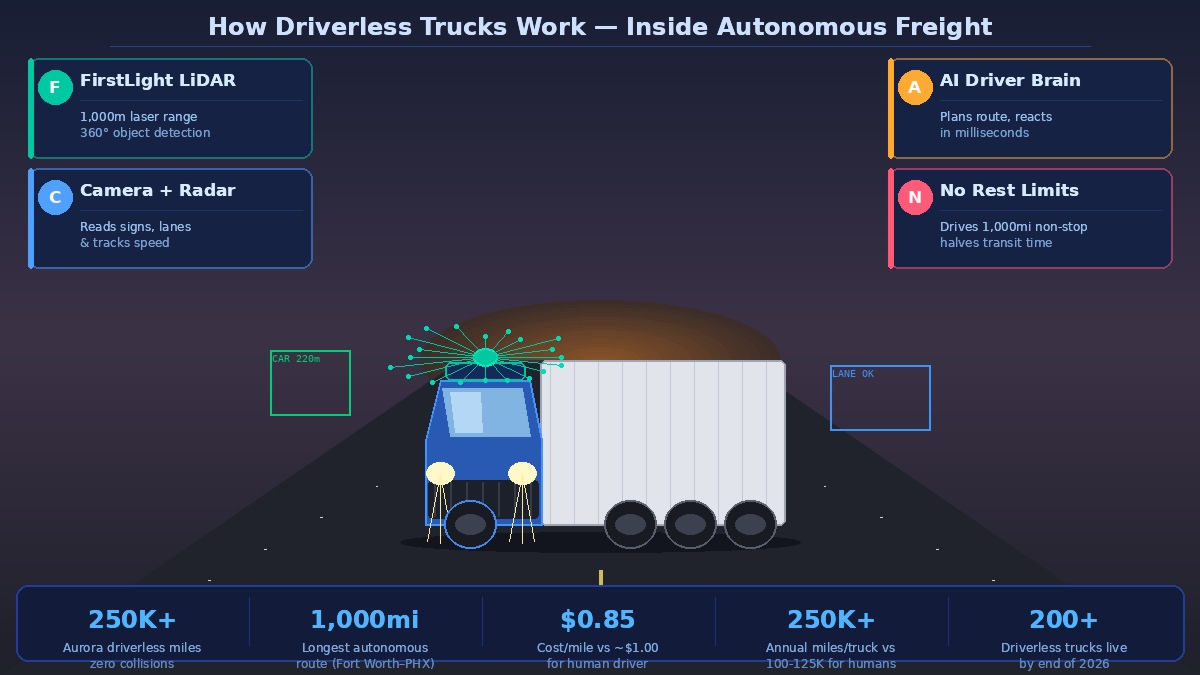
For years, “driverless trucks” sounded like a futurist’s fantasy — something perpetually a decade away. Then, in April 2025, Aurora Innovation quietly launched the first fully driverless commercial trucking operation on US public roads, running between Dallas and Houston with no human in the cab. By January 2026, those trucks had logged over 250,000 driverless miles with a perfect safety record — zero collisions attributed to the system. The fantasy became freight.
So how does a 40-ton truck drive itself down a highway at 65mph, in rain and fog, without anyone behind the wheel? Let’s break down how the technology actually works.
The Core Idea: The Truck Is the Driver, Not the Hardware
The first thing to understand is the business model, because it shapes everything. Aurora — the clear leader in this space — doesn’t sell trucks. It sells “the Aurora Driver,” a complete self-driving system that gets installed onto trucks built by partners like Paccar and International. The model is called “driver-as-a-service”: carriers buy trucks equipped with the autonomous system, then offer freight services using them.
The Aurora Driver, as the company describes it, has superhuman capabilities — it can operate longer than human drivers, never gets drowsy, and vigilantly monitors 360 degrees around the truck at all times. That last point is key: a human driver looks forward and checks mirrors. The autonomous system sees everything, everywhere, simultaneously, every fraction of a second.
The Eyes: LiDAR, Cameras, and Radar Working Together
A driverless truck builds its understanding of the world by fusing data from three complementary sensor types.
LiDAR is the centerpiece. It fires laser pulses in every direction and measures how long they take to bounce back, building a precise, real-time 3D map of everything around the truck. Aurora’s proprietary FirstLight LiDAR is particularly notable because of its range — the second-generation hardware coming in mid-2026 doubles the detection range to 1,000 metres. At highway speeds, that extra range is critical: a truck travelling at 65mph needs far more stopping distance than a car, so seeing a kilometre ahead gives the system time to react smoothly rather than abruptly.
Cameras handle the visual interpretation that LiDAR can’t — reading road signs, traffic signals, lane markings, and brake lights. Radar fills in the gaps, tracking the speed and distance of other vehicles and performing reliably in conditions where cameras and LiDAR can struggle, like heavy rain or direct sun.
Together, these three systems create overlapping, redundant coverage. If one sensor type is degraded, the others compensate — which is exactly how the truck achieves the reliability needed to operate without a human safety net.
The Brain: AI That Plans, Predicts, and Reacts
Sensor data is useless without something to interpret it. The Aurora Driver’s AI processes all that incoming information continuously, performing several jobs at once: identifying every object around the truck, predicting where each one is heading, planning the safest path forward, and executing the steering, braking, and acceleration to follow it.
The genuine breakthroughs come through software updates rather than new hardware. Aurora’s progress has been driven by successive software releases since launch — the first validated the Dallas-Houston route, the second added night driving, the third validated El Paso, and the fourth, released in early 2026, was the most significant. That fourth release gave the system the ability to handle inclement weather — rain, fog, and heavy winds — which previously sidelined the fleet roughly 40% of the time. It also gave the trucks the intelligence to navigate routes up to 1,000 miles and to map new customer endpoints with minimal human intervention.
Why Freight Is Easier Than Robotaxis
Here’s something counterintuitive: getting a truck to drive itself on a highway is, in important ways, a more tractable problem than a robotaxi navigating chaotic city streets. Highway driving is repetitive and predictable — fewer pedestrians, no traffic lights, consistent lane structures, and well-mapped corridors. One observer aptly described Aurora’s operation as more like an automated train line than a fully independent car — it runs defined, validated routes rather than going anywhere on demand.
This is why autonomous trucking reached genuine commercial deployment before robotaxis scaled. The constrained problem is solvable now, and the economic incentive is enormous.
The Game-Changing Advantage: No Rest Breaks
The single biggest reason autonomous trucking is so compelling comes down to one regulatory fact: human truck drivers are legally limited in how many hours they can drive before mandatory rest. An autonomous truck has no such limit.
The clearest example is Aurora’s Fort Worth to Phoenix lane — at roughly 1,000 miles, it exceeds the legal hours-of-service limits for a single human driver. By operating without mandatory rest breaks, the Aurora Driver effectively cuts transit time in half. Aurora completes that 1,000-mile journey in about 15 hours; a human driver, bound by federal rest rules, takes considerably longer.
The economics follow directly. An autonomous truck can rack up 250,000+ miles per year versus the 100,000-125,000 typical for a human-driven truck. And Aurora targets a cost of around $0.85 per mile versus roughly $1.00 for a human driver. More miles, lower cost per mile — that’s the entire business case in two numbers.
The Honest Limitations
Driverless trucks aren’t replacing human truckers en masse, and the 2016 predictions of imminent “trucker extinction” overshot badly — there are actually more truckers employed in the US today than a decade ago. The technology currently works on specific, validated, mostly-highway corridors in favourable geography, primarily across the Sun Belt where weather is more predictable.
There’s also still human involvement, just not in the cab. Aurora’s trucks operating with Paccar vehicles currently carry a human safety observer at the manufacturer’s request, though the company plans to deploy a second fleet of International trucks with no onboard observer in Q2 2026. And remote support remains part of the system — the Aurora Driver handles commercial loads without remote human input roughly 90% of the time, with support available for the rest.
Where It’s Headed
Aurora expects to have more than 200 fully driverless trucks operating by the end of 2026, expanding across Texas, New Mexico, and Arizona, with industrialised scaling planned for 2027 and beyond. Its commercial capacity is already fully committed through the third quarter of 2026 — demand is outpacing the fleet.
The technology has crossed the line from experiment to operating business. It won’t replace the trucking workforce overnight, and it’ll spread route by route rather than all at once. But the question is no longer whether trucks can drive themselves. They already do — safely, profitably, and across a thousand miles without stopping to rest.
